Loading...
Huo Guang vs Zigong
Huo Guang leads by 6.7 pts · 2 figures compared
…
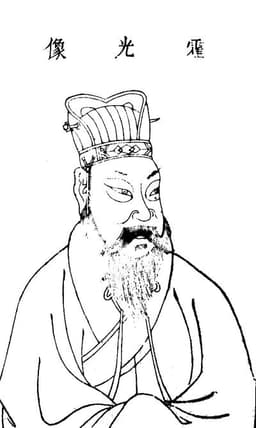
Huo Guang
Politician · Ancient
63.6Total

Zigong
Politician · Ancient
56.9Total
Basic Information
Born
-120
-520
Died
-68
-456
Era
Ancient
Ancient
Nationality
China
China
Occupation
Politician
Politician
Civilization
Eastern
Eastern
Score Comparison
Military (10%)
49.0
43.0
Political (20%)
78.0
68.0
Influence (20%)
60.0
56.4
Legacy (20%)
55.0
56.0
Leadership (15%)
81.7
55.3
Strategy (15%)
60.0
60.0
TOTAL
63.6
56.9
Huo Guang — Complete Timeline
87 BC
Regent for Emperor Zhao of HanPolitical Action◆ Major
Huo Guang was appointed regent for the young Emperor Zhao of Han after Emperor Wu's death. He effectively ruled the Han dynasty for over a decade, maintaining stability and continuing Wu's policies of centralization and expansion.
RegencyHan DynastyStability
Impact: nationalconstructive
74 BC
Deposed Emperor Liu HePolitical Action◆ Major
After Emperor Zhao's death, Huo Guang deposed the incompetent Emperor Liu He after only 27 days on the throne. He cited Liu He's debauchery and misrule as reasons. Huo Guang then installed Liu Xun as Emperor Xuan, ensuring competent leadership.
DepositionHan DynastyPolitical Crisis
Impact: nationalconstructive
73 BC
Consolidation of PowerPolitical Action◆ Major
Huo Guang's family and allies held key positions in the Han court. His wife poisoned Empress Xu to place her own daughter as empress. After Huo Guang's death, Emperor Xuan purged the Huo clan, executing thousands and ending their influence.
Power StrugglePurgeHan Dynasty
Impact: nationaldestructive
68 BC
Death and Posthumous PurgePolitical Action
Huo Guang died in 68 BC and was given a grand state funeral. However, within two years, Emperor Xuan ordered the execution of Huo Guang's family and stripped him of posthumous honors, accusing the Huo clan of treason and corruption.
PurgeHan DynastyLegacy
Impact: nationaldestructive
Zigong — Complete Timeline
500 BC
Became a disciple of ConfuciusCultural◆ Major
Zigong, originally a merchant, became one of Confucius's most prominent disciples. He was known for his eloquence and skill in diplomacy, and Confucius praised his ability in statecraft, though he also criticized his tendency toward cleverness over virtue.
ConfucianismEducationPhilosophy
Impact: nationalconstructive
484 BC
Diplomatic mission to save LuPolitical Action◆ Major
When the state of Lu was threatened by Qi, Zigong traveled to the courts of Qi, Wu, Yue, and Jin, persuading them to alter their alliances. His diplomacy diverted Qi's attack and preserved Lu's independence, demonstrating his influence as a diplomat.
DiplomacyInterstate RelationsConfucian Disciple
Impact: regionalconstructive
480 BC
Accumulated great wealth as a merchantOther
Zigong engaged in trade between states, amassing a fortune that made him one of the wealthiest men of his time. His wealth allowed him to travel with large retinues and entertain rulers, enhancing his political influence and enabling him to promote Confucian ideas.
CommerceWealthConfucianism
Impact: nationalconstructive
470 BC
Served as a minister in Lu and WeiPolitical Action
Zigong held high office in both Lu and Wei, implementing policies that reflected Confucian principles of good governance. His administrative career was marked by efforts to maintain peace and order, though his tenure was not without political challenges.
Government ServiceConfucianismAdministration
constructive
Expert Analysis
Origins
Huo Guang (c. 130–68 BC) was born into a modest family in Hedong (modern Shanxi). His father, Huo Zhongru, died early, and Huo Guang was raised by his elder half-brother Huo Qubing, a celebrated general under Emperor Wu of Han. Through Huo Qubing's influence, Huo Guang entered the imperial court as a low-ranking official. His steady competence and loyalty earned him promotions, and by Emperor Wu's later years, he had become a trusted advisor. Zigong (520–456 BC), born Duanmu Ci, hailed from the state of Wei. Unlike Huo Guang's political lineage, Zigong came from a merchant family. He was known for his sharp intellect and eloquence, which led him to become a disciple of Confucius at a relatively young age. Confucius praised Zigong's business acumen but sometimes criticized his tendency to argue. Zigong's early life as a trader shaped his diplomatic approach, emphasizing negotiation and mutual benefit.
Rise to Power
Huo Guang's rise was gradual and institutional. In 87 BC, on his deathbed, Emperor Wu appointed Huo Guang as one of four regents for his young son, Emperor Zhao. Huo Guang quickly outmaneuvered rivals like Shangguan Jie and Sang Hongyang, consolidating power. His key ally was Jin Midi, a Xiongnu prince turned Han official. After Emperor Zhao died childless in 74 BC, Huo Guang selected Liu He as emperor. When Liu He proved dissolute, Huo Guang deposed him after only 27 days, citing 1,127 offenses. He then installed Liu Xun (Emperor Xuan), a commoner from the imperial clan. This move solidified Huo Guang's control, as Emperor Xuan owed his throne to Huo. Zigong's rise came through his diplomatic skills. He served as a minister in Lu and Wei, but his most famous achievement was in 484 BC when the state of Qi threatened Lu. Zigong traveled to Qi, Wu, Yue, and Jin, persuading each to change their alliances. His rhetoric convinced Qi to attack Wu instead, Wu to aid Lu, Yue to distract Wu, and Jin to prepare for Wu's weakened state. The result was that Lu survived without fighting, while Qi and Wu suffered. Zigong's political score of 68.0 reflects his ability to influence multiple states.
Leadership & Governance
Huo Guang's leadership was autocratic and effective. As regent, he maintained the policies of Emperor Wu, including state monopolies on salt and iron, and kept the bureaucracy functioning. He appointed loyalists to key posts and suppressed dissent. For example, in 80 BC, he crushed a rebellion led by the Shangguan family and Prince Dan, executing thousands. His governance score of 81.7 suggests he was decisive and maintained stability. However, his style was secretive and nepotistic; his wife poisoned Empress Xu to place their daughter as empress, a crime that later doomed his family. Zigong's leadership was more diplomatic and persuasive. As a minister, he advocated for Confucian values like benevolence and righteousness. He used his wealth to support his political activities, traveling with a retinue of carriages and gifts. His strategy score of 60.0 indicates he was skilled at leveraging resources but lacked coercive power. Unlike Huo Guang's top-down control, Zigong built influence through networks and negotiation.
Triumph & Tragedy
Huo Guang's greatest triumph was stabilizing the Han dynasty after Emperor Wu's expansionist policies had strained the state. He ensured a smooth succession, deposed a bad emperor, and maintained peace for over a decade. His greatest tragedy was his family's downfall. After his death in 68 BC, Emperor Xuan purged the Huo clan, accusing them of plotting rebellion. Huo Guang's wife and sons were executed, and his tomb was desecrated. The emperor had always resented Huo Guang's overshadowing presence. Zigong's triumph was his diplomatic mission that saved Lu without bloodshed, a masterpiece of statecraft. His tragedy was that his influence was limited by the prevailing power of military states. He died in relative obscurity, and his diplomatic achievements were not sustained—Lu was eventually annexed by Chu. His legacy score of 56.0 reflects his enduring but niche reputation.
Character & Destiny
Huo Guang was cautious, calculating, and ruthless. He avoided personal corruption but tolerated it in his family. His character—deferential to the throne but absolute in practice—led to his posthumous purge. Emperor Xuan, once seated, could not tolerate such a powerful regent's legacy. Zigong was eloquent, ambitious, and adaptable. Confucius noted his quick tongue and business sense. Zigong's destiny was to be a secondary figure—a brilliant diplomat but not a ruler. His scores (Political 68.0, Leadership 55.3) show he was effective but not transformative.
Legacy
Huo Guang is remembered as a model regent in Chinese history, often compared to the Duke of Zhou. The phrase "Huo Guang's example" refers to a regent who puts the state above the emperor. However, his family's purge tainted his legacy. His political score of 78.0 reflects his institutional impact. Zigong is revered in Confucian tradition as one of the "Twelve Philosophers" and is the patron deity of merchants. His diplomatic mission is studied in Chinese strategy. His influence score of 56.4 is lower because his achievements were more personal than systemic.
Conclusion
Huo Guang had greater impact on the Han dynasty, with a total score of 63.6 vs Zigong's 56.9. Huo Guang's regency preserved the Han state during a critical transition, while Zigong's diplomacy, though brilliant, was a single event. Huo Guang's political score of 78.0 and leadership of 81.7 demonstrate his ability to govern effectively, whereas Zigong's influence was limited by his era's chaos. Thus, Huo Guang's legacy as a stabilizer outweighs Zigong's as a diplomat.
Rankings
🥇
Huo GuangLeader
Mil: 49.0Pol: 78.0Inf: 60.0
63.6
🥈
Zigong
Mil: 43.0Pol: 68.0Inf: 56.4
56.9
+6.7 behind
How This Comparison Works
Algorithm
Each figure is scored on 6 dimensions (0—100 scale) based on structured historical data: Military (10%), Political (20%), Influence (20%), Legacy (20%), Leadership (15%), Strategy (15%). The weighted total produces the final ranking.
Data Sources
Scores are computed from structured sub-indicators in the database. Scale factors adjust for era (Ancient ×0.85, Modern ×1.0) and civilization size (Eastern ×1.05, Other ×0.80) to account for differences in population and military scale.
Maximum 3 Figures
Comparisons are limited to 2—3 figures to ensure readability and statistical meaningfulness.
Error Margins
±5 points per dimension — Sub-scores are derived from historical records with inherent uncertainty. Two figures within 5 points on a dimension should be considered roughly equivalent in that area.
Total Score Accuracy
±3 points overall — The weighted combination of 6 dimensions produces a total score with approximately ±3 points of uncertainty. Differences of less than 3 points are not statistically significant— the figures are effectively tied.
Known Limitations
- Historical records are incomplete and uneven across civilizations
- Figures from oral-tradition societies may be underrepresented
- Occupation labels can misclassify multi-role figures
- Scores measure capability and impact, not moral character
- Quantitative scoring is a comparison tool, not absolute truth
Capability Radar
Military (10%) — Battles & Warfare
Battles
40
38
Win Rate
43
42
Expansion
44
49
Political (20%) — Governance & Reform
Reform
75
10
Diplomacy
70
70
Economy
70
75
Influence (20%) — Cultural & Global Reach
Cultural
40
40
Global
30
30
Legacy (20%) — Historical Impact
Historical
70
50
Longevity
60
60
Leadership (15%) — Power & Stability
Tenure
85
20
Stability
90
30
Strategy (15%) — Tactics & Innovation
Strategy
52
49
Tactics
50
53
Reform
58
55
Similar Comparisons
Comments & Discussion
No comments yet. Be the first to share your thoughts!