Loading...
This comparison has not been analyzed yet.
One-time AI generation (~1 minute). Scores and timeline are already available below.
Hwang Pyong-so vs Zorawar Singh Kahluria
Zorawar Singh Kahluria leads by 16.1 pts · 2 figures compared
…
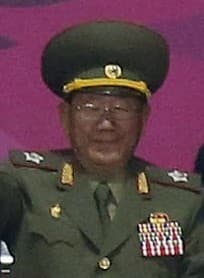
Hwang Pyong-so
General · Modern
39.7Total

Zorawar Singh Kahluria
General · Modern
55.8Total
Basic Information
Born
1949
1786
Died
—
1841
Era
Modern
Modern
Nationality
North Korea
India
Occupation
General
General
Civilization
Eastern
Indian
Score Comparison
Military (10%)
10.2
64.4
Political (20%)
30.8
42.2
Influence (20%)
51.8
55.7
Legacy (20%)
39.2
50.0
Leadership (15%)
58.8
68.0
Strategy (15%)
25.0
64.1
TOTAL
39.7
55.8
Hwang Pyong-so — Complete Timeline
2014 AD
Appointed Director of the Korean People's Army General Political BureauPolitical Action◆ Major
Hwang Pyong-so was appointed director of the KPA General Political Bureau, making him the top political officer in the North Korean military. This position placed him as a key figure in the regime's military command structure under Kim Jong-un.
North KoreaMilitary PoliticsKim Jong-un
Impact: national
2017 AD
Purged from all postsPolitical Action◆ Major
Hwang Pyong-so was removed from all his official positions, including his role as director of the KPA General Political Bureau and vice chairman of the State Affairs Commission. This purge followed a period of intense factional struggle within the North Korean leadership.
North KoreaPurgeLeadership Change
Impact: nationaldestructive
Zorawar Singh Kahluria — Complete Timeline
1834 AD
Conquest of LadakhWar◆ Major
Zorawar Singh Kahluria led a Dogra army to conquer Ladakh, defeating the local Namgyal dynasty. He annexed the region to the Sikh Empire under Maharaja Ranjit Singh, extending Dogra control into the Himalayas.
Dogra ConquestLadakhSikh Empire
Impact: regional
1840 AD
Conquest of BaltistanWar
Zorawar Singh Kahluria conquered Baltistan, defeating the local Maqpon rulers. He annexed the region to the Sikh Empire, further expanding Dogra territory in the Karakoram mountains.
Dogra ConquestBaltistanSikh Empire
Impact: regional
1841 AD
Invasion of TibetWar◆ Major
Zorawar Singh Kahluria invaded Tibet with a Dogra army, capturing several forts and advancing toward Lhasa. The invasion was a major military campaign that challenged Tibetan sovereignty and alarmed the Chinese Qing dynasty.
Dogra-Tibetan WarInvasionTibet
Impact: regional
Death in Battle of To-yoWar◆ Major
Zorawar Singh Kahluria was killed in the Battle of To-yo in Tibet during a winter campaign. His army was defeated by Tibetan forces, and his death ended the Dogra invasion, leading to a peace treaty.
BattleDeathDogra-Tibetan War
Impact: regionaltragic
This comparison has not been analyzed yet.
One-time AI generation (~1 minute). Scores and timeline are already available below.
Rankings
🥇
Zorawar Singh KahluriaLeader
Mil: 64.4Pol: 42.2Inf: 55.7
55.8
🥈
Hwang Pyong-so
Mil: 10.2Pol: 30.8Inf: 51.8
39.7
+16.1 behind
How This Comparison Works
Algorithm
Each figure is scored on 6 dimensions (0—100 scale) based on structured historical data: Military (10%), Political (20%), Influence (20%), Legacy (20%), Leadership (15%), Strategy (15%). The weighted total produces the final ranking.
Data Sources
Scores are computed from structured sub-indicators in the database. Scale factors adjust for era (Ancient ×0.85, Modern ×1.0) and civilization size (Eastern ×1.05, Other ×0.80) to account for differences in population and military scale.
Maximum 3 Figures
Comparisons are limited to 2—3 figures to ensure readability and statistical meaningfulness.
Error Margins
±5 points per dimension — Sub-scores are derived from historical records with inherent uncertainty. Two figures within 5 points on a dimension should be considered roughly equivalent in that area.
Total Score Accuracy
±3 points overall — The weighted combination of 6 dimensions produces a total score with approximately ±3 points of uncertainty. Differences of less than 3 points are not statistically significant— the figures are effectively tied.
Known Limitations
- Historical records are incomplete and uneven across civilizations
- Figures from oral-tradition societies may be underrepresented
- Occupation labels can misclassify multi-role figures
- Scores measure capability and impact, not moral character
- Quantitative scoring is a comparison tool, not absolute truth
Capability Radar
Military (10%) — Battles & Warfare
Battles
5
65
Win Rate
5
70
Expansion
5
68
Political (20%) — Governance & Reform
Reform
15
20
Diplomacy
20
40
Economy
10
25
Influence (20%) — Cultural & Global Reach
Cultural
10
35
Global
10
30
Legacy (20%) — Historical Impact
Historical
15
50
Longevity
10
40
Leadership (15%) — Power & Stability
Tenure
30
45
Stability
25
30
Strategy (15%) — Tactics & Innovation
Strategy
10
72
Tactics
10
75
Reform
15
30
Similar Comparisons
Comments & Discussion
No comments yet. Be the first to share your thoughts!