Loading...
Inukai Tsuyoshi vs William T. Cosgrave
William T. Cosgrave leads by 10.2 pts · 2 figures compared
…
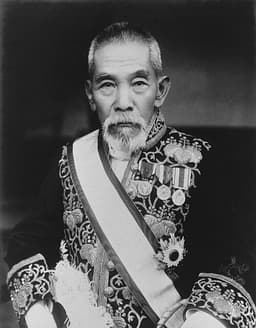
Inukai Tsuyoshi
Politician · Modern
46.0Total

William T. Cosgrave
Politician · Modern
56.2Total
Basic Information
Born
1855
1880
Died
1932
1965
Era
Modern
Modern
Nationality
Japan
Ireland
Occupation
Politician
Politician
Civilization
Eastern
Western
Score Comparison
Military (10%)
16.1
50.0
Political (20%)
48.0
68.0
Influence (20%)
51.8
55.7
Legacy (20%)
44.2
47.5
Leadership (15%)
64.0
72.0
Strategy (15%)
35.7
43.7
TOTAL
46.0
56.2
Inukai Tsuyoshi — Complete Timeline
1931 AD
Appointed Prime MinisterPolitical Action◆ Major
Inukai Tsuyoshi became Prime Minister of Japan during a period of rising militarism and economic crisis. He sought to restrain the military's influence and resolve the Manchurian crisis diplomatically.
Prime MinisterJapan1930s
Impact: national
1932 AD
Assassinated in the May 15 IncidentPolitical Action
Inukai Tsuyoshi was assassinated by a group of young naval officers and army cadets in the May 15 Incident. His murder marked the end of party cabinets in pre-war Japan and accelerated the shift toward military-dominated government.
AssassinationMay 15 IncidentMilitarism
Impact: nationaltragic
William T. Cosgrave — Complete Timeline
1921 AD
Anglo-Irish Treaty NegotiationsPolitical Action◆ Major
William T. Cosgrave was a member of the Irish delegation that negotiated the Anglo-Irish Treaty with the British government. The treaty established the Irish Free State as a dominion within the British Empire, leading to the partition of Ireland.
TreatyNegotiationIrish Free State
Impact: national
1922 AD
President of the Executive Council of the Irish Free StatePolitical Action◆ Major
William T. Cosgrave became the first President of the Executive Council of the Irish Free State, leading the government after the Anglo-Irish Treaty. He oversaw the establishment of the new state, including the creation of institutions and the suppression of anti-Treaty forces during the Civil War.
Irish Free StateGovernmentTreaty
Impact: nationalconstructive
Irish Civil War ExecutionsPolitical Action◆ Major
As head of the Free State government, Cosgrave authorized the execution of 77 anti-Treaty prisoners, including Rory O'Connor and Liam Mellows. These executions were intended to end the Irish Civil War but caused lasting bitterness and division in Irish politics.
Civil WarExecutionsControversy
Impact: nationaldestructive
1923 AD
Founding of Cumann na nGaedhealPolitical Action◆ Major
William T. Cosgrave founded Cumann na nGaedheal, the political party that supported the Anglo-Irish Treaty. The party governed the Irish Free State until 1932, focusing on law and order, economic stability, and building state institutions.
Political PartyTreatyGovernment
Impact: nationalconstructive
1932 AD
Defeat in 1932 General ElectionPolitical Action◆ Major
William T. Cosgrave's Cumann na nGaedheal government was defeated by Fianna F
ElectionDefeatPolitical Change
Impact: national
Expert Analysis
Origins
Inukai Tsuyoshi was born on April 20, 1855, in Okayama, Japan, into a samurai family. His father was a low-ranking retainer of the Okayama domain. Inukai studied at Keio Gijuku (later Keio University) under Fukuzawa Yukichi, where he was exposed to Western political thought. He began his career as a journalist and founded a newspaper before entering politics in 1890 as a member of the House of Representatives.
William T. Cosgrave was born on June 6, 1880, in Dublin, Ireland, into a working-class family. His father was a publican and small farmer. Cosgrave was educated at the Christian Brothers school in Dublin. He joined the Irish Republican Brotherhood and later Sinn Féin, becoming involved in the independence movement. He was elected as a Sinn Féin MP in 1917.
Rise to Power
Inukai rose through the ranks of the Rikken Kaishintō and later the Rikken Seiyūkai parties. He served as Minister of Education (1898) and Minister of Communications (1913-1914). His political career spanned decades, but he only became Prime Minister on December 13, 1931, at age 76, during the Manchurian Crisis. He was seen as a moderate who could curb military influence.
Cosgrave rose to prominence during the Irish War of Independence. He was appointed Minister for Local Government in the First Dáil (1919) and proved effective. After the Anglo-Irish Treaty of 1921, he supported the settlement. When the Irish Free State was established, he became President of the Executive Council (prime minister) on December 6, 1922, succeeding Michael Collins after Collins's assassination.
Leadership & Governance
Inukai's leadership was characterized by attempts to restrain the Japanese military and uphold constitutional government. He sought to resolve the Manchurian crisis through diplomacy with China and the League of Nations, scoring 35.7 in strategy. He opposed the military's unilateral actions in Manchuria and tried to reduce the army's budget. However, his party government was weak, and he lacked the institutional power to enforce civilian control.
Cosgrave's governance focused on establishing the institutions of the Irish Free State. He founded Cumann na nGaedheal in 1923, which governed with a conservative, law-and-order approach. He prioritized stability, building the civil service, police force (Garda Síochána), and judicial system. His government also passed the Land Act (1923) to redistribute land. However, his leadership was marked by the execution of 77 anti-Treaty prisoners during the Civil War, a decision that earned him lasting enmity. His political score of 68.0 reflects his effectiveness in building a state under difficult circumstances.
Triumph & Tragedy
Inukai's greatest triumph was his commitment to parliamentary democracy at a time when it was under threat. He scored 64.0 in leadership for his principled stand. His tragedy was his assassination on May 15, 1932, in the May 15 Incident, when naval officers and army cadets stormed his residence. His murder effectively ended party cabinets in Japan until after World War II, marking a turning point toward militarist rule.
Cosgrave's greatest triumph was successfully establishing the Irish Free State as a functional dominion, achieving independence within the Commonwealth. He scored 72.0 in leadership for guiding the new state through civil war and consolidating democratic institutions. His tragedy was his defeat in the 1932 general election to Éamon de Valera's Fianna Fáil, which he had suppressed during the Civil War. His party never regained power, and his legacy was overshadowed by de Valera's.
Character & Destiny
Inukai was known as a witty, cultured man with a passion for Chinese poetry. He was a skilled orator but politically isolated, unable to build a coalition against the military. His character—a stubborn defender of civilian rule—led directly to his assassination. He refused to resign or compromise, believing that to do so would betray democracy. Historical assessments note his courage but also his lack of realistic strategy.
Cosgrave was pragmatic, cautious, and methodical. He was not a charismatic speaker but was respected for his administrative competence. His character shaped his destiny: his willingness to use harsh measures to establish order alienated many nationalists, but it also ensured the Free State's survival. Historians view him as a steady hand who prioritized stability over popularity.
Legacy
Inukai's legacy is that of a martyr for Japanese democracy. His assassination is seen as the moment when Japan's path toward militarism became irreversible. He scored 44.2 in legacy, reflecting his limited long-term impact, as his policies were reversed. However, post-war Japan has honored him as a defender of constitutional government.
Cosgrave's legacy is more substantial. He founded Cumann na nGaedheal, which later merged into Fine Gael, one of Ireland's two major parties. The institutions he built—the civil service, police, and legal system—endure. He scored 47.5 in legacy, but his role in the Civil War executions remains controversial. His reputation has been reassessed positively in recent decades as a founder of the Irish state.
Conclusion
William T. Cosgrave had a greater impact than Inukai Tsuyoshi. Cosgrave's total score of 56.2 against Inukai's 46.0 reflects his higher effectiveness in governance and leadership. While Inukai's stand against militarism was noble, it failed to prevent Japan's descent into war. Cosgrave, despite his controversial methods, successfully built a democratic state that survived. Inukai's tragedy was his inability to translate his principles into lasting change; Cosgrave's institutional achievements outlasted him. Therefore, Cosgrave emerges as the more consequential leader.
Rankings
🥇
William T. CosgraveLeader
Mil: 50.0Pol: 68.0Inf: 55.7
56.2
🥈
Inukai Tsuyoshi
Mil: 16.1Pol: 48.0Inf: 51.8
46.0
+10.2 behind
How This Comparison Works
Algorithm
Each figure is scored on 6 dimensions (0—100 scale) based on structured historical data: Military (10%), Political (20%), Influence (20%), Legacy (20%), Leadership (15%), Strategy (15%). The weighted total produces the final ranking.
Data Sources
Scores are computed from structured sub-indicators in the database. Scale factors adjust for era (Ancient ×0.85, Modern ×1.0) and civilization size (Eastern ×1.05, Other ×0.80) to account for differences in population and military scale.
Maximum 3 Figures
Comparisons are limited to 2—3 figures to ensure readability and statistical meaningfulness.
Error Margins
±5 points per dimension — Sub-scores are derived from historical records with inherent uncertainty. Two figures within 5 points on a dimension should be considered roughly equivalent in that area.
Total Score Accuracy
±3 points overall — The weighted combination of 6 dimensions produces a total score with approximately ±3 points of uncertainty. Differences of less than 3 points are not statistically significant— the figures are effectively tied.
Known Limitations
- Historical records are incomplete and uneven across civilizations
- Figures from oral-tradition societies may be underrepresented
- Occupation labels can misclassify multi-role figures
- Scores measure capability and impact, not moral character
- Quantitative scoring is a comparison tool, not absolute truth
Capability Radar
Military (10%) — Battles & Warfare
Battles
15
27
Win Rate
16
33
Expansion
18
35
Political (20%) — Governance & Reform
Reform
40
60
Diplomacy
45
55
Economy
35
50
Influence (20%) — Cultural & Global Reach
Cultural
30
30
Global
20
35
Legacy (20%) — Historical Impact
Historical
40
45
Longevity
25
40
Leadership (15%) — Power & Stability
Tenure
55
65
Stability
20
55
Strategy (15%) — Tactics & Innovation
Strategy
21
39
Tactics
26
42
Reform
30
46
Similar Comparisons
Comments & Discussion
No comments yet. Be the first to share your thoughts!