Loading...
This comparison has not been analyzed yet.
One-time AI generation (~1 minute). Scores and timeline are already available below.
Ishbi-Erra of Mari vs Sobekneferu
Sobekneferu leads by 2.0 pts · 2 figures compared
…

Ishbi-Erra of Mari
Emperor · Ancient
37.6Total
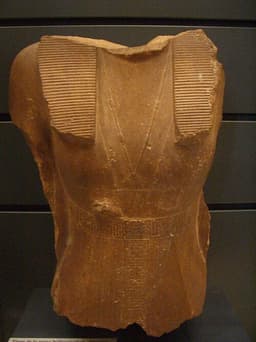
Sobekneferu
Emperor · Ancient
39.6Total
Basic Information
Born
-1770
-1745
Died
-1750
-1740
Era
Ancient
Ancient
Nationality
Mari
Middle Kingdom Egypt
Occupation
Emperor
Emperor
Civilization
Middle Eastern
Middle Eastern
Score Comparison
Military (10%)
10.2
10.2
Political (20%)
35.0
30.8
Influence (20%)
42.4
48.6
Legacy (20%)
31.7
44.2
Leadership (15%)
55.3
41.5
Strategy (15%)
45.0
45.0
TOTAL
37.6
39.6
Sobekneferu — Complete Timeline
1745 BC
Accession as First Confirmed Female PharaohPolitical Action
Sobekneferu ascended the throne after the death of her brother Amenemhat IV, becoming the first confirmed female pharaoh of Egypt. She adopted full royal titulary, including the throne name Sobekkare, and was depicted in male regalia, legitimizing her rule in a traditionally male role.
Female PharaohSuccessionGender
Impact: nationalprogressive
1743 BC
Construction of Funerary Complex at MazghunaCultural
Sobekneferu began construction of a pyramid complex at Mazghuna, south of Dahshur. The pyramid was never completed, and only its mudbrick core and some granite elements remain. It represents her attempt to establish a royal burial place, though her actual tomb location remains uncertain.
PyramidArchitectureBurial
Impact: national
1740 BC
End of the 12th DynastyPolitical Action◆ Major
Sobekneferu's death without a clear heir marked the end of the 12th Dynasty. Her reign was brief, lasting about 4 years, and her passing led to a period of political fragmentation and the rise of the 13th Dynasty, which was weaker and more unstable, contributing to the decline of the Middle Kingdom.
End of DynastySuccession CrisisMiddle Kingdom
Impact: nationaltragic
This comparison has not been analyzed yet.
One-time AI generation (~1 minute). Scores and timeline are already available below.
Rankings
🥇
SobekneferuLeader
Mil: 10.2Pol: 30.8Inf: 48.6
39.6
🥈
Ishbi-Erra of Mari
Mil: 10.2Pol: 35.0Inf: 42.4
37.6
+2.0 behind
How This Comparison Works
Algorithm
Each figure is scored on 6 dimensions (0—100 scale) based on structured historical data: Military (10%), Political (20%), Influence (20%), Legacy (20%), Leadership (15%), Strategy (15%). The weighted total produces the final ranking.
Data Sources
Scores are computed from structured sub-indicators in the database. Scale factors adjust for era (Ancient ×0.85, Modern ×1.0) and civilization size (Eastern ×1.05, Other ×0.80) to account for differences in population and military scale.
Maximum 3 Figures
Comparisons are limited to 2—3 figures to ensure readability and statistical meaningfulness.
Error Margins
±5 points per dimension — Sub-scores are derived from historical records with inherent uncertainty. Two figures within 5 points on a dimension should be considered roughly equivalent in that area.
Total Score Accuracy
±3 points overall — The weighted combination of 6 dimensions produces a total score with approximately ±3 points of uncertainty. Differences of less than 3 points are not statistically significant— the figures are effectively tied.
Known Limitations
- Historical records are incomplete and uneven across civilizations
- Figures from oral-tradition societies may be underrepresented
- Occupation labels can misclassify multi-role figures
- Scores measure capability and impact, not moral character
- Quantitative scoring is a comparison tool, not absolute truth
Capability Radar
Military (10%) — Battles & Warfare
Battles
5
5
Win Rate
5
5
Expansion
5
5
Political (20%) — Governance & Reform
Reform
5
25
Diplomacy
5
25
Economy
5
25
Influence (20%) — Cultural & Global Reach
Cultural
5
30
Global
5
20
Legacy (20%) — Historical Impact
Historical
5
40
Longevity
5
35
Leadership (15%) — Power & Stability
Tenure
5
30
Stability
5
20
Strategy (15%) — Tactics & Innovation
Strategy
5
5
Tactics
5
5
Reform
5
5
Similar Comparisons
Comments & Discussion
No comments yet. Be the first to share your thoughts!