Loading...
Islam Karimov vs Tuilaepa Sailele
Tuilaepa Sailele leads by 3.5 pts · 2 figures compared
…
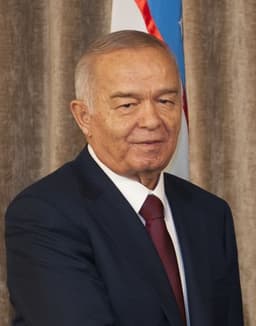
Islam Karimov
Politician · Modern
49.1Total

Tuilaepa Sailele
Politician · Modern
52.6Total
Basic Information
Born
1938
1945
Died
—
—
Era
Modern
Modern
Nationality
Uzbekistan
Samoa
Occupation
Politician
Politician
Civilization
Eastern
Other
Score Comparison
Military (10%)
32.5
33.1
Political (20%)
48.0
45.0
Influence (20%)
50.2
55.7
Legacy (20%)
41.7
49.2
Leadership (15%)
66.0
80.0
Strategy (15%)
58.1
42.8
TOTAL
49.1
52.6
Islam Karimov — Complete Timeline
1991 AD
Became First President of UzbekistanPolitical Action◆ Major
Islam Karimov was elected as the first president of independent Uzbekistan after the dissolution of the Soviet Union. He had previously served as the First Secretary of the Communist Party of Uzbekistan. His presidency established an authoritarian regime that would last for 25 years.
IndependenceAuthoritarian RegimePost-Soviet Transition
Impact: national
1994 AD
Implemented Economic ReformsReform◆ Major
Karimov pursued a gradualist approach to economic reform, maintaining state control over key sectors while allowing limited private enterprise. His policies focused on energy independence and cotton production. Uzbekistan achieved modest economic growth but remained largely isolated from global markets.
Economic PolicyState ControlGradual Reform
Impact: nationalconstructive
2005 AD
Suppressed Andijan UprisingPolitical Action◆ Major
Karimov's government violently suppressed a protest in Andijan, killing hundreds of civilians. The uprising was sparked by the trial of local businessmen accused of extremism. The crackdown drew international condemnation and led to a deterioration of relations with the West.
MassacreHuman Rights ViolationsAuthoritarian Repression
Impact: nationaldestructive
2016 AD
Died in OfficePolitical Action◆ Major
Islam Karimov died in office at the age of 78 after suffering a stroke. His death ended 25 years of authoritarian rule. He was succeeded by Shavkat Mirziyoyev, who had served as prime minister. Karimov's death marked a turning point in Uzbek politics, leading to cautious reforms.
Death in OfficeSuccessionEnd of Era
Impact: national
Tuilaepa Sailele — Complete Timeline
1998 AD
Elected Prime Minister of SamoaPolitical Action◆ Major
Tuilaepa Sailele was elected as Prime Minister of Samoa, beginning his tenure as the longest-serving head of government in the country's history. He succeeded Tofilau Eti Alesana and led the Human Rights Protection Party.
ElectionLeadershipSamoa
Impact: nationalconstructive
2009 AD
Switched Samoa to driving on the left side of the roadReform◆ Major
Tuilaepa's government implemented a change from driving on the right to driving on the left, aligning with neighboring Australia and New Zealand. The switch aimed to reduce import costs for vehicles and improve road safety, though it caused initial disruption.
Transport ReformInfrastructurePolicy Change
Impact: nationalconstructive
2016 AD
Re-elected for fifth consecutive termPolitical Action◆ Major
Tuilaepa won a fifth consecutive term as Prime Minister, extending his record as the longest-serving leader in Samoa. His party, HRPP, secured a majority in the general election, continuing his dominance in Samoan politics.
ElectionRe-electionSamoa
Impact: national
2019 AD
Declared state of emergency during measles outbreakPolitical Action◆ Major
Tuilaepa declared a state of emergency in response to a severe measles epidemic that killed over 80 people, mostly children. The government mandated vaccinations and closed schools, but the outbreak highlighted gaps in healthcare infrastructure.
Public HealthCrisis ManagementMeasles
Impact: nationaltragic
2021 AD
Lost general election after 22 years in powerPolitical Action
Tuilaepa's HRPP lost the general election to the FAST party led by Fiame Naomi Mataafa. The result led to a constitutional crisis and legal battles, but Tuilaepa eventually conceded, ending his 22-year tenure as Prime Minister.
ElectionTransition of PowerSamoa
Impact: national
Expert Analysis
Origins
Islam Karimov was born on January 30, 1938, in Samarkand, Uzbek SSR, into a working-class family. He studied mechanical engineering at the Tashkent State Technical University and later worked as a factory worker before entering the Soviet bureaucracy. Karimov joined the Communist Party in 1964 and rose through the ranks of the Soviet planning apparatus, eventually becoming the First Secretary of the Communist Party of Uzbekistan in 1989. His background in Soviet administration shaped his authoritarian approach to governance.
Tuilaepa Sailele Malielegaoi was born on April 14, 1945, in Lepa, Samoa, to a family of chiefs. He studied at the University of Auckland in New Zealand, earning a master's degree in commerce. Tuilaepa worked as a civil servant and later as a diplomat before entering politics. He was first elected to parliament in 1980 as a member of the Human Rights Protection Party (HRPP). His Western education and diplomatic experience gave him a pragmatic and gradualist style.
Rise to Power
Karimov's rise came with the collapse of the Soviet Union. In 1991, Uzbekistan declared independence, and Karimov, as the former Communist leader, won the presidential election with 86% of the vote in a contest widely seen as rigged. He consolidated power by suppressing opposition, banning rival parties, and controlling the media. By 1995, he had extended his term via a referendum, effectively becoming president for life. His rise was marked by the elimination of political rivals and the establishment of a cult of personality.
Tuilaepa became Prime Minister in 1998 after the death of his predecessor, Tofilau Eti Alesana. He had served as Deputy Prime Minister and Minister of Finance since 1991. His rise was within a democratic framework: he was elected by parliament and led the HRPP to repeated electoral victories. He won five consecutive terms, with the party securing majorities in every election until 2021. His leadership style was consultative, rooted in Samoan traditions of consensus-building.
Leadership & Governance
Karimov governed as an autocrat. He maintained a Soviet-style command economy, with state control over cotton, gold, and energy sectors. His regime was characterized by human rights abuses, including torture, forced labor in cotton fields, and suppression of dissent. In 2005, his forces killed hundreds of protesters in Andijan, an event that drew international condemnation. Karimov scored 66.0 in leadership, reflecting his firm control, but his political score of 48.0 indicates the fragility of his regime due to lack of legitimacy.
Tuilaepa led a democratic government with regular elections, though his party dominated. He implemented gradual reforms: privatizing state assets, improving infrastructure, and strengthening ties with Australia and New Zealand. In 2009, he controversially switched Samoa from driving on the right to the left, aligning with regional neighbors. He also declared a state of emergency during a 2019 measles outbreak, mandating vaccinations. His leadership score of 80.0 is higher than Karimov's, reflecting his ability to maintain stability and legitimacy through democratic processes.
Triumph & Tragedy
Karimov's greatest success was maintaining Uzbekistan's stability and independence after the Soviet collapse, avoiding the civil wars that plagued other Central Asian states. His economic reforms, though gradual, prevented a total collapse. However, his greatest failure was the brutal suppression of the Andijan uprising, which killed hundreds and isolated Uzbekistan internationally. His legacy is tarnished by human rights abuses and a stagnant economy dependent on cotton and gas exports.
Tuilaepa's triumphs include overseeing Samoa's economic growth, improving health and education indicators, and navigating the country through natural disasters. He also secured a fifth consecutive term in 2016. His tragedy came in 2021 when his party lost the election after 22 years in power, leading to a constitutional crisis. Additionally, the 2019 measles outbreak killed 83 people, mostly children, exposing weaknesses in the healthcare system. His legacy is mixed: respected for stability but criticized for staying too long and for the measles crisis.
Character & Destiny
Karimov was secretive, paranoid, and ruthless. He centralized power and eliminated any potential rivals, including former allies. His character led to a regime that was stable but brittle, collapsing into succession uncertainty upon his death in 2016. He died in office at age 78, leaving a system that could not function without him. Historians assess him as a classic post-Soviet autocrat who prioritized control over development.
Tuilaepa was dignified, patient, and consensus-oriented. He was known for his diplomatic skills and ability to maintain party unity. However, his reluctance to step down led to a loss of public trust and eventual electoral defeat. His character shaped a stable but increasingly stagnant political system. He scored 42.8 in strategy, lower than Karimov's 58.1, indicating less strategic maneuvering.
Legacy
Karimov's legacy is one of authoritarian rule and missed opportunities. Uzbekistan remains repressive, with his successor Shavkat Mirziyoyev continuing many of his policies. His score of 41.7 in legacy reflects the limited positive impact. The forced labor system and human rights abuses are his enduring negative marks.
Tuilaepa's legacy is more positive but ambiguous. He modernized Samoa and maintained democracy, but his long tenure contributed to political stagnation. His score of 49.2 in legacy is higher than Karimov's, reflecting a more balanced record. The switch to left-side driving and his handling of the measles outbreak are defining events. Samoa remains a stable democracy, partly due to his efforts.
Conclusion
Tuilaepa Sailele had a greater positive impact on Samoa than Islam Karimov had on Uzbekistan. Tuilaepa's leadership score of 80.0 against Karimov's 66.0, and his legacy score of 49.2 against 41.7, reflect his more constructive role. While Karimov maintained stability, he did so through repression and economic stagnation, scoring 50.2 in influence versus Tuilaepa's 55.7. Tuilaepa's democratic governance and gradual reforms, despite the measles tragedy, provided a foundation for future progress. Karimov's rule, though stable, left a legacy of fear and underdevelopment. In the comparison of impact, Tuilaepa's democratic leadership outweighs Karimov's authoritarian control.
Rankings
🥇
Tuilaepa SaileleLeader
Mil: 33.1Pol: 45.0Inf: 55.7
52.6
🥈
Islam Karimov
Mil: 32.5Pol: 48.0Inf: 50.2
49.1
+3.5 behind
How This Comparison Works
Algorithm
Each figure is scored on 6 dimensions (0—100 scale) based on structured historical data: Military (10%), Political (20%), Influence (20%), Legacy (20%), Leadership (15%), Strategy (15%). The weighted total produces the final ranking.
Data Sources
Scores are computed from structured sub-indicators in the database. Scale factors adjust for era (Ancient ×0.85, Modern ×1.0) and civilization size (Eastern ×1.05, Other ×0.80) to account for differences in population and military scale.
Maximum 3 Figures
Comparisons are limited to 2—3 figures to ensure readability and statistical meaningfulness.
Error Margins
±5 points per dimension — Sub-scores are derived from historical records with inherent uncertainty. Two figures within 5 points on a dimension should be considered roughly equivalent in that area.
Total Score Accuracy
±3 points overall — The weighted combination of 6 dimensions produces a total score with approximately ±3 points of uncertainty. Differences of less than 3 points are not statistically significant— the figures are effectively tied.
Known Limitations
- Historical records are incomplete and uneven across civilizations
- Figures from oral-tradition societies may be underrepresented
- Occupation labels can misclassify multi-role figures
- Scores measure capability and impact, not moral character
- Quantitative scoring is a comparison tool, not absolute truth
Capability Radar
Military (10%) — Battles & Warfare
Battles
53
21
Win Rate
52
25
Expansion
58
26
Political (20%) — Governance & Reform
Reform
30
60
Diplomacy
50
65
Economy
40
55
Influence (20%) — Cultural & Global Reach
Cultural
20
40
Global
20
35
Legacy (20%) — Historical Impact
Historical
30
50
Longevity
20
45
Leadership (15%) — Power & Stability
Tenure
70
85
Stability
45
70
Strategy (15%) — Tactics & Innovation
Strategy
59
32
Tactics
62
32
Reform
68
37
Similar Comparisons
Comments & Discussion
No comments yet. Be the first to share your thoughts!