Loading...
This comparison has not been analyzed yet.
One-time AI generation (~1 minute). Scores and timeline are already available below.
Iyoas I vs Pragmulji II of Kutch
Pragmulji II of Kutch leads by 10.3 pts · 2 figures compared
…
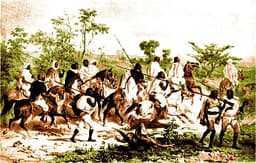
Iyoas I
Emperor · Modern
38.4Total

Pragmulji II of Kutch
Emperor · Modern
48.7Total
Basic Information
Born
1740
1839
Died
1769
1875
Era
Modern
Modern
Nationality
Ethiopia
India
Occupation
Emperor
Emperor
Civilization
Other
Indian
Score Comparison
Military (10%)
20.0
21.2
Political (20%)
26.4
68.0
Influence (20%)
47.9
50.2
Legacy (20%)
39.2
40.0
Leadership (15%)
34.6
66.0
Strategy (15%)
54.3
39.6
TOTAL
38.4
48.7
Iyoas I — Complete Timeline
1755 AD
Accession to the thronePolitical Action◆ Major
Iyoas I became Emperor of Ethiopia at age 15 following the death of his father, Iyasu II. His reign was dominated by the rivalry between his mother, Empress Mentewab, and the powerful noble Ras Mikael Sehul.
SuccessionCourt Politics
Impact: national
1767 AD
Conflict between Mentewab and Mikael SehulPolitical Action◆ Major
A power struggle erupted between Empress Mentewab and Ras Mikael Sehul over control of the young emperor. Mikael Sehul, who had married Iyoas's aunt, gained dominance and effectively ruled the empire, sidelining the empress.
Power StruggleMikael SehulMentewab
Impact: nationaldestructive
1769 AD
Assassination of Iyoas IPolitical Action
Ras Mikael Sehul ordered the assassination of Emperor Iyoas I after a dispute. This regicide shattered the traditional authority of the Solomonic dynasty and plunged Ethiopia into the Zemene Mesafint (Era of the Princes), a period of decentralized rule and civil war lasting until 1855.
AssassinationZemene MesafintRegicide
Impact: nationaltragic
Pragmulji II of Kutch — Complete Timeline
1860 AD
Accession as Maharao of KutchPolitical Action◆ Major
Pragmulji II became Maharao of Kutch at age 21 after the death of his father. His reign focused on administrative reforms and modernization, including the construction of infrastructure and public buildings.
AccessionKutchMaharao
Impact: regional
1865 AD
Construction of Prag Mahal PalaceCultural◆ Major
Pragmulji II commissioned the construction of the Prag Mahal Palace in Bhuj, designed in Italian Gothic style by British architect Colonel Henry Saint Clair Wilkins. The palace was completed after his death by his son Khengarji III.
ArchitecturePrag MahalBhuj
Impact: regionalconstructive
1870 AD
Administrative reforms in KutchReform◆ Major
Pragmulji II introduced administrative reforms including a modern revenue system, judiciary, and police force. He established schools and hospitals, improving governance and public welfare in the princely state.
AdministrationReformKutch
Impact: regionalconstructive
1875 AD
Death and successionOther
Pragmulji II died in 1875 after a 15-year reign. He was succeeded by his son Khengarji III. His reforms and architectural projects laid the foundation for Kutch's modernization under his successor.
DeathSuccessionKutch
Impact: regional
This comparison has not been analyzed yet.
One-time AI generation (~1 minute). Scores and timeline are already available below.
Rankings
🥇
Pragmulji II of KutchLeader
Mil: 21.2Pol: 68.0Inf: 50.2
48.7
🥈
Iyoas I
Mil: 20.0Pol: 26.4Inf: 47.9
38.4
+10.3 behind
How This Comparison Works
Algorithm
Each figure is scored on 6 dimensions (0—100 scale) based on structured historical data: Military (10%), Political (20%), Influence (20%), Legacy (20%), Leadership (15%), Strategy (15%). The weighted total produces the final ranking.
Data Sources
Scores are computed from structured sub-indicators in the database. Scale factors adjust for era (Ancient ×0.85, Modern ×1.0) and civilization size (Eastern ×1.05, Other ×0.80) to account for differences in population and military scale.
Maximum 3 Figures
Comparisons are limited to 2—3 figures to ensure readability and statistical meaningfulness.
Error Margins
±5 points per dimension — Sub-scores are derived from historical records with inherent uncertainty. Two figures within 5 points on a dimension should be considered roughly equivalent in that area.
Total Score Accuracy
±3 points overall — The weighted combination of 6 dimensions produces a total score with approximately ±3 points of uncertainty. Differences of less than 3 points are not statistically significant— the figures are effectively tied.
Known Limitations
- Historical records are incomplete and uneven across civilizations
- Figures from oral-tradition societies may be underrepresented
- Occupation labels can misclassify multi-role figures
- Scores measure capability and impact, not moral character
- Quantitative scoring is a comparison tool, not absolute truth
Capability Radar
Military (10%) — Battles & Warfare
Battles
5
10
Win Rate
5
10
Expansion
5
10
Political (20%) — Governance & Reform
Reform
10
50
Diplomacy
10
40
Economy
10
50
Influence (20%) — Cultural & Global Reach
Cultural
10
30
Global
5
10
Legacy (20%) — Historical Impact
Historical
20
30
Longevity
15
20
Leadership (15%) — Power & Stability
Tenure
15
60
Stability
5
55
Strategy (15%) — Tactics & Innovation
Strategy
5
10
Tactics
5
10
Reform
5
20
Similar Comparisons
Comments & Discussion
No comments yet. Be the first to share your thoughts!