Loading...
Jia Xu vs Solon
Solon leads by 18.8 pts · 2 figures compared
…
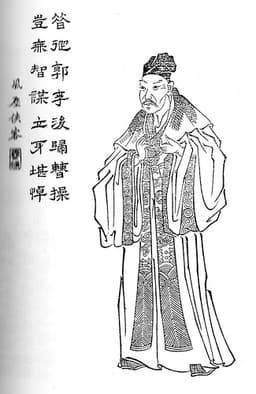
Jia Xu
Politician · Ancient
51.4Total

Solon
Politician · Ancient
70.2Total
Basic Information
Born
147
-638
Died
223
-558
Era
Ancient
Ancient
Nationality
China
Greece
Occupation
Politician
Politician
Civilization
Eastern
Western
Score Comparison
Military (10%)
45.0
49.8
Political (20%)
39.4
85.0
Influence (20%)
56.4
65.0
Legacy (20%)
50.0
80.0
Leadership (15%)
67.0
62.0
Strategy (15%)
43.3
69.2
TOTAL
51.4
70.2
Jia Xu — Complete Timeline
192 AD
Advised Li Jue and Guo Si to attack Chang'anWar◆ Major
After Dong Zhuo's death, Jia Xu advised his subordinates Li Jue and Guo Si to gather their troops and attack Chang'an rather than disbanding. This led to the capture of the capital and the restoration of their power, though it plunged the region into further chaos.
Han DynastyWarlord EraChang'an
Impact: nationaldestructive
199 AD
Switched allegiance to Cao CaoPolitical Action
Jia Xu left Zhang Xiu's service and joined Cao Cao, bringing with him strategic advice. Cao Cao welcomed him and later relied on his counsel for major decisions.
Cao CaoAllegiance ChangeAdvisor
Impact: national
200 AD
Advised Cao Cao to attack Yuan Shao at GuanduWar◆ Major
When Cao Cao hesitated to engage Yuan Shao due to lack of supplies, Jia Xu argued that Cao Cao's strategic acumen and the morale of his troops outweighed Yuan Shao's numerical advantage. Cao Cao followed the advice and won the Battle of Guandu.
Battle of GuanduCao CaoMilitary Advice
Impact: regionalconstructive
208 AD
Opposed Cao Cao's plan to attack Sun QuanPolitical Action
After Cao Cao's defeat at Red Cliffs, Jia Xu advised against a hasty second invasion of Jiangdong, arguing that Cao Cao should consolidate his gains first. Cao Cao did not follow this advice and suffered further setbacks.
Red CliffsCao CaoStrategic Advice
Impact: regionalconstructive
215 AD
Advised Cao Cao to invade Hanzhong via the Qinling MountainsWar
Jia Xu recommended that Cao Cao launch a campaign against Zhang Lu in Hanzhong using a mountain route. The campaign succeeded, and Cao Cao gained control of Hanzhong.
Hanzhong CampaignCao CaoMilitary Strategy
Impact: regionalconstructive
Solon — Complete Timeline
594 BC
Seisachtheia (Shaking Off of Burdens)Reform
Solon canceled all outstanding debts and freed Athenians enslaved for debt. He abolished debt bondage and prohibited using personal freedom as collateral for loans, addressing the severe economic crisis and social unrest caused by the exploitation of the poor by the wealthy.
Debt ReformSocial JusticeAthens
Impact: nationalprogressive
Constitutional Reforms of SolonReform◆ Major
Solon divided Athenian citizens into four property classes (pentakosiomedimnoi, hippeis, zeugitai, thetes) determining political rights. He created the Council of 400 and the popular courts (Heliaia), opening political participation to a broader segment of the population while retaining aristocratic elements.
Constitutional ReformAthenian DemocracyClass System
Impact: globalprogressive
Economic Reforms of SolonReform◆ Major
Solon reformed Athenian coinage and weights and measures, standardizing them to facilitate trade. He encouraged the cultivation of olives and the export of olive oil, while banning the export of grain to ensure local food supply, stimulating the Athenian economy.
Economic ReformTradeAgriculture
Impact: nationalconstructive
Solon's Laws on Family and InheritanceReform
Solon introduced laws regulating marriage, inheritance, and family property. He allowed childless men to adopt heirs and restricted the dowry system, aiming to protect family estates and prevent the concentration of wealth in a few hands.
Family LawInheritanceSocial Reform
Impact: nationalconstructive
Expert Analysis
Origins
Jia Xu (147-224 CE) was born in the late Eastern Han dynasty in what is now Wuwei, Gansu. Little is known of his early life, but he was recognized for his intelligence and studied the classics. He began his career as a minor official under the warlord Dong Zhuo. Solon (c. 630-560 BCE) was born into a noble Athenian family with a tradition of public service. His early life included travel and trade, which exposed him to diverse political systems. He was appointed archon in 594 BCE amid severe social strife between the rich and poor.
Rise to Power
Jia Xu rose to prominence by offering strategic advice to various warlords. After Dong Zhuo's death in 192, he advised Li Jue and Guo Si to attack Chang'an, which succeeded and gave him influence. Later, he served Zhang Xiu and then Cao Cao in 199, becoming a key strategist. His advice at the Battle of Guandu in 200, urging Cao Cao to attack Yuan Shao, proved decisive. Solon's rise came through his reputation for wisdom and moderation. In 594 BCE, he was elected archon with extraordinary powers to resolve the debt crisis. His reforms, known as the Seisachtheia, canceled debts and freed enslaved debtors, immediately earning him broad support but also opposition from the aristocracy.
Leadership & Governance
Jia Xu's leadership was indirect; he influenced decisions through counsel. He scored 67.0 in leadership, reflecting his ability to guide powerful figures. His political score of 39.4 indicates he never held supreme power. He advised caution after Red Cliffs, but Cao Cao ignored him, leading to defeat. Solon governed directly, scoring 85.0 in politics. He created a timocratic constitution based on wealth classes, established the Council of 400, and allowed all citizens to appeal verdicts. His reforms balanced power between rich and poor, but he refused to become a tyrant, leaving Athens after his reforms were enacted.
Triumph & Tragedy
Jia Xu's greatest success was his flawless strategic advice; he never gave a wrong counsel. His advice at Guandu and Hanzhong campaigns were pivotal. However, his tragedy was that his advice was sometimes ignored, and he served under warlords who ultimately failed, like Li Jue. Solon's triumph was ending debt slavery and laying the foundations for democracy. His constitutional reforms created a more just society. But his tragedy was that his reforms did not prevent future tyranny; Peisistratus later seized power. Solon's moderation failed to satisfy either the rich or the poor permanently.
Character & Destiny
Jia Xu was cautious and calculating, never seeking personal glory. He avoided high office and lived to 77, a rare feat in turbulent times. His character of self-preservation and strategic withdrawal shaped his fate. Solon was principled and idealistic, refusing tyranny despite having the power. He traveled after his reforms, perhaps to avoid being forced to modify them. His character of balance and justice led to his legacy as a lawgiver, but also to political instability after his departure.
Legacy
Jia Xu's legacy is limited to Chinese history, remembered as a master strategist whose advice was nearly infallible. His influence score of 56.4 reflects his impact on the Three Kingdoms period. Solon's legacy is global; he is credited as the father of Athenian democracy. His reforms influenced later democratic systems. His legacy score of 80.0 is significantly higher than Jia Xu's 50.0. Solon's laws and constitutional ideas endured for centuries, while Jia Xu's advice shaped events but left no lasting institutions.
Conclusion
Solon had greater impact. His political score (85.0) and legacy (80.0) far exceed Jia Xu's (39.4 and 50.0). While Jia Xu's strategic advice was precise and influential in the short term, Solon's reforms created a system that influenced Western political thought for millennia. Solon's total score of 70.2 to Jia Xu's 51.4 reflects this. Jia Xu was a brilliant tactician, but Solon was a foundational architect of democracy.
Rankings
🥇
SolonLeader
Mil: 49.8Pol: 85.0Inf: 65.0
70.2
🥈
Jia Xu
Mil: 45.0Pol: 39.4Inf: 56.4
51.4
+18.8 behind
How This Comparison Works
Algorithm
Each figure is scored on 6 dimensions (0—100 scale) based on structured historical data: Military (10%), Political (20%), Influence (20%), Legacy (20%), Leadership (15%), Strategy (15%). The weighted total produces the final ranking.
Data Sources
Scores are computed from structured sub-indicators in the database. Scale factors adjust for era (Ancient ×0.85, Modern ×1.0) and civilization size (Eastern ×1.05, Other ×0.80) to account for differences in population and military scale.
Maximum 3 Figures
Comparisons are limited to 2—3 figures to ensure readability and statistical meaningfulness.
Error Margins
±5 points per dimension — Sub-scores are derived from historical records with inherent uncertainty. Two figures within 5 points on a dimension should be considered roughly equivalent in that area.
Total Score Accuracy
±3 points overall — The weighted combination of 6 dimensions produces a total score with approximately ±3 points of uncertainty. Differences of less than 3 points are not statistically significant— the figures are effectively tied.
Known Limitations
- Historical records are incomplete and uneven across civilizations
- Figures from oral-tradition societies may be underrepresented
- Occupation labels can misclassify multi-role figures
- Scores measure capability and impact, not moral character
- Quantitative scoring is a comparison tool, not absolute truth
Capability Radar
Military (10%) — Battles & Warfare
Battles
10
58
Win Rate
15
58
Expansion
5
63
Political (20%) — Governance & Reform
Reform
10
85
Diplomacy
70
70
Economy
10
80
Influence (20%) — Cultural & Global Reach
Cultural
30
75
Global
20
70
Legacy (20%) — Historical Impact
Historical
50
85
Longevity
40
80
Leadership (15%) — Power & Stability
Tenure
30
40
Stability
40
65
Strategy (15%) — Tactics & Innovation
Strategy
70
62
Tactics
60
69
Reform
5
72
Similar Comparisons
Comments & Discussion
No comments yet. Be the first to share your thoughts!