Loading...
This comparison has not been analyzed yet.
One-time AI generation (~1 minute). Scores and timeline are already available below.
John IV of Portugal vs Pedro I of Brazil
John IV of Portugal leads by 4.6 pts · 2 figures compared
…

John IV of Portugal
Emperor · Modern
59.2Total
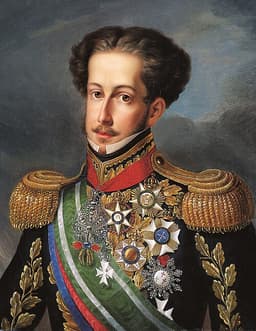
Pedro I of Brazil
Emperor · Modern
54.6Total
Basic Information
Born
1604
1798
Died
1656
1834
Era
Modern
Modern
Nationality
Portugal
Brazil
Occupation
Emperor
Emperor
Civilization
Western
Western
Score Comparison
Military (10%)
25.0
55.0
Political (20%)
72.0
62.7
Influence (20%)
58.3
59.0
Legacy (20%)
58.0
50.0
Leadership (15%)
72.0
53.2
Strategy (15%)
60.0
45.0
TOTAL
59.2
54.6
John IV of Portugal — Complete Timeline
1640 AD
Portuguese Restoration War BeginsWar
John IV was acclaimed King of Portugal after a coup in Lisbon overthrew Spanish Habsburg rule. This started the Portuguese Restoration War, a 28-year conflict to re-establish Portuguese independence from Spain.
IndependenceWarRestoration
Impact: regionalconstructive
1641 AD
Treaty of The Hague (1641)Political Action◆ Major
John IV signed a treaty with the Dutch Republic, agreeing to a truce in their colonial conflicts. The treaty recognized Portuguese sovereignty but ceded territories in Brazil and Asia, a pragmatic move to secure Dutch support against Spain.
DiplomacyColonialTreaty
Impact: global
1643 AD
Founding of the Council of OverseasReform◆ Major
John IV created the Council of Overseas to centralize administration of Portuguese colonies. This reform improved colonial governance and defense, helping to preserve Portugal's overseas empire during the war with Spain.
ReformColonialAdministration
Impact: globalconstructive
1644 AD
Battle of MontijoWar◆ Major
Portuguese forces defeated the Spanish army at Montijo in Extremadura. This victory boosted Portuguese morale and demonstrated the viability of the Restoration, though it did not end the war.
WarBattleIndependence
Impact: regionalconstructive
1648 AD
Recognition by Pope Innocent XPolitical Action◆ Major
Pope Innocent X recognized John IV as King of Portugal, ending papal support for Spain's claim. This diplomatic victory legitimized the Braganza dynasty and weakened Spain's position internationally.
DiplomacyPapacyLegitimacy
Impact: regionalconstructive
Pedro I of Brazil — Complete Timeline
1822 AD
Declaration of Independence of BrazilPolitical Action
Pedro I declared Brazil's independence from Portugal on September 7, 1822, at the Ipiranga River in S
Impact: globalprogressive
Coronation as Emperor of BrazilPolitical Action◆ Major
Pedro I was crowned Emperor of Brazil on December 1, 1822, in Rio de Janeiro. The coronation formalized the new imperial government, with Pedro I as constitutional monarch, though he retained significant executive powers.
Impact: nationalconstructive
1823 AD
War of Independence of BrazilWar◆ Major
Pedro I led Brazilian forces against Portuguese loyalists in the War of Independence. Key battles occurred in Bahia, Maranh
Impact: national
Dissolution of the Constituent AssemblyPolitical Action◆ Major
Pedro I dissolved the Constituent Assembly after conflicts over the constitution's limits on imperial power. He then imposed the 1824 Constitution, which granted the emperor extensive powers, including the Moderating Power, centralizing authority.
Impact: nationaldestructive
1831 AD
Abdication of the Brazilian ThronePolitical Action
Pedro I abdicated the Brazilian throne in favor of his five-year-old son Pedro II on April 7, 1831. He returned to Portugal to claim the Portuguese throne, leaving Brazil under a regency until his son came of age.
Impact: national
This comparison has not been analyzed yet.
One-time AI generation (~1 minute). Scores and timeline are already available below.
Rankings
🥇
John IV of PortugalLeader
Mil: 25.0Pol: 72.0Inf: 58.3
59.2
🥈
Pedro I of Brazil
Mil: 55.0Pol: 62.7Inf: 59.0
54.6
+4.6 behind
How This Comparison Works
Algorithm
Each figure is scored on 6 dimensions (0—100 scale) based on structured historical data: Military (10%), Political (20%), Influence (20%), Legacy (20%), Leadership (15%), Strategy (15%). The weighted total produces the final ranking.
Data Sources
Scores are computed from structured sub-indicators in the database. Scale factors adjust for era (Ancient ×0.85, Modern ×1.0) and civilization size (Eastern ×1.05, Other ×0.80) to account for differences in population and military scale.
Maximum 3 Figures
Comparisons are limited to 2—3 figures to ensure readability and statistical meaningfulness.
Error Margins
±5 points per dimension — Sub-scores are derived from historical records with inherent uncertainty. Two figures within 5 points on a dimension should be considered roughly equivalent in that area.
Total Score Accuracy
±3 points overall — The weighted combination of 6 dimensions produces a total score with approximately ±3 points of uncertainty. Differences of less than 3 points are not statistically significant— the figures are effectively tied.
Known Limitations
- Historical records are incomplete and uneven across civilizations
- Figures from oral-tradition societies may be underrepresented
- Occupation labels can misclassify multi-role figures
- Scores measure capability and impact, not moral character
- Quantitative scoring is a comparison tool, not absolute truth
Capability Radar
Military (10%) — Battles & Warfare
Battles
40
35
Win Rate
45
40
Expansion
30
30
Political (20%) — Governance & Reform
Reform
65
45
Diplomacy
70
50
Economy
55
30
Influence (20%) — Cultural & Global Reach
Cultural
55
40
Global
55
45
Legacy (20%) — Historical Impact
Historical
65
55
Longevity
60
50
Leadership (15%) — Power & Stability
Tenure
60
55
Stability
50
25
Strategy (15%) — Tactics & Innovation
Strategy
50
35
Tactics
35
30
Reform
55
20
Similar Comparisons
Comments & Discussion
No comments yet. Be the first to share your thoughts!