Loading...
John Major vs Veluthampi Dalawa
John Major leads by 10.2 pts · 2 figures compared
…
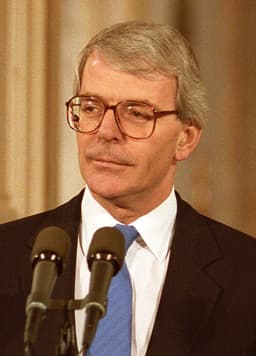
John Major
Politician · Modern
58.0Total

Veluthampi Dalawa
Politician · Modern
47.8Total
Basic Information
Born
1943
1765
Died
—
1809
Era
Modern
Modern
Nationality
United Kingdom
India
Occupation
Politician
Politician
Civilization
Western
Indian
Score Comparison
Military (10%)
50.0
22.6
Political (20%)
72.0
48.0
Influence (20%)
58.0
52.5
Legacy (20%)
50.0
45.0
Leadership (15%)
72.0
65.7
Strategy (15%)
43.7
41.0
TOTAL
58.0
47.8
John Major — Complete Timeline
1991 AD
Negotiated the Maastricht TreatyPolitical Action
Major negotiated the Maastricht Treaty, which created the European Union and established the euro currency. He secured opt-outs for the UK from the single currency and social chapter, a major achievement in European integration.
European UnionTreatyUK Opt-Outs
Impact: globalconstructive
1992 AD
Black WednesdayOther
The UK was forced to withdraw the pound sterling from the European Exchange Rate Mechanism after a speculative attack. The government spent billions trying to defend the currency, a major economic and political failure for Major's government.
Economic CrisisERMCurrency Crisis
Impact: nationaldestructive
Won the 1992 General ElectionPolitical Action◆ Major
Major led the Conservative Party to an unexpected victory in the 1992 general election, winning a majority of 21 seats. This was the Conservatives' fourth consecutive election win, despite predictions of a hung parliament.
General ElectionConservative VictoryPolitical Surprise
Impact: national
1993 AD
Signed the Downing Street DeclarationPolitical Action◆ Major
Major and Irish Taoiseach Albert Reynolds signed the Downing Street Declaration, a joint peace initiative for Northern Ireland. The declaration affirmed the principle of consent and opened the way for peace negotiations.
Northern IrelandPeace ProcessAnglo-Irish Relations
Impact: regionalconstructive
1997 AD
Resigned as Prime MinisterPolitical Action◆ Major
Major resigned as prime minister after the Conservative Party suffered a landslide defeat in the 1997 general election to Tony Blair's Labour Party. The defeat ended 18 years of Conservative government.
General ElectionConservative DefeatPolitical Transition
Impact: nationaltragic
Veluthampi Dalawa — Complete Timeline
1801 AD
Appointment as DalawaPolitical Action◆ Major
Veluthampi Dalawa was appointed as the Diwan (prime minister) of Travancore by the Maharaja. He inherited a state burdened by debts and British interference, and immediately began administrative and financial reforms.
TravancoreDiwanAdministration
Impact: regionalconstructive
1805 AD
Reforms and ResistanceReform◆ Major
Veluthampi Dalawa implemented financial reforms to reduce Travancore's debt to the British East India Company. He also reorganized the army and attempted to reduce British influence, which led to growing tension with the Company.
ReformBritish East India CompanyTravancore
Impact: regionalconstructive
1809 AD
Kundara ProclamationPolitical Action
Veluthampi Dalawa issued the Kundara Proclamation, calling on the people of Travancore to rise against British rule. He denounced British interference and urged resistance, marking the start of an open rebellion.
RebellionBritish East India CompanyKerala
Impact: regional
Defeat and SuicidePolitical Action
After British forces defeated the Travancore army, Veluthampi Dalawa was pursued by Company troops. To avoid capture, he committed suicide at the temple of Mannadi. His death ended the rebellion and solidified British control over Travancore.
DeathBritish East India CompanyRebellion
Impact: regionaltragic
Expert Analysis
Origins
John Major was born on March 29, 1943, in London, into a lower-middle-class family. His father was a former music hall performer and his mother was a homemaker. Major left school at 16 to work, later studying at the London College of Business. He entered banking before turning to politics.
Veluthampi Dalawa was born in 1765 in Thalassery, Kerala, into a Nair family. His father was a lower-level official in the Travancore kingdom. He received traditional education in Malayalam, Sanskrit, and Tamil. He rose through the ranks of the Travancore bureaucracy.
Rise to Power
Major entered Parliament in 1979 as MP for Huntingdon. He held junior ministerial posts, then became Chief Secretary to the Treasury in 1987. In 1989, he was appointed Foreign Secretary, then Chancellor of the Exchequer. In November 1990, after Margaret Thatcher's resignation, Major won the Conservative leadership contest and became Prime Minister at age 47.
Veluthampi Dalawa became Dalawa (prime minister) of Travancore in 1801 after the death of his predecessor. He inherited a state heavily indebted to the British East India Company and under growing British influence. He initially cooperated with the British but grew resentful of their demands.
Leadership & Governance
Major's leadership style was consensual and pragmatic. He negotiated the Maastricht Treaty (1992), which created the European Union and established the euro. He secured opt-outs for the UK from the single currency and social chapter. Domestically, he pursued privatization and public sector reforms. However, his government was plagued by internal divisions over Europe.
Veluthampi Dalawa implemented financial reforms to reduce Travancore's debt, including raising taxes and cutting expenses. He reorganized the army and attempted to assert Travancore's independence. His approach was confrontational, leading to direct conflict with the British. He issued the Kundara Proclamation in 1809, calling for rebellion.
Triumph & Tragedy
Major's greatest triumph was winning the 1992 general election against expectations, securing a 21-seat majority. He also played a key role in the Northern Ireland peace process, signing the Downing Street Declaration in 1993. His tragedy was Black Wednesday (September 16, 1992), when the UK was forced to withdraw the pound from the European Exchange Rate Mechanism, costing billions and damaging his economic credibility. He lost the 1997 election in a landslide to Tony Blair.
Veluthampi Dalawa's triumph was his initial success in rallying Travancore against British dominance, leading to the Kundara Proclamation. His tragedy was the defeat of his forces by the British East India Company in 1809. To avoid capture, he committed suicide at the temple of Bhagavathy in Mannadi. His rebellion ultimately failed.
Character & Destiny
Major was known for his modesty and resilience. He was a pragmatist who sought compromise but was often seen as indecisive. His character shaped his fate: he held his party together through difficult times but could not prevent its eventual defeat. Historians rate his leadership at 72.0, reflecting his steady but uncharismatic style.
Veluthampi Dalawa was determined and patriotic, but also impulsive. His confrontational approach led to a doomed rebellion. His leadership score is 65.7, but his strategy score is only 41.0. His character drove him to resist British domination, but his lack of military and diplomatic strategy led to his downfall.
Legacy
Major's legacy is tied to the Maastricht Treaty and the European Union. His opt-outs shaped the UK's relationship with Europe for decades. He also contributed to the Northern Ireland peace process. His political score is 72.0, influence 58.0, legacy 50.0. He is remembered as a caretaker prime minister who managed a difficult transition.
Veluthampi Dalawa is remembered in Kerala as a martyr who fought against British colonialism. His Kundara Proclamation is seen as an early call for independence. His legacy score is 45.0, influence 52.5. He is celebrated in local folklore and has monuments in his honor, but his national impact is limited.
Conclusion
John Major had a significantly greater impact on world history than Veluthampi Dalawa. Major's total score is 58.0 compared to Veluthampi's 47.8, a gap of 10.2 points. Major's negotiation of the Maastricht Treaty reshaped Europe and the global economy, while his role in Northern Ireland contributed to peace. Veluthampi's rebellion, though brave, was a localized failure that did not alter the course of British colonialism in India. Major's influence on modern international relations far outweighs Veluthampi's regional legacy. Therefore, John Major is the more consequential figure.
Rankings
🥇
John MajorLeader
Mil: 50.0Pol: 72.0Inf: 58.0
58.0
🥈
Veluthampi Dalawa
Mil: 22.6Pol: 48.0Inf: 52.5
47.8
+10.2 behind
How This Comparison Works
Algorithm
Each figure is scored on 6 dimensions (0—100 scale) based on structured historical data: Military (10%), Political (20%), Influence (20%), Legacy (20%), Leadership (15%), Strategy (15%). The weighted total produces the final ranking.
Data Sources
Scores are computed from structured sub-indicators in the database. Scale factors adjust for era (Ancient ×0.85, Modern ×1.0) and civilization size (Eastern ×1.05, Other ×0.80) to account for differences in population and military scale.
Maximum 3 Figures
Comparisons are limited to 2—3 figures to ensure readability and statistical meaningfulness.
Error Margins
±5 points per dimension — Sub-scores are derived from historical records with inherent uncertainty. Two figures within 5 points on a dimension should be considered roughly equivalent in that area.
Total Score Accuracy
±3 points overall — The weighted combination of 6 dimensions produces a total score with approximately ±3 points of uncertainty. Differences of less than 3 points are not statistically significant— the figures are effectively tied.
Known Limitations
- Historical records are incomplete and uneven across civilizations
- Figures from oral-tradition societies may be underrepresented
- Occupation labels can misclassify multi-role figures
- Scores measure capability and impact, not moral character
- Quantitative scoring is a comparison tool, not absolute truth
Capability Radar
Military (10%) — Battles & Warfare
Battles
27
35
Win Rate
29
20
Expansion
36
10
Political (20%) — Governance & Reform
Reform
55
50
Diplomacy
70
30
Economy
50
40
Influence (20%) — Cultural & Global Reach
Cultural
30
30
Global
50
15
Legacy (20%) — Historical Impact
Historical
55
35
Longevity
40
25
Leadership (15%) — Power & Stability
Tenure
65
45
Stability
45
20
Strategy (15%) — Tactics & Innovation
Strategy
39
25
Tactics
43
30
Reform
44
40
Similar Comparisons
Comments & Discussion
No comments yet. Be the first to share your thoughts!