Loading...
Jomo Kenyatta vs Midhat Pasha
Midhat Pasha leads by 6.2 pts · 2 figures compared
…
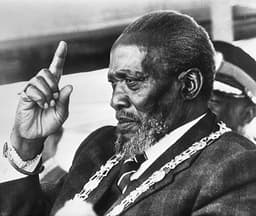
Jomo Kenyatta
Politician · Modern
58.1Total
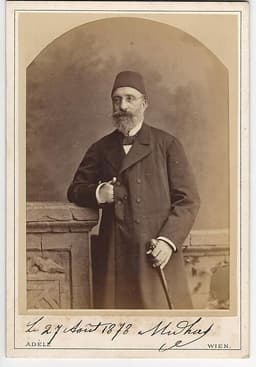
Midhat Pasha
Politician · Modern
64.3Total
Basic Information
Born
1897
1822
Died
1978
1884
Era
Modern
Modern
Nationality
Kenya
Ottoman Empire
Occupation
Politician
Politician
Civilization
Other
Middle Eastern
Score Comparison
Military (10%)
25.9
10.0
Political (20%)
72.0
78.0
Influence (20%)
65.0
82.0
Legacy (20%)
55.0
72.0
Leadership (15%)
72.0
62.0
Strategy (15%)
39.3
38.3
TOTAL
58.1
64.3
Jomo Kenyatta — Complete Timeline
1952 AD
Mau Mau Uprising and DetentionPolitical Action◆ Major
Kenyatta was arrested and tried for his alleged involvement in the Mau Mau rebellion against British rule. He was sentenced to seven years' imprisonment, becoming a symbol of African nationalism. His detention galvanized support for independence.
Mau MauImprisonmentNationalism
Impact: regional
1963 AD
Kenya IndependencePolitical Action
Jomo Kenyatta became the first Prime Minister of independent Kenya after negotiations with British colonial authorities. His leadership marked the end of British rule and the beginning of Kenya's sovereignty, with Kenyatta advocating for racial reconciliation and economic development.
IndependenceDecolonizationPrime Minister
Impact: nationalconstructive
1964 AD
Presidency and One-Party StatePolitical Action◆ Major
Kenyatta became the first President of Kenya and established a de facto one-party state under the Kenya African National Union (KANU). He consolidated power, suppressed opposition, and promoted a capitalist economy, diverging from the socialist paths of other African leaders.
PresidencyOne-Party StateKANU
Impact: national
1965 AD
Land Redistribution PoliciesReform◆ Major
Kenyatta implemented land redistribution programs that transferred large tracts of land from white settlers to Africans. However, the policies favored his political allies and ethnic Kikuyu supporters, leading to land inequality and ethnic tensions that persisted for decades.
Land ReformEthnic PoliticsEconomic Policy
Impact: national
Midhat Pasha — Complete Timeline
1864 AD
Governorship of the Danube VilayetReform◆ Major
As governor of the Danube Vilayet from 1864 to 1868, Midhat Pasha implemented extensive reforms. He built roads, bridges, and schools, established a provincial bank, and promoted agricultural development. His administration became a model for Tanzimat provincial governance.
GovernorshipReformInfrastructure
Impact: regionalconstructive
1872 AD
Appointment as Grand VizierPolitical Action◆ Major
Midhat Pasha was appointed Grand Vizier for the first time in 1872. He had previously served as governor of the Danube Vilayet and was known for his reformist ideas. His tenure was short-lived due to opposition from conservative factions and the sultan.
AppointmentReformOttoman Politics
Impact: nationalconstructive
1876 AD
Proclamation of the Ottoman Constitution of 1876Reform
Midhat Pasha was the chief architect of the first Ottoman Constitution, proclaimed on December 23, 1876. The constitution established a bicameral parliament, guaranteed civil liberties, and limited the sultan's powers. It was a landmark in Ottoman modernization, though it was suspended in 1878.
ConstitutionReformParliament
Impact: nationalprogressive
1881 AD
Exile and TrialPolitical Action◆ Major
Midhat Pasha was arrested in 1881 on charges of involvement in the murder of Sultan Abd
ExileTrialExecution
Impact: nationaltragic
Expert Analysis
Origins
Jomo Kenyatta was born Kamau wa Ngengi around 1891 in Gatundu, British East Africa (now Kenya). He was the son of a Kikuyu farmer and was educated at a Scottish mission school. He later studied at the London School of Economics and University College London, where he became involved in pan-Africanist movements. Midhat Pasha was born Ahmed Şefik in 1822 in Istanbul, Ottoman Empire. His father was a religious judge. He received a traditional Islamic education and entered government service, rising through the ranks due to his administrative skills. While Kenyatta's early life was shaped by colonial subjugation, Midhat's was shaped by the waning Ottoman Empire's need for reform.
Rise to Power
Kenyatta rose to prominence as a leader of the Kenya African Union (KAU) in the 1940s, advocating for African rights. His involvement in the Mau Mau uprising led to his arrest in 1952 and imprisonment until 1961. Despite this, his stature grew, and he became the first Prime Minister of independent Kenya on June 1, 1963. Midhat Pasha rose through administrative posts, becoming governor of the Danube Vilayet in 1864, where he implemented successful reforms. He was appointed Grand Vizier in 1872 and again in 1876, playing a key role in the proclamation of the first Ottoman Constitution on December 23, 1876. His political score of 78.0 reflects his ability to navigate the complex Ottoman court.
Leadership & Governance
Kenyatta's leadership as president from 1964 to 1978 was characterized by consolidation of power. He established a de facto one-party state under KANU, suppressing opposition. His land redistribution policies favored his ethnic Kikuyu group, creating economic disparities. He pursued a capitalist, pro-Western foreign policy. Midhat Pasha, as Grand Vizier, championed constitutionalism and reform. He established a bicameral parliament, guaranteed civil liberties, and modernized the empire's administration. His governance score is 62.0 compared to Kenyatta's 72.0, but Midhat's reforms were more inclusive and institutional.
Triumph & Tragedy
Kenyatta's greatest triumph was leading Kenya to independence and maintaining stability amid ethnic tensions. His tragedy was the entrenchment of authoritarianism and corruption, setting a precedent for future leaders. Midhat Pasha's triumph was the constitution, which limited sultanic power and introduced democracy. His tragedy was his exile and execution in 1884 after being implicated in the death of Sultan Abdülaziz, a charge likely fabricated. His legacy score of 72.0 exceeds Kenyatta's 55.0, indicating a more enduring impact.
Character & Destiny
Kenyatta was pragmatic and authoritarian, using his charisma to build a cult of personality. His decision to centralize power reflected his belief in strong leadership. Midhat Pasha was idealistic and reform-minded, but his naivety in court politics led to his downfall. Historians note that Kenyatta's character was shaped by his detention, making him cautious, while Midhat's optimism drove him to push reforms too quickly.
Legacy
Kenyatta is remembered as the "Father of the Nation" in Kenya, but his legacy is tainted by authoritarianism and land inequality. His influence score of 65.0 reflects his role in decolonization. Midhat Pasha is celebrated as a pioneer of Ottoman constitutionalism, influencing later Turkish reforms. His constitution was short-lived, but it set a precedent. Midhat's overall score of 64.3 surpasses Kenyatta's 58.1, indicating a greater impact on political structures.
Conclusion
While Kenyatta's role in Kenya's independence is significant, Midhat Pasha's constitutional reforms had a broader and more lasting impact on governance. Midhat's higher political score (78.0 vs 72.0) and legacy score (72.0 vs 55.0) demonstrate his greater influence. Kenyatta's authoritarian turn limited his long-term contribution. Midhat Pasha, despite his tragic end, laid the groundwork for modern democratic movements in the Middle East. Therefore, Midhat Pasha had a greater overall impact on political development.
Rankings
🥇
Midhat PashaLeader
Mil: 10.0Pol: 78.0Inf: 82.0
64.3
🥈
Jomo Kenyatta
Mil: 25.9Pol: 72.0Inf: 65.0
58.1
+6.2 behind
How This Comparison Works
Algorithm
Each figure is scored on 6 dimensions (0—100 scale) based on structured historical data: Military (10%), Political (20%), Influence (20%), Legacy (20%), Leadership (15%), Strategy (15%). The weighted total produces the final ranking.
Data Sources
Scores are computed from structured sub-indicators in the database. Scale factors adjust for era (Ancient ×0.85, Modern ×1.0) and civilization size (Eastern ×1.05, Other ×0.80) to account for differences in population and military scale.
Maximum 3 Figures
Comparisons are limited to 2—3 figures to ensure readability and statistical meaningfulness.
Error Margins
±5 points per dimension — Sub-scores are derived from historical records with inherent uncertainty. Two figures within 5 points on a dimension should be considered roughly equivalent in that area.
Total Score Accuracy
±3 points overall — The weighted combination of 6 dimensions produces a total score with approximately ±3 points of uncertainty. Differences of less than 3 points are not statistically significant— the figures are effectively tied.
Known Limitations
- Historical records are incomplete and uneven across civilizations
- Figures from oral-tradition societies may be underrepresented
- Occupation labels can misclassify multi-role figures
- Scores measure capability and impact, not moral character
- Quantitative scoring is a comparison tool, not absolute truth
Capability Radar
Military (10%) — Battles & Warfare
Battles
20
0
Win Rate
26
0
Expansion
24
0
Political (20%) — Governance & Reform
Reform
65
85
Diplomacy
70
70
Economy
55
60
Influence (20%) — Cultural & Global Reach
Cultural
65
55
Global
55
55
Legacy (20%) — Historical Impact
Historical
70
70
Longevity
60
60
Leadership (15%) — Power & Stability
Tenure
60
65
Stability
50
40
Strategy (15%) — Tactics & Innovation
Strategy
33
0
Tactics
34
0
Reform
38
10
Similar Comparisons
Comments & Discussion
No comments yet. Be the first to share your thoughts!