Loading...
Joseph Arthur Ankrah vs Yue Zhongqi
Yue Zhongqi leads by 15.3 pts · 2 figures compared
…
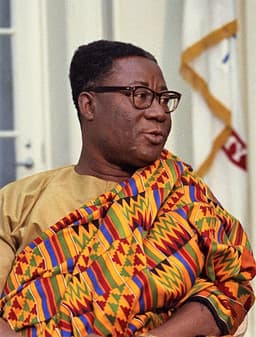
Joseph Arthur Ankrah
General · Modern
41.5Total

Yue Zhongqi
General · Modern
56.8Total
Basic Information
Born
1915
1686
Died
1992
1754
Era
Modern
Modern
Nationality
Ghana
China
Occupation
General
General
Civilization
Other
Eastern
Score Comparison
Military (10%)
10.2
67.5
Political (20%)
46.6
54.7
Influence (20%)
48.6
54.9
Legacy (20%)
40.0
46.7
Leadership (15%)
55.3
71.0
Strategy (15%)
30.3
57.5
TOTAL
41.5
56.8
Joseph Arthur Ankrah — Complete Timeline
1966 AD
Appointment as Chairman of the National Liberation CouncilPolitical Action◆ Major
After the coup that overthrew Kwame Nkrumah, Ankrah was appointed Chairman of the National Liberation Council (NLC), Ghana's military government. He led the country during the transition from Nkrumah's rule.
Military GovernmentCoupNLC
Impact: national
1969 AD
Resignation due to corruption scandalPolitical Action◆ Major
Ankrah resigned as NLC Chairman after a scandal involving funds from a Nigerian businessman. The scandal undermined the NLC's credibility and led to his replacement by Akwasi Afrifa.
CorruptionResignationScandal
Impact: nationaldestructive
Yue Zhongqi — Complete Timeline
1720 AD
Campaign in TibetWar◆ Major
Yue Zhongqi led Qing forces into Tibet to expel the Dzungar invaders. The campaign successfully restored Qing control over Lhasa and installed the 7th Dalai Lama, solidifying Qing influence in Tibet for decades.
TibetDzungar-Qing WarExpedition
Impact: regional
1731 AD
Battle of Khalkha RiverWar
Yue Zhongqi commanded Qing forces against the Dzungars at the Khalkha River. The battle ended in a Qing defeat, leading to Yue's recall and temporary loss of command due to perceived failure.
Dzungar-Qing WarBattleDefeat
Impact: regionaltragic
Expert Analysis
Origins
Joseph Arthur Ankrah was born on August 18, 1915, in Accra, Gold Coast (now Ghana). He was the son of a Methodist catechist. He attended the Government Boys School and later the Accra Academy. He joined the Gold Coast Regiment of the Royal West African Frontier Force in 1939, serving in World War II. After the war, he rose through the ranks, becoming a lieutenant in 1947 and a captain in 1952. He served in the Congo as part of the UN peacekeeping force in 1960.
Yue Zhongqi was born in 1686 in Gansu, China, into a military family. He was a 21st-generation descendant of the Song dynasty general Yue Fei. His father, Yue Shenglong, was a Qing general. Yue Zhongqi began his military career as a young officer, serving in the border campaigns against the Dzungars. He was known for his physical strength and archery skills, and he quickly rose through the ranks due to his family connections and personal abilities.
Rise to Power
Ankrah's rise to power came through the 1966 military coup that overthrew President Kwame Nkrumah. On February 24, 1966, while Nkrumah was visiting China and North Vietnam, the military and police seized power. Ankrah, then a major general, was appointed Chairman of the National Liberation Council (NLC), the new military government. His appointment was partly due to his reputation as a moderate and his lack of close ties to Nkrumah.
Yue Zhongqi's rise was more gradual. He gained prominence during the Qing campaigns against the Dzungar Khanate. In 1715, he served under General Fu'an in the Battle of Khalkha River, where the Qing suffered a defeat. However, Yue's performance was noted, and he was promoted. In 1720, he was appointed commander of a force sent to Tibet to expel the Dzungars. This campaign successfully restored Qing control over Lhasa in 1720 and installed the 7th Dalai Lama. Yue was rewarded with the title of 'General Who Pacifies the West' and appointed commander of the Sichuan-Yunnan border region.
Leadership & Governance
Ankrah led the NLC as a collective body, with a focus on restoring civilian rule. The NLC's governance was characterized by austerity measures, anti-corruption campaigns, and a return to pro-Western foreign policy. Ankrah's leadership style was cautious and consensus-driven. He scored 55.3 in leadership, reflecting his ability to maintain order but limited vision. Under his rule, Ghana's economy struggled with debt and inflation, and the NLC failed to address structural issues.
Yue Zhongqi was a hands-on military commander. He scored 71.0 in leadership, indicating strong command presence. He was known for his discipline and tactical acumen. As governor of Sichuan, he implemented agricultural policies to boost food production and maintain border security. However, his governance was marred by factional conflicts at the Qing court. He was involved in a power struggle with Nian Gengyao, another general, and was eventually purged after Nian's fall.
Triumph & Tragedy
Ankrah's greatest success was overseeing a peaceful transition back to civilian rule in 1969, after the NLC handed power to a democratically elected government. He also maintained stability in Ghana during a turbulent period. However, his tenure was marred by the corruption scandal that forced his resignation in 1969. Ankrah was implicated in accepting bribes from a Nigerian businessman, which undermined the NLC's legitimacy and led to his resignation.
Yue Zhongqi's triumph was the successful campaign in Tibet, which secured Qing control and stabilized the region. He also suppressed rebellions in Sichuan and Yunnan. However, his tragedy was the defeat at the Battle of Khalkha River in 1715, which led to his temporary recall and demotion. Later, he was caught in the political purge of Nian Gengyao in 1725, was stripped of his titles, and exiled. He died in 1754 in obscurity.
Character & Destiny
Ankrah was an amiable and honest man, but he lacked the ruthlessness to maintain power. His integrity was compromised by the corruption scandal, which reflected poorly on his judgment. He scored 46.6 in political acumen, indicating he was not adept at navigating political intrigues. His destiny was to be a transitional figure, overshadowed by more forceful leaders.
Yue Zhongqi was a prideful and ambitious general, driven by his family legacy. He was a capable commander but politically naive. His involvement in court factions led to his downfall. He scored 54.7 in politics, showing moderate political skill. His destiny was to be a victim of Qing court politics, despite his military achievements.
Legacy
Ankrah's legacy is mixed. He is remembered as the head of Ghana's first successful military coup, but his regime is seen as a period of stagnation. The NLC's return to civilian rule is a positive aspect, but the precedent of military intervention in politics was set. He scored 40.0 in legacy, reflecting limited long-term impact.
Yue Zhongqi's legacy is more enduring. He is celebrated as a national hero in China, especially for his role in securing Tibet. His military strategies are studied, and his connection to Yue Fei adds to his fame. He scored 46.7 in legacy, but his influence on Qing expansion is significant. However, his defeat at Khalkha River is often overlooked.
Conclusion
Yue Zhongqi had greater impact than Joseph Arthur Ankrah. Yue's military campaigns directly shaped Qing China's borders and stabilized Tibet, with effects lasting centuries. Ankrah's governance was brief and left Ghana with a legacy of instability. Yue scores higher overall (56.8 vs 41.5) and in key areas like military (67.5 vs 10.2) and leadership (71.0 vs 55.3). While both faced failures, Yue's triumphs were more consequential. Therefore, Yue Zhongqi is the more significant historical figure.
Rankings
🥇
Yue ZhongqiLeader
Mil: 67.5Pol: 54.7Inf: 54.9
56.8
🥈
Joseph Arthur Ankrah
Mil: 10.2Pol: 46.6Inf: 48.6
41.5
+15.3 behind
How This Comparison Works
Algorithm
Each figure is scored on 6 dimensions (0—100 scale) based on structured historical data: Military (10%), Political (20%), Influence (20%), Legacy (20%), Leadership (15%), Strategy (15%). The weighted total produces the final ranking.
Data Sources
Scores are computed from structured sub-indicators in the database. Scale factors adjust for era (Ancient ×0.85, Modern ×1.0) and civilization size (Eastern ×1.05, Other ×0.80) to account for differences in population and military scale.
Maximum 3 Figures
Comparisons are limited to 2—3 figures to ensure readability and statistical meaningfulness.
Error Margins
±5 points per dimension — Sub-scores are derived from historical records with inherent uncertainty. Two figures within 5 points on a dimension should be considered roughly equivalent in that area.
Total Score Accuracy
±3 points overall — The weighted combination of 6 dimensions produces a total score with approximately ±3 points of uncertainty. Differences of less than 3 points are not statistically significant— the figures are effectively tied.
Known Limitations
- Historical records are incomplete and uneven across civilizations
- Figures from oral-tradition societies may be underrepresented
- Occupation labels can misclassify multi-role figures
- Scores measure capability and impact, not moral character
- Quantitative scoring is a comparison tool, not absolute truth
Capability Radar
Military (10%) — Battles & Warfare
Battles
5
65
Win Rate
5
60
Expansion
5
55
Political (20%) — Governance & Reform
Reform
40
30
Diplomacy
30
45
Economy
30
35
Influence (20%) — Cultural & Global Reach
Cultural
10
35
Global
10
25
Legacy (20%) — Historical Impact
Historical
20
40
Longevity
10
30
Leadership (15%) — Power & Stability
Tenure
30
50
Stability
20
40
Strategy (15%) — Tactics & Innovation
Strategy
10
60
Tactics
10
55
Reform
20
30
Similar Comparisons
Comments & Discussion
No comments yet. Be the first to share your thoughts!