Loading...
This comparison has not been analyzed yet.
One-time AI generation (~1 minute). Scores and timeline are already available below.
Joseph Boakai vs Ong Ye Kung
Joseph Boakai leads by 0.5 pts · 2 figures compared
…

Joseph Boakai
Politician · Modern
47.8Total
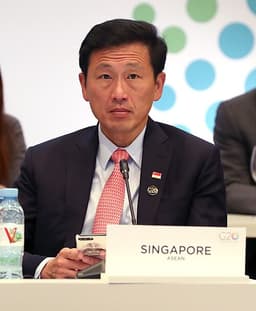
Ong Ye Kung
Politician · Modern
47.3Total
Basic Information
Born
1944
1969
Died
—
—
Era
Modern
Modern
Nationality
Liberia
Singapore
Occupation
Politician
Politician
Civilization
Other
Eastern
Score Comparison
Military (10%)
24.0
13.9
Political (20%)
61.3
53.8
Influence (20%)
49.4
49.4
Legacy (20%)
40.8
39.2
Leadership (15%)
64.0
79.8
Strategy (15%)
40.9
36.8
TOTAL
47.8
47.3
Joseph Boakai — Complete Timeline
2006 AD
Service as Vice President of LiberiaPolitical Action◆ Major
Boakai served as Vice President under President Ellen Johnson Sirleaf from 2006 to 2018. During his tenure, he oversaw post-war reconstruction efforts and helped stabilize Liberia's economy after the civil wars.
Vice PresidencyPost-warReconstruction
Impact: nationalconstructive
2023 AD
Election as President of LiberiaPolitical Action◆ Major
Joseph Boakai defeated incumbent President George Weah in the 2023 Liberian presidential election runoff, winning 50.6% of the vote. Boakai, a veteran politician and former vice president, campaigned on promises to fight corruption and improve infrastructure.
ElectionLiberiaPresidency
Impact: nationalconstructive
Ong Ye Kung — Complete Timeline
2011 AD
Elected to Parliament for Sembawang GRCPolitical Action
Ong Ye Kung was first elected to Parliament as a Member of Parliament for Sembawang GRC. This marked the start of his political career in the People's Action Party.
ElectionParliamentPAP
constructive
2015 AD
Appointed Minister for EducationPolitical Action◆ Major
Ong Ye Kung was appointed Minister for Education (Higher Education and Skills), overseeing the university and polytechnic sectors. He promoted lifelong learning and skills upgrading.
EducationHigher EducationSkills
Impact: nationalconstructive
2018 AD
Appointed Minister for TransportPolitical Action◆ Major
Ong was appointed Minister for Transport, overseeing Singapore's transport infrastructure. He oversaw the expansion of the MRT network and the implementation of the 'Walk Cycle Ride' vision.
TransportInfrastructureSingapore
Impact: nationalconstructive
2021 AD
Appointed Minister for HealthPolitical Action◆ Major
Ong Ye Kung was appointed Minister for Health, overseeing Singapore's healthcare system. He managed the later stages of the COVID-19 pandemic, including the transition to endemic living and healthcare reforms.
HealthCOVID-19Healthcare
Impact: nationalconstructive
This comparison has not been analyzed yet.
One-time AI generation (~1 minute). Scores and timeline are already available below.
Rankings
🥇
Joseph BoakaiLeader
Mil: 24.0Pol: 61.3Inf: 49.4
47.8
🥈
Ong Ye Kung
Mil: 13.9Pol: 53.8Inf: 49.4
47.3
+0.5 behind
How This Comparison Works
Algorithm
Each figure is scored on 6 dimensions (0—100 scale) based on structured historical data: Military (10%), Political (20%), Influence (20%), Legacy (20%), Leadership (15%), Strategy (15%). The weighted total produces the final ranking.
Data Sources
Scores are computed from structured sub-indicators in the database. Scale factors adjust for era (Ancient ×0.85, Modern ×1.0) and civilization size (Eastern ×1.05, Other ×0.80) to account for differences in population and military scale.
Maximum 3 Figures
Comparisons are limited to 2—3 figures to ensure readability and statistical meaningfulness.
Error Margins
±5 points per dimension — Sub-scores are derived from historical records with inherent uncertainty. Two figures within 5 points on a dimension should be considered roughly equivalent in that area.
Total Score Accuracy
±3 points overall — The weighted combination of 6 dimensions produces a total score with approximately ±3 points of uncertainty. Differences of less than 3 points are not statistically significant— the figures are effectively tied.
Known Limitations
- Historical records are incomplete and uneven across civilizations
- Figures from oral-tradition societies may be underrepresented
- Occupation labels can misclassify multi-role figures
- Scores measure capability and impact, not moral character
- Quantitative scoring is a comparison tool, not absolute truth
Capability Radar
Military (10%) — Battles & Warfare
Battles
21
16
Win Rate
22
15
Expansion
27
20
Political (20%) — Governance & Reform
Reform
40
60
Diplomacy
55
55
Economy
35
60
Influence (20%) — Cultural & Global Reach
Cultural
20
20
Global
15
15
Legacy (20%) — Historical Impact
Historical
25
20
Longevity
20
15
Leadership (15%) — Power & Stability
Tenure
45
65
Stability
30
65
Strategy (15%) — Tactics & Innovation
Strategy
32
23
Tactics
35
24
Reform
36
28
Similar Comparisons
Comments & Discussion
No comments yet. Be the first to share your thoughts!