Loading...
Joseph Joffre vs Li Zongren
Joseph Joffre leads by 6.3 pts · 2 figures compared
…

Joseph Joffre
General · Modern
64.8Total
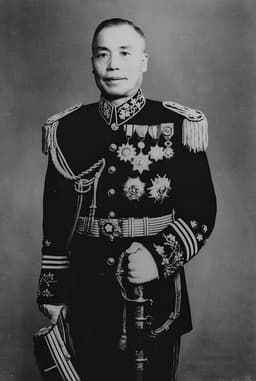
Li Zongren
General · Modern
58.5Total
Basic Information
Born
1852
1890
Died
1931
1969
Era
Modern
Modern
Nationality
France
China
Occupation
General
General
Civilization
Western
Eastern
Score Comparison
Military (10%)
65.0
65.0
Political (20%)
62.7
53.8
Influence (20%)
82.0
58.0
Legacy (20%)
52.0
52.0
Leadership (15%)
62.0
72.0
Strategy (15%)
61.2
56.8
TOTAL
64.8
58.5
Joseph Joffre — Complete Timeline
1914 AD
First Battle of the MarneWar
As Commander-in-Chief of the French Army, Joffre oversaw the French retreat and then the counterattack at the First Battle of the Marne. The victory saved Paris and prevented a quick German victory in the West.
World War IWestern FrontVictory
Impact: global
Battle of the FrontiersWar◆ Major
Joffre launched the Battle of the Frontiers, a series of French offensives into Alsace-Lorraine and Belgium. The attacks failed with heavy casualties, exposing flaws in French war planning and leading to the German advance.
World War IWestern FrontOffensive
Impact: regional
1916 AD
Replaced as Commander-in-ChiefPolitical Action◆ Major
Joffre was replaced as Commander-in-Chief of the French Army due to the heavy losses at Verdun and the Somme, and political criticism. He was promoted to Marshal of France but given a largely ceremonial role.
World War ICommandDismissal
Impact: national
Li Zongren — Complete Timeline
1921 AD
Command of the Guangxi ArmyPolitical Action◆ Major
Li Zongren became a commander in the Guangxi Army and helped unify Guangxi province under the New Guangxi Clique. He established a powerful regional base that rivaled other warlords.
Guangxi CliqueMilitary CommandWarlord Era
Impact: regional
1926 AD
Alliance with the Nationalist GovernmentPolitical Action◆ Major
Li Zongren allied the Guangxi Clique with Chiang Kai-shek's Nationalist government during the Northern Expedition. His forces played a key role in defeating warlords and unifying China under KMT rule.
Northern ExpeditionAllianceKMT
Impact: nationalconstructive
1938 AD
Battle of TaierzhuangWar
Li Zongren commanded Chinese forces to a major victory over the Japanese at the Battle of Taierzhuang during the Second Sino-Japanese War. This was the first significant Chinese victory of the war and boosted national morale.
Second Sino-Japanese WarBattleVictory
Impact: nationalconstructive
1949 AD
Acting Presidency of the Republic of ChinaPolitical Action◆ Major
Li Zongren served as Acting President of the Republic of China after Chiang Kai-shek's resignation during the Chinese Civil War. He attempted to negotiate peace with the Communists but failed, leading to the KMT's retreat to Taiwan.
Chinese Civil WarPresidencyKMT
Impact: nationaltragic
Exile to the United StatesPolitical Action
After the Communist victory, Li Zongren fled to the United States, where he lived in exile. He criticized Chiang Kai-shek's leadership and advocated for a reformed KMT, but remained politically marginalized.
ExileChinese Civil WarPolitics
Impact: nationaltragic
Expert Analysis
Origins
Joseph Joffre was born on January 12, 1852, in Rivesaltes, France, into a family of wine merchants. He graduated from the École Polytechnique in 1873 and served in the Franco-Prussian War. Li Zongren was born on August 13, 1890, in Guilin, Guangxi, China, into a farming family. He studied at the Guangxi Military Academy and joined the Nationalist Revolution.
Rise to Power
Joffre rose through the French colonial service, serving in West Africa and Madagascar. In 1911, he was appointed Chief of the General Staff and then Commander-in-Chief of the French Army in 1914. His calm demeanor during the German invasion earned him trust. Li Zongren became a leader of the New Guangxi Clique after unifying Guangxi province in the 1920s. He allied with Chiang Kai-shek during the Northern Expedition (1926-1928), commanding the 7th Army and defeating warlords.
Leadership & Governance
Joffre's leadership was characterized by steady nerves and organizational skill. He orchestrated the French retreat and counterattack at the Marne in September 1914, using rail networks to move troops. However, his offensives in 1915 (Artois, Champagne) and the Battle of the Frontiers (August 1914) resulted in heavy casualties—over 300,000 in the first month. Li Zongren governed Guangxi with pragmatic reforms, improving infrastructure and education. He maintained regional autonomy while cooperating with the Nationalist government. His military style emphasized mobile defense and local initiative.
Triumph & Tragedy
Joffre's greatest triumph was the First Battle of the Marne (September 5-12, 1914), where his decision to counterattack saved Paris and shattered the German Schlieffen Plan. His score for strategy is 61.2, reflecting mixed results. His tragedy was the stalemate of trench warfare and the costly failures at Verdun (1916) and the Somme, leading to his replacement in December 1916. Li Zongren's triumph was the Battle of Taierzhuang (March-April 1938), China's first major victory against Japan, where he encircled and defeated the Japanese 10th Division. His tragedy was the failure of his peace negotiations with the Communists as acting president in 1949, leading to exile.
Character & Destiny
Joffre was known for his imperturbable calm, earning the nickname 'Papa Joffre.' He rarely smiled and was a methodical planner. His character suited the defensive battles of 1914 but not the attritional warfare that followed. Li Zongren was charismatic and politically astute, but his regional power base limited his national influence. He scored 72.0 in leadership, higher than Joffre's 62.0, reflecting his ability to command loyalty. However, his political score of 53.8 was lower than Joffre's 62.7.
Legacy
Joffre's legacy is tied to the Marne victory, which made him a national hero. He was promoted to Marshal of France in 1916. His name is on streets and monuments, but his strategic reputation declined as the war's costs were realized. Li Zongren is remembered in China as a patriotic general who won at Taierzhuang. His role as acting president is less celebrated. Both have legacy scores of 52.0, indicating limited long-term impact.
Conclusion
Joseph Joffre had greater impact due to his decisive role in World War I. His Marne victory altered the course of the war and saved France from immediate defeat. Li Zongren's Taierzhuang victory was significant but did not change the overall outcome of the Sino-Japanese War. Joffre's total score of 64.8 surpasses Li's 58.5, reflecting his higher influence (82.0 vs. 58.0). While Li was a capable commander, Joffre's actions had global consequences. Thus, Joffre's impact was greater.
Rankings
🥇
Joseph JoffreLeader
Mil: 65.0Pol: 62.7Inf: 82.0
64.8
🥈
Li Zongren
Mil: 65.0Pol: 53.8Inf: 58.0
58.5
+6.3 behind
How This Comparison Works
Algorithm
Each figure is scored on 6 dimensions (0—100 scale) based on structured historical data: Military (10%), Political (20%), Influence (20%), Legacy (20%), Leadership (15%), Strategy (15%). The weighted total produces the final ranking.
Data Sources
Scores are computed from structured sub-indicators in the database. Scale factors adjust for era (Ancient ×0.85, Modern ×1.0) and civilization size (Eastern ×1.05, Other ×0.80) to account for differences in population and military scale.
Maximum 3 Figures
Comparisons are limited to 2—3 figures to ensure readability and statistical meaningfulness.
Error Margins
±5 points per dimension — Sub-scores are derived from historical records with inherent uncertainty. Two figures within 5 points on a dimension should be considered roughly equivalent in that area.
Total Score Accuracy
±3 points overall — The weighted combination of 6 dimensions produces a total score with approximately ±3 points of uncertainty. Differences of less than 3 points are not statistically significant— the figures are effectively tied.
Known Limitations
- Historical records are incomplete and uneven across civilizations
- Figures from oral-tradition societies may be underrepresented
- Occupation labels can misclassify multi-role figures
- Scores measure capability and impact, not moral character
- Quantitative scoring is a comparison tool, not absolute truth
Capability Radar
Military (10%) — Battles & Warfare
Battles
75
65
Win Rate
70
60
Expansion
40
60
Political (20%) — Governance & Reform
Reform
50
45
Diplomacy
60
60
Economy
45
40
Influence (20%) — Cultural & Global Reach
Cultural
50
40
Global
60
40
Legacy (20%) — Historical Impact
Historical
70
55
Longevity
55
45
Leadership (15%) — Power & Stability
Tenure
55
55
Stability
55
35
Strategy (15%) — Tactics & Innovation
Strategy
80
68
Tactics
65
70
Reform
60
55
Similar Comparisons
Comments & Discussion
No comments yet. Be the first to share your thoughts!