Loading...
Joseph Muscat vs Tarō Asō
Joseph Muscat leads by 4.9 pts · 2 figures compared
…
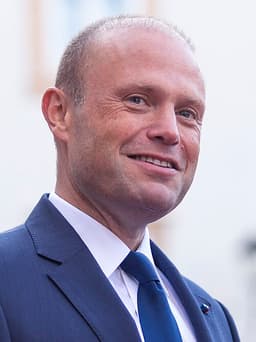
Joseph Muscat
Politician · Modern
50.5Total

Tarō Asō
Politician · Modern
45.6Total
Basic Information
Born
1974
1940
Died
—
—
Era
Modern
Modern
Nationality
Malta
Japan
Occupation
Politician
Politician
Civilization
Western
Eastern
Score Comparison
Military (10%)
46.3
11.7
Political (20%)
61.3
68.0
Influence (20%)
52.5
53.3
Legacy (20%)
40.0
41.7
Leadership (15%)
62.2
53.2
Strategy (15%)
42.1
25.1
TOTAL
50.5
45.6
Joseph Muscat — Complete Timeline
2013 AD
Elected Prime Minister of MaltaPolitical Action◆ Major
Muscat became Prime Minister of Malta in March 2013, leading the Labour Party to a landslide victory. His campaign focused on economic growth, anti-corruption, and social liberalization.
ElectionPolitical Change
Impact: national
2014 AD
Introduced the Individual Investor Programme (IIP)Political Action◆ Major
Muscat's government launched the Individual Investor Programme, selling Maltese citizenship for a
Citizenship by InvestmentEconomic Policy
Impact: nationalconstructive
2017 AD
Re-elected Prime MinisterPolitical Action◆ Major
Muscat won a second term in the 2017 snap election, called after a scandal involving his wife's Panama company. His Labour Party increased its majority, despite the controversy.
ElectionRe-election
Impact: national
Murder of Daphne Caruana GaliziaOther
Investigative journalist Daphne Caruana Galizia was assassinated by a car bomb on October 16, 2017. She had been investigating corruption involving Muscat's associates, leading to a major political crisis and allegations of a cover-up.
AssassinationJournalismCorruption
Impact: nationaltragic
2020 AD
Resigned as Prime MinisterPolitical Action◆ Major
Muscat resigned as Prime Minister in January 2020, following months of protests over the Caruana Galizia murder investigation. His resignation came after the arrest of businessman Yorgen Fenech, who was implicated in the murder.
ResignationPolitical Crisis
Impact: nationaltragic
Tarō Asō — Complete Timeline
2008 AD
Elected Prime Minister of JapanPolitical Action◆ Major
Asō was elected as Prime Minister of Japan after winning the LDP leadership election. He succeeded Yasuo Fukuda and formed a cabinet during the global financial crisis.
JapanPrime MinisterLDP
Impact: national
2009 AD
Implemented economic stimulus packageReform◆ Major
Asō's government enacted a 15.4 trillion yen economic stimulus package to combat the global financial crisis. The measures included cash handouts to households, tax cuts, and public works spending.
JapanEconomic StimulusFinancial Crisis
Impact: nationalconstructive
Lost general election to DPJPolitical Action◆ Major
Asō's LDP suffered a historic defeat in the 2009 general election, losing to the Democratic Party of Japan. This ended the LDP's nearly unbroken 54-year hold on power, and Asō resigned as party leader.
JapanElectionLDP Defeat
Impact: nationaltragic
2012 AD
Appointed Deputy Prime Minister and Finance MinisterPolitical Action◆ Major
Asō was appointed Deputy Prime Minister and Minister of Finance under Prime Minister Shinzo Abe. He served in this role from 2012 to 2021, implementing Abenomics policies including aggressive monetary easing and fiscal stimulus.
JapanFinance MinisterAbenomics
Impact: national
Expert Analysis
Origins
Joseph Muscat was born on January 22, 1974, in Pietà, Malta, into a working-class family. He studied management and public policy at the University of Malta, later earning a PhD in management from the University of Bristol. His early career included work as a journalist and consultant. Tarō Asō was born on September 20, 1940, in Fukuoka, Japan, into a prominent political family; his grandfather was Prime Minister Shigeru Yoshida, and his father was a businessman and politician. He studied at Gakushuin University and later at Stanford University, but did not graduate. He worked in the family mining business before entering politics.
Rise to Power
Muscat became leader of the Labour Party in 2008, modernizing its platform. He won the 2013 general election, becoming Prime Minister of Malta on March 11, 2013, with a focus on economic growth and anti-corruption. His government introduced the Individual Investor Programme (IIP) in 2014, selling citizenship for €650,000, which generated significant revenue. Asō was first elected to the Diet in 1979. He held various cabinet posts, including Minister of Internal Affairs and Minister of Economic Planning. He became Prime Minister of Japan on September 24, 2008, after winning the Liberal Democratic Party (LDP) leadership election, succeeding Yasuo Fukuda during the global financial crisis.
Leadership & Governance
Muscat's leadership style was populist and centralizing. He pursued economic liberalization, including tax cuts and privatization, and the IIP boosted the economy but drew criticism for enabling corruption. His government faced accusations of cronyism and lack of transparency. Asō's governance was more bureaucratic and conservative. As PM, he enacted a 15.4 trillion yen stimulus package (about 5% of GDP) with cash handouts and infrastructure spending. He also promoted fiscal consolidation, but his approval ratings fell due to perceived insensitivity and policy missteps. Later, as Finance Minister under Abe (2012-2021), he supported Abenomics, including aggressive monetary easing and fiscal stimulus.
Triumph & Tragedy
Muscat's triumphs include overseeing strong economic growth, with GDP per capita rising from €16,400 in 2013 to €22,500 in 2019, and reducing unemployment to under 4%. However, his tragedy was the assassination of journalist Daphne Caruana Galizia on October 16, 2017, who had exposed corruption in his administration. The subsequent investigation revealed links to his chief of staff and other officials, leading to mass protests and his resignation on January 13, 2020. His legacy is tarnished by this scandal. Asō's triumph was his role in Japan's economic policy as Finance Minister, contributing to the longest post-war economic expansion (2012-2019). His tragedy was his brief premiership: he lost the 2009 general election to the Democratic Party of Japan, ending the LDP's 54-year rule. His approval rating fell to 17% before the election, and his government's stimulus package was criticized as insufficient.
Character & Destiny
Muscat was charismatic and media-savvy, but his centralization of power and tolerance of corruption led to his downfall. His political score of 61.3 reflects initial success but eventual failure. Asō was seen as a fiscal conservative with a blunt speaking style, often making gaffes. His strategic score of 25.1 indicates poor political judgment, yet his loyalty and longevity in Abe's cabinet show resilience. His leadership score of 53.2 is moderate, reflecting a mixed record.
Legacy
Muscat's legacy is dominated by the Caruana Galizia murder and the IIP, which raised over €1 billion but damaged Malta's reputation. The rule of law in Malta remains under question. Asō's legacy is tied to Abenomics and Japan's economic policies; his tenure as Finance Minister saw the Bank of Japan's quantitative easing and negative interest rates. He also contributed to the Trans-Pacific Partnership negotiations. His overall influence score of 53.3 is higher than Muscat's 52.5, but Muscat's total score of 50.5 edges Asō's 45.6.
Conclusion
Joseph Muscat had a higher impact in a shorter time, transforming Malta's economy but leaving a corrosive legacy of corruption. Tarō Asō had a longer, more stable career but less dramatic impact. While Muscat's political score (61.3) exceeds Asō's (68.0) in terms of effectiveness, Asō's influence (53.3) and legacy (41.7) are comparable. However, Muscat's scandal-ridden departure and damage to democratic institutions make Asō's more durable, albeit less flashy, contributions more positive overall. Therefore, Asō had greater lasting impact through his economic stewardship.
Rankings
🥇
Joseph MuscatLeader
Mil: 46.3Pol: 61.3Inf: 52.5
50.5
🥈
Tarō Asō
Mil: 11.7Pol: 68.0Inf: 53.3
45.6
+4.9 behind
How This Comparison Works
Algorithm
Each figure is scored on 6 dimensions (0—100 scale) based on structured historical data: Military (10%), Political (20%), Influence (20%), Legacy (20%), Leadership (15%), Strategy (15%). The weighted total produces the final ranking.
Data Sources
Scores are computed from structured sub-indicators in the database. Scale factors adjust for era (Ancient ×0.85, Modern ×1.0) and civilization size (Eastern ×1.05, Other ×0.80) to account for differences in population and military scale.
Maximum 3 Figures
Comparisons are limited to 2—3 figures to ensure readability and statistical meaningfulness.
Error Margins
±5 points per dimension — Sub-scores are derived from historical records with inherent uncertainty. Two figures within 5 points on a dimension should be considered roughly equivalent in that area.
Total Score Accuracy
±3 points overall — The weighted combination of 6 dimensions produces a total score with approximately ±3 points of uncertainty. Differences of less than 3 points are not statistically significant— the figures are effectively tied.
Known Limitations
- Historical records are incomplete and uneven across civilizations
- Figures from oral-tradition societies may be underrepresented
- Occupation labels can misclassify multi-role figures
- Scores measure capability and impact, not moral character
- Quantitative scoring is a comparison tool, not absolute truth
Capability Radar
Military (10%) — Battles & Warfare
Battles
32
14
Win Rate
35
19
Expansion
36
20
Political (20%) — Governance & Reform
Reform
35
45
Diplomacy
45
50
Economy
50
55
Influence (20%) — Cultural & Global Reach
Cultural
20
20
Global
25
30
Legacy (20%) — Historical Impact
Historical
25
25
Longevity
15
15
Leadership (15%) — Power & Stability
Tenure
40
60
Stability
20
40
Strategy (15%) — Tactics & Innovation
Strategy
37
26
Tactics
38
23
Reform
46
31
Similar Comparisons
Comments & Discussion
No comments yet. Be the first to share your thoughts!