Loading...
This comparison has not been analyzed yet.
One-time AI generation (~1 minute). Scores and timeline are already available below.
Jovian vs Tai Jia of Shang
Jovian leads by 0.5 pts · 2 figures compared
…

Jovian
Emperor · Ancient
36.6Total
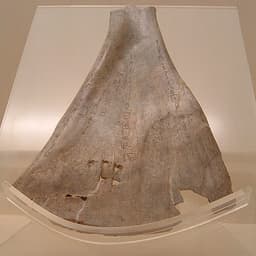
Tai Jia of Shang
Emperor · Ancient
36.1Total
Basic Information
Born
331
-1600
Died
364
-1580
Era
Ancient
Ancient
Nationality
Roman Empire
Shang China
Occupation
Emperor
Emperor
Civilization
Western
Eastern
Score Comparison
Military (10%)
22.6
10.2
Political (20%)
27.9
26.4
Influence (20%)
45.5
45.5
Legacy (20%)
35.8
38.3
Leadership (15%)
39.0
38.1
Strategy (15%)
39.6
45.0
TOTAL
36.6
36.1
Jovian — Complete Timeline
363 AD
Restoration of ChristianityReform◆ Major
Jovian issued edicts restoring privileges to the Christian church that had been revoked by Julian. He recalled Christian bishops from exile and returned confiscated property. This reestablished Nicene Christianity as the favored religion of the Roman state.
ChristianityReligious PolicyRoman Empire
Impact: regionalconstructive
Election as Roman EmperorPolitical Action◆ Major
After the death of Emperor Julian during his Persian campaign, the Roman army elected Jovian, the commander of the imperial guard, as emperor. Jovian was a Christian, reversing Julian's pagan revival and restoring Christianity's favored status.
Imperial ElectionChristianityRoman Empire
Impact: regionalconstructive
Treaty of 363 with Shapur IIPolitical Action◆ Major
Stranded deep in Persian territory after Julian's failed invasion, Jovian negotiated a humiliating peace treaty with Shapur II. He ceded five Roman provinces east of the Tigris, including Nisibis and Singara, and abandoned Roman allies in Armenia.
TreatyRoman-Persian WarsTerritorial Loss
Impact: regionaldestructive
364 AD
Death from carbon monoxide poisoningOther◆ Major
Jovian died suddenly in his tent at Dadastana in Bithynia, likely from carbon monoxide poisoning caused by a charcoal brazier used for heating. His reign lasted only eight months. His unexpected death created a power vacuum and led to the election of Valentinian I.
DeathAccidentRoman Empire
Impact: regionaltragic
Tai Jia of Shang — Complete Timeline
1598 BC
Exile by Yi YinPolitical Action◆ Major
Tai Jia's reckless behavior and disregard for ancestral rituals led his chief minister Yi Yin to exile him to the Tong Palace. Yi Yin ruled as regent for three years, an unprecedented act of ministerial authority over a Shang king.
RegencyPolitical CrisisMinisterial Power
Impact: regionaldestructive
1595 BC
Implementation of Yi Yin's ReformsReform
After his restoration, Tai Jia enacted administrative and moral reforms based on Yi Yin's teachings. These included stricter adherence to ancestral rites, fair taxation, and appointment of virtuous officials, stabilizing the early Shang state.
GovernanceMoral ReformAdministration
Impact: regionalconstructive
Restoration by Yi YinPolitical Action◆ Major
After three years in exile, Tai Jia reformed his behavior under Yi Yin's guidance. Yi Yin then restored him to the throne. Tai Jia subsequently ruled wisely, becoming a model of moral transformation in Chinese historiography.
RestorationMoral ReformYi Yin
Impact: regionalconstructive
This comparison has not been analyzed yet.
One-time AI generation (~1 minute). Scores and timeline are already available below.
Rankings
🥇
JovianLeader
Mil: 22.6Pol: 27.9Inf: 45.5
36.6
🥈
Tai Jia of Shang
Mil: 10.2Pol: 26.4Inf: 45.5
36.1
+0.5 behind
How This Comparison Works
Algorithm
Each figure is scored on 6 dimensions (0—100 scale) based on structured historical data: Military (10%), Political (20%), Influence (20%), Legacy (20%), Leadership (15%), Strategy (15%). The weighted total produces the final ranking.
Data Sources
Scores are computed from structured sub-indicators in the database. Scale factors adjust for era (Ancient ×0.85, Modern ×1.0) and civilization size (Eastern ×1.05, Other ×0.80) to account for differences in population and military scale.
Maximum 3 Figures
Comparisons are limited to 2—3 figures to ensure readability and statistical meaningfulness.
Error Margins
±5 points per dimension — Sub-scores are derived from historical records with inherent uncertainty. Two figures within 5 points on a dimension should be considered roughly equivalent in that area.
Total Score Accuracy
±3 points overall — The weighted combination of 6 dimensions produces a total score with approximately ±3 points of uncertainty. Differences of less than 3 points are not statistically significant— the figures are effectively tied.
Known Limitations
- Historical records are incomplete and uneven across civilizations
- Figures from oral-tradition societies may be underrepresented
- Occupation labels can misclassify multi-role figures
- Scores measure capability and impact, not moral character
- Quantitative scoring is a comparison tool, not absolute truth
Capability Radar
Military (10%) — Battles & Warfare
Battles
10
5
Win Rate
10
5
Expansion
5
5
Political (20%) — Governance & Reform
Reform
30
20
Diplomacy
20
20
Economy
15
20
Influence (20%) — Cultural & Global Reach
Cultural
20
20
Global
10
10
Legacy (20%) — Historical Impact
Historical
20
30
Longevity
15
20
Leadership (15%) — Power & Stability
Tenure
15
30
Stability
10
15
Strategy (15%) — Tactics & Innovation
Strategy
10
5
Tactics
10
5
Reform
5
5
Similar Comparisons
Comments & Discussion
No comments yet. Be the first to share your thoughts!