Loading...
Juan Carlos I of Spain vs Ovonramwen Nogbaisi
Juan Carlos I of Spain leads by 9.3 pts · 2 figures compared
…
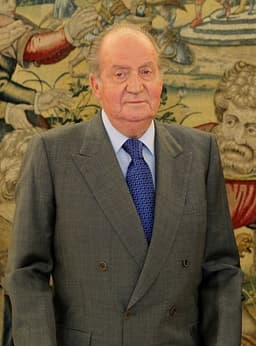
Juan Carlos I of Spain
Emperor · Modern
57.1Total

Ovonramwen Nogbaisi
Emperor · Modern
47.8Total
Basic Information
Born
1938
1857
Died
—
1914
Era
Modern
Modern
Nationality
Spain
Benin Kingdom
Occupation
Emperor
Emperor
Civilization
Western
Other
Score Comparison
Military (10%)
27.1
25.9
Political (20%)
75.0
43.7
Influence (20%)
55.0
57.2
Legacy (20%)
52.0
45.8
Leadership (15%)
72.0
62.2
Strategy (15%)
56.0
35.7
TOTAL
57.1
47.8
Juan Carlos I of Spain — Complete Timeline
1969 AD
Appointment as Franco's successorPolitical Action
Francisco Franco designated Juan Carlos as his successor, with the title of Prince of Spain. This decision was made to ensure the continuation of the regime after Franco's death, but Juan Carlos secretly worked to transition Spain to democracy.
SuccessionFrancoTransition
Impact: national
1975 AD
Proclamation as King of SpainPolitical Action
Juan Carlos I was proclaimed king two days after Franco's death. He inherited a dictatorial regime but quickly moved to dismantle it, initiating a process of political reform that would lead to democracy.
ProclamationMonarchyReform
Impact: nationalconstructive
1977 AD
Legalization of political partiesReform◆ Major
Under Juan Carlos I's guidance, the Spanish government legalized political parties, including the Communist Party. This was a key step in the transition to democracy, allowing for free elections and the establishment of a pluralistic political system.
DemocracyPolitical ReformLegalization
Impact: nationalprogressive
1978 AD
Approval of the 1978 ConstitutionReform
Juan Carlos I oversaw the drafting and approval of a new democratic constitution. The constitution established a parliamentary monarchy, guaranteed civil rights, and decentralized the state through autonomous communities, ending the Francoist centralization.
ConstitutionDemocracyDecentralization
Impact: nationalconstructive
1981 AD
Role in thwarting the 1981 coup attemptPolitical Action
During an attempted military coup, Juan Carlos I went on national television to denounce the coup and order the military to remain loyal to the democratic government. His decisive action helped defeat the coup and consolidate Spanish democracy.
CoupDemocracyLeadership
Impact: nationalconstructive
2014 AD
Abdication in favor of Felipe VIPolitical Action◆ Major
Juan Carlos I abdicated the throne, citing personal reasons and a desire to rejuvenate the monarchy. His abdication followed a series of scandals that had damaged the monarchy's reputation, and he handed over the crown to his son Felipe VI.
AbdicationSuccessionFelipe VI
Impact: national
Ovonramwen Nogbaisi — Complete Timeline
1892 AD
Resistance to British trade demandsPolitical Action◆ Major
Ovonramwen refused British demands to sign a treaty granting exclusive trading rights and extraterritorial jurisdiction. He maintained Benin's independence and restricted European access to the kingdom's interior.
ResistanceTradeBenin
Impact: regional
1897 AD
Punitive Expedition of 1897War◆ Major
British forces launched a punitive expedition against Benin City after the killing of a British delegation. The expedition captured and burned the city, looting thousands of bronze and ivory artworks from the royal palace.
Punitive ExpeditionLootingBenin Bronzes
Impact: globaldestructive
Exile to CalabarPolitical Action◆ Major
Ovonramwen was captured by British forces and deposed as Oba of Benin. He was exiled to Calabar in southeastern Nigeria, where he lived under British supervision until his death in 1914.
ExileColonialismBenin
Impact: regionaltragic
End of independent Benin KingdomPolitical Action◆ Major
Following Ovonramwen's exile, the British incorporated Benin into the Niger Coast Protectorate. The ancient kingdom lost its sovereignty and became part of British colonial Nigeria, ending centuries of independence.
ColonialismEnd of KingdomBenin
Impact: regionaltragic
Expert Analysis
Origins
Juan Carlos I was born on January 5, 1938, in Rome, Italy, during his family's exile from the Second Spanish Republic. He was the grandson of King Alfonso XIII, who had been deposed in 1931. His father, Don Juan de Borbón, was the pretender to the throne. Franco's regime, however, bypassed Don Juan and selected Juan Carlos as his successor, raising him under his tutelage. Juan Carlos attended military academies and universities in Spain, receiving a controlled education aimed at ensuring loyalty to the regime.
Ovonramwen Nogbaisi was born around 1857 in Benin City, in the Kingdom of Benin (modern-day Nigeria). He became the Oba (king) in 1888, succeeding his father Adolo. The Benin Kingdom was a powerful West African empire with a rich cultural heritage, known for its sophisticated bronze sculptures. Ovonramwen inherited a kingdom facing increasing European encroachment, particularly from the British, who sought to expand their colonial influence. He was educated in the traditions and governance of the Benin monarchy, preparing him for leadership.
Rise to Power
Juan Carlos's rise was orchestrated by Francisco Franco, who designated him as his successor in 1969, granting him the title Prince of Spain. This decision was controversial among monarchists who supported his father, but Franco saw Juan Carlos as malleable. After Franco's death on November 20, 1975, Juan Carlos was proclaimed king on November 22, 1975. He quickly surprised observers by initiating democratic reforms, distancing himself from the Francoist legacy. He appointed Adolfo Suárez as Prime Minister and supported the legalization of political parties, including the Communist Party, in 1977.
Ovonramwen's rise was traditional: he became Oba upon his father's death in 1888. He consolidated power within the kingdom, maintaining Benin's independence amid British pressures. The British wanted to control Benin's trade in palm oil and rubber, and they demanded a protectorate treaty. Ovonramwen refused, asserting his sovereignty. His resistance culminated in the 1897 Punitive Expedition, when a British delegation was killed while trying to force a meeting. The British retaliated with a military expedition that captured and burned Benin City, looting its treasures.
Leadership & Governance
Juan Carlos's leadership style was measured and strategic. As king, he deliberately stepped back from daily politics, using his influence behind the scenes. He supported the 1978 Constitution, which transformed Spain into a parliamentary monarchy with democratic institutions. His most notable act was on February 23, 1981, when he addressed the nation in military uniform, denouncing a coup attempt and ordering the military to remain loyal to the government. This decisiveness secured Spanish democracy. His governance score of 72.0 reflects his effective but cautious approach.
Ovonramwen's governance was that of an absolute monarch, ruling through a council of chiefs and priests. He upheld Benin's traditions and managed trade relations with Europeans. However, his refusal to compromise with British demands, while principled, left Benin isolated. He lacked the military strength to resist British power; his military score of 25.9 is low. His political score of 43.7 indicates limited diplomatic maneuvering. He prioritized sovereignty over adaptation, a stance that ultimately led to the kingdom's downfall.
Triumph & Tragedy
Juan Carlos's greatest triumph was overseeing Spain's peaceful transition from dictatorship to democracy, a process known as the Spanish Transition. He played a key role in legalizing political parties, holding free elections in 1977, and approving the 1978 Constitution. His intervention in the 1981 coup attempt solidified his legacy as a defender of democracy. However, his later reign was marred by scandals, including corruption allegations involving his son-in-law and a controversial elephant-hunting trip in 2012 during Spain's economic crisis. He abdicated in 2014, and his reputation suffered, leading to a legacy score of 52.0.
Ovonramwen's triumph was his steadfast resistance to British colonialism, maintaining Benin's independence until 1897. He became a symbol of African defiance. However, his tragedy was the violent destruction of Benin City, the loss of thousands of artworks (now known as the Benin Bronzes), and his exile to Calabar, where he died in 1914. His kingdom was absorbed into the British Empire. His leadership score of 62.2 indicates some respect, but his strategy score of 35.7 shows he was outmaneuvered.
Character & Destiny
Juan Carlos was pragmatic and adaptable. He recognized the need for change after Franco's death and used his position to facilitate it. His character was shaped by his upbringing under Franco, which taught him patience and discretion. However, his later scandals suggest a sense of entitlement and poor judgment. His total score of 57.1 reflects a mixed legacy: a successful transition dampened by personal failings.
Ovonramwen was proud and uncompromising. He valued Benin's sovereignty above all and refused to bow to British demands. His character was rooted in the divine status of the Oba, which made negotiation difficult. His destiny was sealed by the technological and military disparity between Benin and Britain. His total score of 47.8 indicates a tragic figure who was out of step with the forces of history.
Legacy
Juan Carlos's legacy is complex. He is credited with establishing Spanish democracy, which has endured. The 1978 Constitution remains the foundation of Spain's political system. However, his abdication and subsequent scandals have tarnished his image. He scored 55.0 in influence and 52.0 in legacy, reflecting his impact on Spain's modern identity.
Ovonramwen's legacy is that of a resistance leader and a symbol of pre-colonial African sovereignty. The Benin Bronzes, looted during the Punitive Expedition, have become a focus of restitution debates. His exile marked the end of an independent Benin Kingdom, but his memory persists. He scored 57.2 in influence but 45.8 in legacy, as his kingdom's loss was total.
Conclusion
Juan Carlos I had a greater impact on history than Ovonramwen Nogbaisi. His political score of 75.0 versus Ovonramwen's 43.7 underscores his effectiveness in navigating a complex transition. While Ovonramwen's resistance was noble, it failed to preserve his kingdom. Juan Carlos, by contrast, successfully transformed Spain, creating a stable democracy that endures. The score gap of 9.3 points reflects this reality. Juan Carlos's influence extends beyond Spain as a model of peaceful democratic transition, whereas Ovonramwen's legacy is primarily symbolic. Thus, Juan Carlos I is the more historically significant figure.
Rankings
🥇
Juan Carlos I of SpainLeader
Mil: 27.1Pol: 75.0Inf: 55.0
57.1
🥈
Ovonramwen Nogbaisi
Mil: 25.9Pol: 43.7Inf: 57.2
47.8
+9.3 behind
How This Comparison Works
Algorithm
Each figure is scored on 6 dimensions (0—100 scale) based on structured historical data: Military (10%), Political (20%), Influence (20%), Legacy (20%), Leadership (15%), Strategy (15%). The weighted total produces the final ranking.
Data Sources
Scores are computed from structured sub-indicators in the database. Scale factors adjust for era (Ancient ×0.85, Modern ×1.0) and civilization size (Eastern ×1.05, Other ×0.80) to account for differences in population and military scale.
Maximum 3 Figures
Comparisons are limited to 2—3 figures to ensure readability and statistical meaningfulness.
Error Margins
±5 points per dimension — Sub-scores are derived from historical records with inherent uncertainty. Two figures within 5 points on a dimension should be considered roughly equivalent in that area.
Total Score Accuracy
±3 points overall — The weighted combination of 6 dimensions produces a total score with approximately ±3 points of uncertainty. Differences of less than 3 points are not statistically significant— the figures are effectively tied.
Known Limitations
- Historical records are incomplete and uneven across civilizations
- Figures from oral-tradition societies may be underrepresented
- Occupation labels can misclassify multi-role figures
- Scores measure capability and impact, not moral character
- Quantitative scoring is a comparison tool, not absolute truth
Capability Radar
Military (10%) — Battles & Warfare
Battles
35
20
Win Rate
37
10
Expansion
42
10
Political (20%) — Governance & Reform
Reform
85
30
Diplomacy
80
25
Economy
60
35
Influence (20%) — Cultural & Global Reach
Cultural
55
45
Global
65
30
Legacy (20%) — Historical Impact
Historical
70
40
Longevity
60
35
Leadership (15%) — Power & Stability
Tenure
65
40
Stability
75
20
Strategy (15%) — Tactics & Innovation
Strategy
48
20
Tactics
49
25
Reform
51
15
Similar Comparisons
Comments & Discussion
No comments yet. Be the first to share your thoughts!