Loading...
This comparison has not been analyzed yet.
One-time AI generation (~1 minute). Scores and timeline are already available below.
Julio Cesar Turbay vs Urho Kekkonen
Urho Kekkonen leads by 11.0 pts · 2 figures compared
…
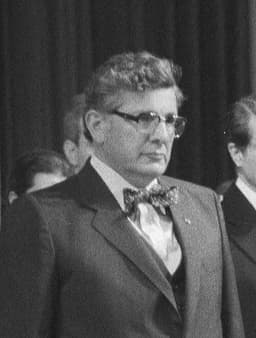
Julio Cesar Turbay
Politician · Modern
50.7Total

Urho Kekkonen
Politician · Modern
61.7Total
Basic Information
Born
1916
1900
Died
2005
1986
Era
Modern
Modern
Nationality
Colombia
Finland
Occupation
Politician
Politician
Civilization
Western
Western
Score Comparison
Military (10%)
48.9
49.0
Political (20%)
48.0
62.7
Influence (20%)
51.0
72.0
Legacy (20%)
41.7
52.0
Leadership (15%)
74.0
80.7
Strategy (15%)
43.2
42.7
TOTAL
50.7
61.7
Julio Cesar Turbay — Complete Timeline
1978 AD
Presidency of ColombiaPolitical Action◆ Major
Julio César Turbay became President of Colombia in 1978. His administration was marked by a hardline security policy against guerrilla groups and drug traffickers, including the controversial Security Statute.
PresidencySecurity PolicyCounterinsurgency
Impact: national
Security Statute of 1978Political Action◆ Major
Turbay enacted the Security Statute, a set of emergency decrees that expanded military powers to arrest, detain, and try civilians in military courts. The statute was criticized for human rights abuses and led to numerous arbitrary detentions.
Security StatuteHuman RightsMilitary Justice
Impact: nationaldestructive
1979 AD
Drug Trafficking CrackdownPolitical Action◆ Major
Turbay intensified efforts against drug trafficking, including extradition of traffickers to the United States. His administration signed a bilateral extradition treaty with the US in 1979, escalating the war on drugs.
Drug WarExtraditionUS-Colombia Relations
Impact: national
1980 AD
M-19 Palace of Justice SiegeWar◆ Major
The M-19 guerrilla group seized the Dominican Embassy in Bogot
M-19Hostage CrisisDiplomacy
Impact: national
Urho Kekkonen — Complete Timeline
1956 AD
Presidency of Finland (1956-1982)Political Action
Urho Kekkonen was elected President of Finland in 1956 and served for 26 years until 1982, the longest tenure in Finnish history. His presidency was marked by a policy of active neutrality, maintaining friendly relations with the Soviet Union while preserving Finland's independence and democratic system.
PresidencyFinlandLongevity
Impact: national
The 'Kekkonen Doctrine' of NeutralityPolitical Action◆ Major
Kekkonen developed a foreign policy doctrine that emphasized Finland's neutrality in the Cold War, balancing relations with the Soviet Union and the West. He maintained close ties with Moscow through the 1948 Treaty of Friendship, Cooperation, and Mutual Assistance, while also pursuing economic integration with Western Europe.
Foreign PolicyNeutralityCold War
Impact: regionalconstructive
1960 AD
Domestic Political Dominance and the 'Kekkonen System'Political Action◆ Major
Kekkonen consolidated his power through a system of personal influence and coalition-building, often dissolving parliament and calling new elections to achieve his goals. His dominance led to a period of political stability but also criticism of authoritarian tendencies, as he marginalized opponents and controlled foreign policy.
Political SystemFinlandPower
Impact: national
1975 AD
Hosting the Conference on Security and Co-operation in Europe (CSCE)Political Action
Kekkonen hosted the final summit of the Conference on Security and Co-operation in Europe (CSCE) in Helsinki in 1975, which produced the Helsinki Accords. The accords recognized post-war borders in Europe and committed signatories to human rights principles, a landmark achievement in Cold War diplomacy.
DiplomacyCold WarHuman Rights
Impact: globalconstructive
This comparison has not been analyzed yet.
One-time AI generation (~1 minute). Scores and timeline are already available below.
Rankings
🥇
Urho KekkonenLeader
Mil: 49.0Pol: 62.7Inf: 72.0
61.7
🥈
Julio Cesar Turbay
Mil: 48.9Pol: 48.0Inf: 51.0
50.7
+11.0 behind
How This Comparison Works
Algorithm
Each figure is scored on 6 dimensions (0—100 scale) based on structured historical data: Military (10%), Political (20%), Influence (20%), Legacy (20%), Leadership (15%), Strategy (15%). The weighted total produces the final ranking.
Data Sources
Scores are computed from structured sub-indicators in the database. Scale factors adjust for era (Ancient ×0.85, Modern ×1.0) and civilization size (Eastern ×1.05, Other ×0.80) to account for differences in population and military scale.
Maximum 3 Figures
Comparisons are limited to 2—3 figures to ensure readability and statistical meaningfulness.
Error Margins
±5 points per dimension — Sub-scores are derived from historical records with inherent uncertainty. Two figures within 5 points on a dimension should be considered roughly equivalent in that area.
Total Score Accuracy
±3 points overall — The weighted combination of 6 dimensions produces a total score with approximately ±3 points of uncertainty. Differences of less than 3 points are not statistically significant— the figures are effectively tied.
Known Limitations
- Historical records are incomplete and uneven across civilizations
- Figures from oral-tradition societies may be underrepresented
- Occupation labels can misclassify multi-role figures
- Scores measure capability and impact, not moral character
- Quantitative scoring is a comparison tool, not absolute truth
Capability Radar
Military (10%) — Battles & Warfare
Battles
31
29
Win Rate
31
33
Expansion
35
35
Political (20%) — Governance & Reform
Reform
40
75
Diplomacy
45
90
Economy
35
70
Influence (20%) — Cultural & Global Reach
Cultural
25
60
Global
20
65
Legacy (20%) — Historical Impact
Historical
30
70
Longevity
20
65
Leadership (15%) — Power & Stability
Tenure
55
85
Stability
30
85
Strategy (15%) — Tactics & Innovation
Strategy
35
40
Tactics
43
42
Reform
46
42
Similar Comparisons
Comments & Discussion
No comments yet. Be the first to share your thoughts!