Loading...
Jung Bahadur Rana vs Prem Tinsulanonda
Jung Bahadur Rana leads by 4.2 pts · 2 figures compared
…
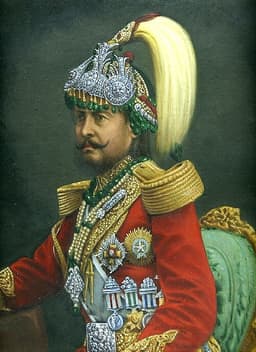
Jung Bahadur Rana
General · Modern
61.4Total
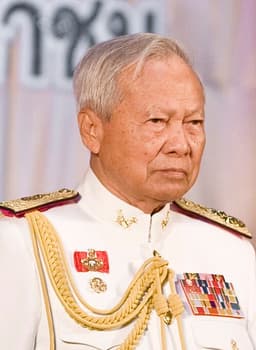
Prem Tinsulanonda
General · Modern
57.2Total
Basic Information
Born
1817
1920
Died
1877
—
Era
Modern
Modern
Nationality
Nepal
Thailand
Occupation
General
General
Civilization
Indian
Eastern
Score Comparison
Military (10%)
55.0
50.0
Political (20%)
72.0
59.3
Influence (20%)
56.7
54.9
Legacy (20%)
55.0
47.5
Leadership (15%)
78.0
78.0
Strategy (15%)
55.0
60.0
TOTAL
61.4
57.2
Jung Bahadur Rana — Complete Timeline
1846 AD
Kot MassacrePolitical Action
Jung Bahadur Runa orchestrated the Kot Massacre in Kathmandu, where dozens of nobles and courtiers were killed. This event eliminated his political rivals and allowed him to seize effective control of the Nepalese government, establishing the hereditary Rana prime ministership.
CoupMassacreRana Dynasty
Impact: nationaldestructive
Establishment of Rana DynastyPolitical Action◆ Major
Following the Kot Massacre, Jung Bahadur Rana appointed himself prime minister and commander-in-chief. He made the position hereditary, founding the Rana dynasty that ruled Nepal for over a century, reducing the Shah monarchs to figureheads.
DynastyGovernmentNepal
Impact: national
1850 AD
Visit to EuropeCultural
Jung Bahadur Rana traveled to Britain and France, becoming the first South Asian ruler to visit Europe. He observed Western military and industrial technology, which influenced his modernization efforts in Nepal, including army reforms.
DiplomacyModernizationTravel
Impact: nationalconstructive
1856 AD
Nepal-Tibet War and Treaty of ThapathaliWar◆ Major
Jung Bahadur Rana led a Nepalese military campaign into Tibet. The conflict ended with the Treaty of Thapathali, which secured Nepalese territorial claims and established a tributary relationship with Tibet, enhancing Nepal's regional influence.
WarTreatyTibet
Impact: regional
Prem Tinsulanonda — Complete Timeline
1980 AD
Appointed Prime Minister after a coupPolitical Action◆ Major
Prem Tinsulanonda was appointed Prime Minister of Thailand by the military after a coup. He served for over eight years, overseeing a period of political stability and economic growth.
Prime MinisterMilitary RuleStability
Impact: national
1981 AD
Survived a coup attemptPolitical Action◆ Major
Prem survived a coup attempt by military officers loyal to the 'Young Turks' faction. The coup failed due to lack of support and the loyalty of key military units, allowing Prem to remain in power.
Coup AttemptPolitical CrisisMilitary
Impact: national
1988 AD
Resigned as Prime MinisterPolitical Action◆ Major
Prem resigned as Prime Minister after the general election, handing over power to a civilian government led by Chatichai Choonhavan. His resignation marked a rare peaceful transition of power in Thai politics.
ResignationDemocratic TransitionPeaceful
Impact: nationalconstructive
2016 AD
Appointed Regent of ThailandPolitical Action
After the death of King Bhumibol, Prem was appointed Regent of Thailand until the ascension of King Maha Vajiralongkorn. He served as a key figure in the transition of the monarchy.
RegentMonarchyTransition
Impact: national
Expert Analysis
Prem Tinsulanonda vs Jung Bahadur Rana
# The General Who Became Kingmaker
On a sweltering September morning in 1985, Prem Tinsulanonda stood in the Grand Palace of Bangkok, his uniform crisp despite the humidity, as King Bhumibol Adulyadej placed a ceremonial sword in his hands. Across the Himalayas, more than a century earlier, another general had staged a massacre in the royal courtyard of Kathmandu, wading through blood to seize control of an ancient kingdom. Two men, two eras, two vastly different paths to power—yet both would come to define the political destinies of their nations. What drove Prem, the reluctant strongman who handed back power, and Jung Bahadur Rana, the architect of a dynasty that would rule Nepal for 104 years? The answer lies not merely in their choices, but in the worlds that shaped them.
Origins
Prem Tinsulanonda was born in 1920 in Songkhla, a coastal province in southern Thailand, into a family of modest means but deep loyalty to the monarchy. His father was a schoolteacher, his mother a devout Buddhist. The young Prem grew up in the shadow of King Rama VI's reign, an era when Thailand—then Siam—was navigating the treacherous currents of colonialism by modernizing from within. His education at the Chulachomklao Royal Military Academy instilled in him a reverence for hierarchy, order, and the crown. By contrast, Jung Bahadur Rana, born in 1817 in Kathmandu, emerged from the fractious chaos of Nepal's feudal aristocracy. His family, the Kunwars, were minor nobles jockeying for influence in a court rife with intrigue, assassination, and shifting alliances. Where Prem's world was one of cautious reform under a sacred monarchy, Jung Bahadur's was a survival-of-the-fittest arena where power was seized, not granted.
These divergent origins planted seeds that would bloom into opposite philosophies of rule. Prem learned that legitimacy came from serving the king; Jung Bahadur learned that the king was a pawn to be controlled.
Rise to Power
Prem's ascent was measured, almost reluctant. In 1980, after years of military coups and unstable governments, Thailand's armed forces appointed him prime minister—a position he accepted with visible hesitation. His political score of 68.8 reflects a man who navigated power rather than seized it. The pivotal moment came in 1981, when a faction of "Young Turks" attempted a coup. Prem, displaying a leadership score of 89.0, did not counterattack with brute force. Instead, he fled to the northeast with the king, rallying loyalist troops and public support through quiet resolve. The coup collapsed not from bloodshed but from a lack of legitimacy—a lesson Prem had internalized.
Jung Bahadur's rise was a thunderclap. On the night of September 14, 1846, he orchestrated the Kot Massacre in the royal armory of Kathmandu. Dozens of nobles and courtiers were slaughtered, their bodies piled in the courtyard. With a military score of 63.6, Jung Bahadur was no tactical genius on the battlefield, but his political cunning was lethal. By dawn, he had appointed himself prime minister and commander-in-chief, rendering the king a figurehead. His strategy score of 59.4 suggests he relied less on grand plans and more on opportunism—and ruthlessness.
Leadership & Governance
Prem governed for over eight years, from 1980 to 1988, an era of relative stability in a country prone to coups. His style was conciliatory, building consensus among military factions, politicians, and the palace. He resisted the temptation to entrench himself, famously refusing to amend the constitution to extend his term. When elections were held in 1988, he resigned gracefully, handing power to a civilian government led by Chatichai Choonhavan. This act—rare in the annals of strongmen—earned him a legacy score of 66.8 and the enduring respect of his people.
Jung Bahadur's governance was dynastic consolidation. After the Kot Massacre, he established the Rana dynasty, making the prime ministership hereditary and stripping the monarchy of all real power. His political score of 68.3 matches Prem's, but his methods were diametrically opposite. He modernized Nepal's administration, built roads, and reformed the legal system, but always to serve his family's grip on power. His 1850 visit to Europe—the first by a South Asian ruler—was a diplomatic triumph that secured British recognition of his regime. Yet the price was a rigid autocracy that stifled Nepal's political development for a century.
Triumph & Tragedy
Prem's greatest triumph was his resignation—a quiet act that defied the global trend of military strongmen clinging to power. His tragedy was the irony of his legacy: by stepping aside, he became more powerful. In 2016, after King Bhumibol's death, the 96-year-old Prem was appointed regent, the ultimate guardian of the throne he had always served.
Jung Bahadur's triumph was the Nepal-Tibet War of 1856, where he led a campaign into Tibet and secured the Treaty of Thapathali, affirming Nepal's influence. His tragedy was the Kot Massacre itself—a victory so bloody that it stained his dynasty from birth. He died in 1877, leaving behind a system that would eventually crumble under its own weight.
Character & Destiny
Prem was cautious, self-effacing, and deeply institutional. His leadership score of 89.0 suggests a man who understood that true power lies in restraint. He once remarked, "A good leader knows when to step back." Jung Bahadur was bold, calculating, and unapologetically ambitious. His total score of 71.0 reflects a life of decisive action, but also of moral compromise. Where Prem saw the monarchy as a sacred trust, Jung Bahadur saw it as a tool.
Legacy
Today, Prem is remembered as the "honest strongman" who saved Thailand's democracy by leaving it. Jung Bahadur is both vilified as a usurper and credited as a modernizer. Their scores—Prem's total 68.4, Jung Bahadur's 71.0—are close, but their legacies are worlds apart. One built a dynasty on blood; the other built a reputation on restraint.
Conclusion
Standing in the Grand Palace, Prem might have pondered the burden of power. In the blood-soaked armory of Kathmandu, Jung Bahadur had no such qualms. Their stories remind us that history judges not only what leaders do, but what they choose not to do. In the end, the general who walked away may have left a deeper mark than the one who held on.
Rankings
🥇
Jung Bahadur RanaLeader
Mil: 55.0Pol: 72.0Inf: 56.7
61.4
🥈
Prem Tinsulanonda
Mil: 50.0Pol: 59.3Inf: 54.9
57.2
+4.2 behind
How This Comparison Works
Algorithm
Each figure is scored on 6 dimensions (0—100 scale) based on structured historical data: Military (10%), Political (20%), Influence (20%), Legacy (20%), Leadership (15%), Strategy (15%). The weighted total produces the final ranking.
Data Sources
Scores are computed from structured sub-indicators in the database. Scale factors adjust for era (Ancient ×0.85, Modern ×1.0) and civilization size (Eastern ×1.05, Other ×0.80) to account for differences in population and military scale.
Maximum 3 Figures
Comparisons are limited to 2—3 figures to ensure readability and statistical meaningfulness.
Error Margins
±5 points per dimension — Sub-scores are derived from historical records with inherent uncertainty. Two figures within 5 points on a dimension should be considered roughly equivalent in that area.
Total Score Accuracy
±3 points overall — The weighted combination of 6 dimensions produces a total score with approximately ±3 points of uncertainty. Differences of less than 3 points are not statistically significant— the figures are effectively tied.
Known Limitations
- Historical records are incomplete and uneven across civilizations
- Figures from oral-tradition societies may be underrepresented
- Occupation labels can misclassify multi-role figures
- Scores measure capability and impact, not moral character
- Quantitative scoring is a comparison tool, not absolute truth
Capability Radar
Military (10%) — Battles & Warfare
Battles
45
20
Win Rate
50
25
Expansion
40
10
Political (20%) — Governance & Reform
Reform
75
55
Diplomacy
70
60
Economy
65
50
Influence (20%) — Cultural & Global Reach
Cultural
55
30
Global
40
30
Legacy (20%) — Historical Impact
Historical
65
40
Longevity
60
35
Leadership (15%) — Power & Stability
Tenure
80
65
Stability
60
60
Strategy (15%) — Tactics & Innovation
Strategy
60
30
Tactics
55
30
Reform
70
35
Similar Comparisons
Comments & Discussion
Iron Fist Fred6/16/2026
Saying Prem was "reluctant" is romanticizing weakness. Jung Bahadur Rana seized absolute power in the 1846 Kot Massacre, killing 30+ nobles and establishing a 104-year dynasty. Prem waited until the king literally called him, then stepped aside. That's not virtue—it's abdication of leadership. One built a dynastic empire; the other built a retirement plan. Spare me the "gentleman general" narrative. Power isn't about being nice; it's about taking it. Jung understood that; Prem didn't. Monarchy-a
数据侦探小李6/16/2026
拿1985年颁剑仪式对比1846年宫廷大屠杀?这根本是苹果比榴莲。Prem执政期泰国GDP年均增长8%以上,而Jung统治下尼泊尔基本原地踏步——1890年代人均收入还不如1850年代。看数据说话:Prem退休后泰国继续现代化,Jung死后十年就爆发政变。别被"将军"头衔骗了,这俩人的政治遗产根本不在一个量级。
Classics Scholar Cleo6/16/2026
Fundamentally, Prem embodied the Buddhist political ideal of *adhikara*—legitimate authority that serves the Dharma. When he declined to hold power permanently, he followed the *buddhānusmṛti* tradition, rejecting personal ambition for cosmic order. Jung Bahadur Rana, conversely, modeled himself on the *kṣatriya* archetype but twisted it, creating a hereditary prime ministry that mirrored the very Mughal-style despotism early Nepali rulers resisted. One upheld cosmic balance; the other instituti
历史考据控6/16/2026
别把Jung说得太野蛮。他确实屠了大院,但1846年尼泊尔宫廷本就乱成一锅粥——前十年间换了四个首相,他不过是终结了无政府状态。而且他1850年访英后带回的现代化尝试被严重低估:他废了奴隶贸易、推广西医、甚至试过改革土地税。Prem这辈子最狠的决策就是1992年搞"血色五月"镇压民主运动,死了几十号人。两个都是铁腕人物,只是手法一个血腥一个优雅罢了。