Loading...
Kenneth Kaunda vs Malcolm Turnbull
Kenneth Kaunda leads by 7.6 pts · 2 figures compared
…
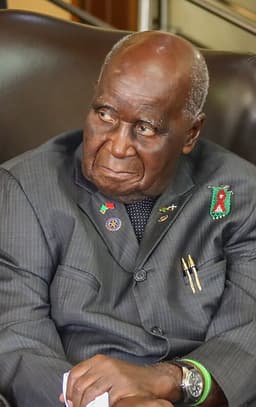
Kenneth Kaunda
Politician · Modern
56.9Total

Malcolm Turnbull
Politician · Modern
49.3Total
Basic Information
Born
1924
1954
Died
—
—
Era
Modern
Modern
Nationality
Zambia
Australia
Occupation
Politician
Politician
Civilization
Other
Western
Score Comparison
Military (10%)
50.0
11.2
Political (20%)
68.0
62.7
Influence (20%)
58.0
53.3
Legacy (20%)
46.7
42.5
Leadership (15%)
74.0
74.0
Strategy (15%)
43.9
37.0
TOTAL
56.9
49.3
Kenneth Kaunda — Complete Timeline
1964 AD
Led Zambia to independencePolitical Action
Kaunda, as leader of the United National Independence Party, negotiated with Britain for Zambia's independence from colonial rule. He became the first president of the Republic of Zambia on October 24, 1964, ending 73 years of British control.
IndependenceDecolonizationFounding President
Impact: nationalconstructive
1972 AD
Introduced one-party statePolitical Action◆ Major
Kaunda's government enacted a constitutional amendment making the United National Independence Party the sole legal political party in Zambia. This move centralized power under his control and suppressed political opposition, remaining in effect until 1990.
AuthoritarianismConstitutional ChangeOne-Party Rule
Impact: nationaldestructive
1975 AD
Hosted frontline states against apartheidPolitical Action◆ Major
Kaunda became a key leader of the Frontline States, a coalition of southern African nations opposing apartheid in South Africa and white minority rule in Rhodesia. Zambia provided bases and support for liberation movements like ZAPU and ANC, incurring economic costs from retaliatory attacks.
Anti-ApartheidDiplomacyLiberation Movements
Impact: regionalconstructive
1991 AD
Lost multi-party elections and stepped downPolitical Action
Under domestic and international pressure, Kaunda legalized opposition parties. In the 1991 presidential election, he was defeated by Frederick Chiluba of the Movement for Multi-Party Democracy. Kaunda peacefully transferred power, a rare event in post-independence Africa.
DemocratizationPeaceful TransitionElectoral Defeat
Impact: nationalconstructive
Malcolm Turnbull — Complete Timeline
2008 AD
Apology to the Stolen Generations (as Opposition Leader)Political Action
As Opposition Leader, Malcolm Turnbull supported the Rudd government's apology to the Stolen Generations. He spoke in Parliament in favor of the apology, emphasizing the need for bipartisan support for Indigenous reconciliation.
Indigenous RightsReconciliation
Impact: nationalconstructive
2016 AD
National Broadband Network (NBN) rolloutReform◆ Major
Turnbull, as Communications Minister and later PM, oversaw the rollout of the National Broadband Network. He shifted from the original fiber-to-the-premises model to a mixed-technology approach, which reduced costs but drew criticism for slower speeds.
InfrastructureTechnology
Impact: nationalconstructive
2017 AD
Prime Ministership and same-sex marriage plebiscitePolitical Action◆ Major
Turnbull's government conducted a voluntary postal plebiscite on same-sex marriage, which returned a 61.6% 'Yes' vote. He then facilitated the passage of legislation legalizing same-sex marriage in Australia, despite internal party opposition.
LGBTQ RightsSocial Reform
Impact: nationalprogressive
2018 AD
Leadership spill and loss of Prime MinistershipPolitical Action◆ Major
Turnbull was ousted as Prime Minister in a Liberal Party leadership spill, losing to Scott Morrison. The spill was triggered by poor polling and internal divisions over energy policy, ending his tenure after 15 months.
Leadership SpillPolitical Defeat
Impact: nationaltragic
Expert Analysis
Origins
Kenneth Kaunda was born on April 28, 1924, in Lubwa, Northern Rhodesia (now Zambia), the youngest of eight children. His father was a Malawian missionary teacher, and his mother was a teacher. Kaunda attended Munali Secondary School and later trained as a teacher, working in Tanzania and Zambia. His early experiences with colonial discrimination shaped his political consciousness.
Malcolm Turnbull was born on October 24, 1954, in Sydney, Australia. His mother was a radio actress, and his father was a hotel broker who left when Turnbull was young. He attended Vaucluse Public School and later Sydney Grammar School. He studied arts and law at the University of Sydney, then a Rhodes Scholarship at Oxford. His legal career began as a journalist and then lawyer, notably representing Peter Wright in the Spycatcher case.
Rise to Power
Kaunda rose through the independence movement. He joined the Northern Rhodesian African National Congress in 1950, but broke away to form the Zambia African National Congress in 1958. After imprisonment, he founded the United National Independence Party (UNIP) in 1960. He led negotiations with Britain, resulting in Zambia's independence on October 24, 1964, and he became the first president.
Turnbull entered politics after a successful legal and business career. He was elected to the Australian House of Representatives in 2004 for the Liberal Party. He served as Minister for the Environment and Water Resources under John Howard. After the Liberals lost in 2007, he became Opposition Leader in 2008. He was Communications Minister under Tony Abbott, then successfully challenged Abbott for the Prime Ministership in September 2015.
Leadership & Governance
Kaunda's leadership was characterized by his philosophy of 'Humanism,' which blended socialism with Christian ethics. He centralized power, amending the constitution in 1973 to make UNIP the sole legal party. He nationalized key industries and expanded education and healthcare. However, economic mismanagement, falling copper prices, and corruption led to decline. His governance scored 74.0 in leadership but only 43.9 in strategy.
Turnbull was a moderate liberal who emphasized economic reform and innovation. As PM, he legalized same-sex marriage via a postal plebiscite (61.6% 'Yes') and pushed for renewable energy and innovation. He oversaw the National Broadband Network, shifting from fiber-to-the-premises to a mixed technology model, which attracted criticism. His leadership score is 74.0, but strategy is 37.0, reflecting poor party management.
Triumph & Tragedy
Kaunda's greatest triumph was leading Zambia to independence without widespread violence, becoming a symbol of African liberation. He hosted frontline states against apartheid, earning international respect. His tragedy was the economic collapse under his rule; Zambia went from prosperity to debt. He also lost the 1991 election and stepped down, but later faced controversy when he tried to return to politics.
Turnbull's triumph was the same-sex marriage legalization, a major social reform. He also improved Australia's climate policy. His tragedy was his inability to unite his party; he was ousted by Scott Morrison in August 2018 after poor polling and internal strife. His NBN legacy is mixed, with many seeing it as a missed opportunity.
Character & Destiny
Kaunda was seen as a principled but stubborn leader. His moral authority was high, but his economic policies failed. He was known for his white handkerchief and his commitment to non-violence. His character led to a long tenure but also to Zambia's decline.
Turnbull was intelligent and wealthy, but his arrogance alienated colleagues. He was a republican but failed to advance the issue. His character as a 'kingmaker' turned target led to his downfall. Both had high political scores (Kaunda 68.0, Turnbull 62.7) but faced internal opposition.
Legacy
Kaunda's legacy is as a founding father of Zambia and a key anti-apartheid figure. However, his one-party state and economic failures are criticized. His total score is 56.9, with legacy at 46.7. Turnbull's legacy is more recent; he is remembered for same-sex marriage and as a reformer who failed to secure his party. His total is 49.3, legacy 42.5.
Conclusion
Kenneth Kaunda had greater impact due to his role in independence and continental influence, despite economic failures. His total score of 56.9 vs Turnbull's 49.3 reflects his broader historical significance. Turnbull's reforms were important but confined to Australia. Kaunda shaped a nation's founding; Turnbull managed a wealthy country's evolution. Kaunda's influence on African decolonization outweighs Turnbull's domestic achievements.
Rankings
🥇
Kenneth KaundaLeader
Mil: 50.0Pol: 68.0Inf: 58.0
56.9
🥈
Malcolm Turnbull
Mil: 11.2Pol: 62.7Inf: 53.3
49.3
+7.6 behind
How This Comparison Works
Algorithm
Each figure is scored on 6 dimensions (0—100 scale) based on structured historical data: Military (10%), Political (20%), Influence (20%), Legacy (20%), Leadership (15%), Strategy (15%). The weighted total produces the final ranking.
Data Sources
Scores are computed from structured sub-indicators in the database. Scale factors adjust for era (Ancient ×0.85, Modern ×1.0) and civilization size (Eastern ×1.05, Other ×0.80) to account for differences in population and military scale.
Maximum 3 Figures
Comparisons are limited to 2—3 figures to ensure readability and statistical meaningfulness.
Error Margins
±5 points per dimension — Sub-scores are derived from historical records with inherent uncertainty. Two figures within 5 points on a dimension should be considered roughly equivalent in that area.
Total Score Accuracy
±3 points overall — The weighted combination of 6 dimensions produces a total score with approximately ±3 points of uncertainty. Differences of less than 3 points are not statistically significant— the figures are effectively tied.
Known Limitations
- Historical records are incomplete and uneven across civilizations
- Figures from oral-tradition societies may be underrepresented
- Occupation labels can misclassify multi-role figures
- Scores measure capability and impact, not moral character
- Quantitative scoring is a comparison tool, not absolute truth
Capability Radar
Military (10%) — Battles & Warfare
Battles
20
23
Win Rate
27
25
Expansion
29
25
Political (20%) — Governance & Reform
Reform
55
55
Diplomacy
55
60
Economy
30
55
Influence (20%) — Cultural & Global Reach
Cultural
40
30
Global
40
30
Legacy (20%) — Historical Impact
Historical
50
35
Longevity
30
20
Leadership (15%) — Power & Stability
Tenure
60
45
Stability
25
40
Strategy (15%) — Tactics & Innovation
Strategy
29
34
Tactics
32
35
Reform
36
38
Similar Comparisons
Comments & Discussion
No comments yet. Be the first to share your thoughts!