Loading...
Kido Takayoshi vs Tan Sitong
Kido Takayoshi leads by 15.7 pts · 2 figures compared
…
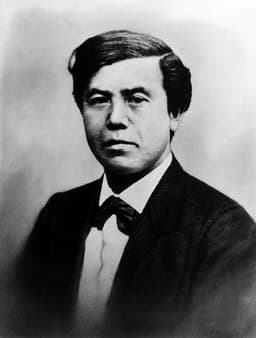
Kido Takayoshi
Politician · Modern
59.5Total

Tan Sitong
Politician · Modern
43.8Total
Basic Information
Born
1833
1865
Died
1877
1898
Era
Modern
Modern
Nationality
Japan
China
Occupation
Politician
Politician
Civilization
Eastern
Eastern
Score Comparison
Military (10%)
36.6
15.4
Political (20%)
72.0
45.1
Influence (20%)
56.7
54.9
Legacy (20%)
55.0
48.3
Leadership (15%)
78.0
40.4
Strategy (15%)
54.6
36.0
TOTAL
59.5
43.8
Kido Takayoshi — Complete Timeline
1866 AD
Formation of the Satsuma-Choshu AlliancePolitical Action
Kido Takayoshi, as a Choshu leader, negotiated the secret Satsuma-Choshu Alliance with Saigo Takamori of Satsuma. This alliance united the two most powerful domains against the Tokugawa shogunate, paving the way for the Meiji Restoration.
Meiji RestorationAlliance
Impact: nationalconstructive
1868 AD
Drafting of the Charter OathPolitical Action◆ Major
Kido Takayoshi was a principal drafter of the Charter Oath, a five-article document outlining the Meiji government's principles. It called for deliberative assemblies, public participation, and the pursuit of knowledge worldwide.
Meiji RestorationConstitutional document
Impact: nationalprogressive
1871 AD
Abolition of the han systemReform
Kido Takayoshi advocated for and helped implement the abolition of feudal domains (han) and their replacement with prefectures. This centralized power under the Meiji government, ending centuries of feudal rule.
CentralizationFeudalism
Impact: nationalprogressive
Establishment of the Iwakura MissionPolitical Action◆ Major
Kido Takayoshi was a key member of the Iwakura Mission, traveling to the United States and Europe to study Western institutions. He helped gather information that shaped Japan's modernization policies.
DiplomacyModernization
Impact: nationalconstructive
1873 AD
Resignation over the Seikanron debatePolitical Action◆ Major
Kido Takayoshi opposed the Seikanron proposal to invade Korea, arguing for domestic reform first. He resigned from the government when the proposal was initially favored, but his stance eventually prevailed, preventing a costly war.
Foreign policyPolitical conflict
Impact: nationalconstructive
Tan Sitong — Complete Timeline
1897 AD
Publication of 'On the Study of the New Text'Cultural
Tan Sitong published his philosophical work 'On the Study of the New Text' (Renxue), which synthesized Confucian, Buddhist, and Western ideas. The book advocated for social and political reform, criticizing traditional Confucian orthodoxy. It influenced later Chinese intellectuals and reformers.
PhilosophyReformPublication
Impact: nationalconstructive
1898 AD
Hundred Days ReformPolitical Action◆ Major
Tan Sitong participated in the Hundred Days Reform initiated by Emperor Guangxu. The reform aimed to modernize China's government, education, and military. Tan served as a secretary in the Grand Council, drafting reform edicts. The reform was abruptly ended by Empress Dowager Cixi's coup.
ReformQing DynastyModernization
Impact: nationalconstructive
Execution as One of the Six GentlemenPolitical Action◆ Major
After the failure of the Hundred Days Reform, Tan Sitong was arrested and executed by order of Empress Dowager Cixi. He was one of the Six Gentlemen of the Hundred Days Reform, executed to suppress reformist ideas. His death made him a martyr for the reform movement.
ExecutionMartyrReform
Impact: nationaltragic
Expert Analysis
Origins
Kido Takayoshi was born in 1833 in Hagi, Choshu domain (modern Yamaguchi Prefecture), into a samurai family. His father was a low-ranking retainer of the Mori clan. Kido studied at the domain school Meirinkan and later under Yoshida Shoin, a radical reformer who influenced his anti-Tokugawa views. He adopted the name Kido Takayoshi after the Meiji Restoration, previously known as Katsura Kogoro.
Tan Sitong was born in 1865 in Beijing, into a wealthy scholar-official family. His father, Tan Jixun, was a governor of Hubei. Tan received a classical Confucian education but also studied Western texts in translation, including mathematics and science. He grew up during the decline of the Qing dynasty, witnessing China's humiliation after the Opium Wars.
Rise to Power
Kido rose through the ranks of the Choshu domain, becoming a key figure in the movement to overthrow the Tokugawa shogunate. In 1866, he negotiated the secret Satsuma-Choshu Alliance with Saigo Takamori, uniting the two most powerful domains against the shogunate. This alliance was crucial for the military victories that led to the Meiji Restoration in 1868. After the restoration, Kido was appointed as a councilor and played a central role in drafting the Charter Oath in 1868.
Tan Sitong rose to prominence during the Hundred Days Reform of 1898, initiated by Emperor Guangxu. He was recommended to the emperor by Xu Zhijing and became a key advisor, advocating for radical modernization. His writings, especially 'On the Study of the New Text' (Renxue), gained attention among reformist circles. However, his rise was cut short after only 103 days.
Leadership & Governance
Kido was a pragmatic reformer who focused on institutional change. As a leader, he advocated for the abolition of feudal domains (han) in 1871, replacing them with prefectures to centralize power. He also helped establish the Iwakura Mission (1871-1873), traveling abroad to study Western systems. His governance style emphasized gradual, systematic reform, contrasting with more radical voices. He scored 78.0 in leadership, reflecting his ability to navigate factional politics.
Tan Sitong was an idealistic reformer who pushed for rapid change. During the Hundred Days Reform, he proposed sweeping measures including modernizing education, reforming the civil service, and adopting Western military techniques. However, his leadership was untested; he scored 40.4 in leadership, reflecting his lack of administrative experience. His approach alienated conservative factions, leading to the coup by Empress Dowager Cixi.
Triumph & Tragedy
Kido's greatest triumph was his role in drafting the Charter Oath, which set the direction for Japan's modernization. His advocacy for the abolition of the han system was a landmark in centralization. However, his tragedy came with the Seikanron debate in 1873, where he opposed invading Korea, arguing for domestic reform first. When the government voted to send a mission, Kido resigned, temporarily sidelining himself. He later returned but struggled with health issues, dying in 1877 at age 44.
Tan Sitong's triumph was his intellectual contribution to Chinese reform thought, particularly his synthesis of Confucian and Western ideas in 'On the Study of the New Text.' His tragedy was his execution at age 33 as one of the Six Gentlemen of the Hundred Days Reform. He became a martyr for reform, but his ideas had limited practical impact during his lifetime. His military score of 15.4 reflects his lack of involvement in armed conflict.
Character & Destiny
Kido was known for his strategic patience and diplomatic skill. He was a conciliator, often mediating between factions. His decision to resign over the Seikanron debate showed his principled stance, but also his frustration with political infighting. Historians describe him as a 'pragmatic idealist' who believed in gradual progress. His total score of 59.5 reflects a balanced but not exceptional profile.
Tan Sitong was passionate and intellectually bold, but politically naive. He believed that moral persuasion and radical reform could transform China quickly. His willingness to die for his beliefs—he refused to flee after the coup—demonstrates his conviction. However, his lack of practical political strategy led to his downfall. His total score of 43.8 reflects his limited effectiveness.
Legacy
Kido's legacy is foundational to modern Japan. The Charter Oath and the abolition of the han system are cornerstones of Meiji Japan's success. He is remembered as one of the 'Three Great Nobles' of the Restoration, alongside Saigo Takamori and Okubo Toshimichi. His influence score of 56.7 reflects his enduring impact on Japanese governance.
Tan Sitong's legacy is as a martyr for reform. He inspired later Chinese reformers and revolutionaries, including Sun Yat-sen. His philosophical work continued to influence Chinese thought, but his practical achievements were minimal. His legacy score of 48.3 is modest, reflecting his symbolic rather than tangible impact.
Conclusion
Kido Takayoshi had a greater impact than Tan Sitong, both in terms of concrete achievements and long-term influence. Kido's political score of 72.0 dwarfs Tan's 45.1, and his leadership score of 78.0 versus 40.4 highlights his effectiveness. While Tan's martyrdom inspired future generations, Kido's institutional reforms shaped Japan's rise as a modern power. The data supports Kido as the more significant figure.
Rankings
🥇
Kido TakayoshiLeader
Mil: 36.6Pol: 72.0Inf: 56.7
59.5
🥈
Tan Sitong
Mil: 15.4Pol: 45.1Inf: 54.9
43.8
+15.7 behind
How This Comparison Works
Algorithm
Each figure is scored on 6 dimensions (0—100 scale) based on structured historical data: Military (10%), Political (20%), Influence (20%), Legacy (20%), Leadership (15%), Strategy (15%). The weighted total produces the final ranking.
Data Sources
Scores are computed from structured sub-indicators in the database. Scale factors adjust for era (Ancient ×0.85, Modern ×1.0) and civilization size (Eastern ×1.05, Other ×0.80) to account for differences in population and military scale.
Maximum 3 Figures
Comparisons are limited to 2—3 figures to ensure readability and statistical meaningfulness.
Error Margins
±5 points per dimension — Sub-scores are derived from historical records with inherent uncertainty. Two figures within 5 points on a dimension should be considered roughly equivalent in that area.
Total Score Accuracy
±3 points overall — The weighted combination of 6 dimensions produces a total score with approximately ±3 points of uncertainty. Differences of less than 3 points are not statistically significant— the figures are effectively tied.
Known Limitations
- Historical records are incomplete and uneven across civilizations
- Figures from oral-tradition societies may be underrepresented
- Occupation labels can misclassify multi-role figures
- Scores measure capability and impact, not moral character
- Quantitative scoring is a comparison tool, not absolute truth
Capability Radar
Military (10%) — Battles & Warfare
Battles
5
15
Win Rate
5
15
Expansion
5
20
Political (20%) — Governance & Reform
Reform
85
60
Diplomacy
75
10
Economy
70
10
Influence (20%) — Cultural & Global Reach
Cultural
60
40
Global
65
20
Legacy (20%) — Historical Impact
Historical
75
50
Longevity
70
40
Leadership (15%) — Power & Stability
Tenure
60
10
Stability
65
5
Strategy (15%) — Tactics & Innovation
Strategy
15
24
Tactics
10
26
Reform
25
27
Similar Comparisons
Comments & Discussion
No comments yet. Be the first to share your thoughts!