Loading...
This comparison has not been analyzed yet.
One-time AI generation (~1 minute). Scores and timeline are already available below.
Kigeli III Ndabarasa vs Rana Bahadur Shah
Kigeli III Ndabarasa leads by 8.2 pts · 2 figures compared
…

Kigeli III Ndabarasa
Emperor · Modern
47.6Total
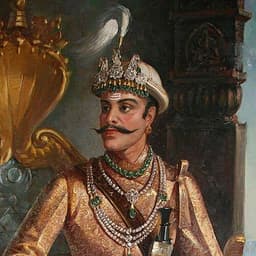
Rana Bahadur Shah
Emperor · Modern
39.4Total
Basic Information
Born
1750
1775
Died
1796
1806
Era
Modern
Modern
Nationality
Rwanda
Nepal
Occupation
Emperor
Emperor
Civilization
Other
Indian
Score Comparison
Military (10%)
30.0
22.6
Political (20%)
43.7
29.3
Influence (20%)
51.0
48.6
Legacy (20%)
42.5
37.5
Leadership (15%)
68.0
38.1
Strategy (15%)
45.0
54.8
TOTAL
47.6
39.4
Kigeli III Ndabarasa — Complete Timeline
1770 AD
Annexation of the Buganza chiefdomWar◆ Major
Kigeli III Ndabarasa led military campaigns to annex the Buganza chiefdom, expanding Rwandan territory. This conquest incorporated new lands and populations under the Rwandan crown, strengthening the kingdom's regional dominance.
Territorial ExpansionRwandaConquest
Impact: regional
1780 AD
Annexation of the Gisaka chiefdomWar◆ Major
Kigeli III Ndabarasa conquered the Gisaka chiefdom, further extending Rwandan control. This annexation added significant territory and resources, consolidating the kingdom's power in the region.
Territorial ExpansionRwandaConquest
Impact: regional
1785 AD
Annexation of the Ndorwa chiefdomWar◆ Major
Kigeli III Ndabarasa's forces annexed the Ndorwa chiefdom, a significant military campaign. This conquest expanded Rwanda's borders and increased the kingdom's influence over neighboring regions.
Territorial ExpansionRwandaConquest
Impact: regional
Rana Bahadur Shah — Complete Timeline
1792 AD
Nepal-Tibet WarWar◆ Major
During his reign, Rana Bahadur Shah led a military campaign into Tibet, initially successful but ultimately repelled by Chinese forces. The war ended with Nepal becoming a tributary state to the Qing dynasty, a humiliating outcome that weakened his authority.
Nepal-Tibet WarQing InterventionTributary Status
Impact: regionaldestructive
1799 AD
Abdication and SannyasaPolitical Action◆ Major
Rana Bahadur Shah abdicated the throne of Nepal in 1799 at age 24, appointing his infant son Girvan Yuddha Bikram Shah as king. He then became a sannyasi (Hindu ascetic), a rare act for a reigning monarch, and took the name Swami Nirvanananda.
AbdicationSannyasaReligious Conversion
Impact: national
1804 AD
Return to Politics and Regent RolePolitical Action◆ Major
Rana Bahadur Shah returned from ascetic life and became regent for his son, effectively ruling Nepal again. He clashed with the powerful Thapa faction, leading to political instability and his eventual assassination.
RegencyPolitical ConflictThapa Faction
Impact: national
1806 AD
Assassination by Half-BrotherPolitical Action
Rana Bahadur Shah was assassinated on April 25, 1806, by his half-brother Sher Bahadur Shah during a court gathering. The assassination triggered a massacre of his rivals led by Bhimsen Thapa, who then became the de facto ruler of Nepal.
AssassinationCourt IntriguePower Struggle
Impact: nationaltragic
This comparison has not been analyzed yet.
One-time AI generation (~1 minute). Scores and timeline are already available below.
Rankings
🥇
Kigeli III NdabarasaLeader
Mil: 30.0Pol: 43.7Inf: 51.0
47.6
🥈
Rana Bahadur Shah
Mil: 22.6Pol: 29.3Inf: 48.6
39.4
+8.2 behind
How This Comparison Works
Algorithm
Each figure is scored on 6 dimensions (0—100 scale) based on structured historical data: Military (10%), Political (20%), Influence (20%), Legacy (20%), Leadership (15%), Strategy (15%). The weighted total produces the final ranking.
Data Sources
Scores are computed from structured sub-indicators in the database. Scale factors adjust for era (Ancient ×0.85, Modern ×1.0) and civilization size (Eastern ×1.05, Other ×0.80) to account for differences in population and military scale.
Maximum 3 Figures
Comparisons are limited to 2—3 figures to ensure readability and statistical meaningfulness.
Error Margins
±5 points per dimension — Sub-scores are derived from historical records with inherent uncertainty. Two figures within 5 points on a dimension should be considered roughly equivalent in that area.
Total Score Accuracy
±3 points overall — The weighted combination of 6 dimensions produces a total score with approximately ±3 points of uncertainty. Differences of less than 3 points are not statistically significant— the figures are effectively tied.
Known Limitations
- Historical records are incomplete and uneven across civilizations
- Figures from oral-tradition societies may be underrepresented
- Occupation labels can misclassify multi-role figures
- Scores measure capability and impact, not moral character
- Quantitative scoring is a comparison tool, not absolute truth
Capability Radar
Military (10%) — Battles & Warfare
Battles
40
15
Win Rate
45
10
Expansion
55
10
Political (20%) — Governance & Reform
Reform
35
15
Diplomacy
40
15
Economy
30
10
Influence (20%) — Cultural & Global Reach
Cultural
30
20
Global
15
10
Legacy (20%) — Historical Impact
Historical
35
20
Longevity
30
15
Leadership (15%) — Power & Stability
Tenure
60
20
Stability
45
5
Strategy (15%) — Tactics & Innovation
Strategy
40
10
Tactics
35
10
Reform
30
5
Similar Comparisons
Comments & Discussion
No comments yet. Be the first to share your thoughts!