Loading...
This comparison has not been analyzed yet.
One-time AI generation (~1 minute). Scores and timeline are already available below.
King Chunghye of Goryeo vs Louis XI
Louis XI leads by 21.6 pts · 2 figures compared
…

King Chunghye of Goryeo
Emperor · Medieval
46.1Total
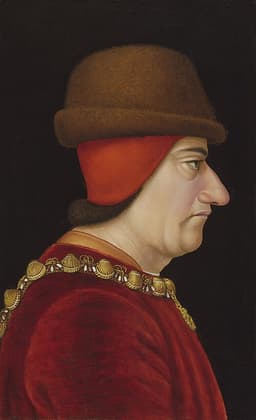
Louis XI
Emperor · Medieval
67.7Total
Basic Information
Born
1315
1423
Died
1344
1483
Era
Medieval
Medieval
Nationality
Korea
France
Occupation
Emperor
Emperor
Civilization
Eastern
Western
Score Comparison
Military (10%)
52.5
45.0
Political (20%)
39.4
78.0
Influence (20%)
52.5
68.0
Legacy (20%)
33.3
65.0
Leadership (15%)
45.0
85.0
Strategy (15%)
67.7
55.0
TOTAL
46.1
67.7
King Chunghye of Goryeo — Complete Timeline
1343 AD
Deposed for MisrulePolitical Action◆ Major
King Chunghye was deposed by the Yuan court after complaints from Goryeo officials about his erratic behavior, womanizing, and neglect of state affairs. He was taken to Yuan and exiled to a remote region.
DepositionMisruleYuan Intervention
Impact: nationaldestructive
1344 AD
Reinstated as KingPolitical Action◆ Major
After a brief period of exile, King Chunghye was reinstated as king by the Yuan court, likely due to political maneuvering by his supporters. His return did not lead to improved governance, and he continued his pattern of misrule.
ReinstatementYuan InfluenceRestoration
Impact: national
Deposed a Second TimePolitical Action◆ Major
King Chunghye was deposed again by the Yuan court later the same year, after renewed complaints about his behavior. He was exiled to Guangdong in China, where he died in 1344, ending his tumultuous reign.
DepositionExileDeath
Impact: nationaltragic
Louis XI — Complete Timeline
1464 AD
Established the Postal SystemReform
Louis XI created a royal postal system with relay stations across France, enabling faster communication between the crown and provincial officials. This administrative reform improved governance and intelligence gathering.
AdministrationCommunicationReform
Impact: nationalconstructive
1465 AD
Defeated the League of the Public WealWar◆ Major
Louis XI faced a coalition of powerful nobles, the League of the Public Weal, led by Charles the Bold of Burgundy. Although the Battle of Montlh
Civil WarNoble RebellionBurgundy
Impact: national
1475 AD
Treaty of PicquignyPolitical Action◆ Major
Louis XI negotiated the Treaty of Picquigny with Edward IV of England, ending English military intervention in France. Louis paid a large pension to Edward in exchange for English withdrawal, avoiding a costly war and securing his northern border.
TreatyDiplomacyEngland
Impact: regionalconstructive
1477 AD
Acquired BurgundyPolitical Action
After Charles the Bold's death at the Battle of Nancy, Louis XI seized the Duchy of Burgundy and other Burgundian territories, including Picardy and the Somme towns. This expansion significantly increased royal domain and weakened the Burgundian state.
Territorial ExpansionBurgundyRoyal Domain
Impact: regionalconstructive
1481 AD
Annexed Anjou and MainePolitical Action
Louis XI annexed the counties of Anjou and Maine after the death of Charles of Anjou, incorporating them into the royal domain. This further consolidated French territory and reduced the power of the Angevin nobility.
Territorial ExpansionAnjouMaine
Impact: nationalconstructive
This comparison has not been analyzed yet.
One-time AI generation (~1 minute). Scores and timeline are already available below.
Rankings
🥇
Louis XILeader
Mil: 45.0Pol: 78.0Inf: 68.0
67.7
🥈
King Chunghye of Goryeo
Mil: 52.5Pol: 39.4Inf: 52.5
46.1
+21.6 behind
How This Comparison Works
Algorithm
Each figure is scored on 6 dimensions (0—100 scale) based on structured historical data: Military (10%), Political (20%), Influence (20%), Legacy (20%), Leadership (15%), Strategy (15%). The weighted total produces the final ranking.
Data Sources
Scores are computed from structured sub-indicators in the database. Scale factors adjust for era (Ancient ×0.85, Modern ×1.0) and civilization size (Eastern ×1.05, Other ×0.80) to account for differences in population and military scale.
Maximum 3 Figures
Comparisons are limited to 2—3 figures to ensure readability and statistical meaningfulness.
Error Margins
±5 points per dimension — Sub-scores are derived from historical records with inherent uncertainty. Two figures within 5 points on a dimension should be considered roughly equivalent in that area.
Total Score Accuracy
±3 points overall — The weighted combination of 6 dimensions produces a total score with approximately ±3 points of uncertainty. Differences of less than 3 points are not statistically significant— the figures are effectively tied.
Known Limitations
- Historical records are incomplete and uneven across civilizations
- Figures from oral-tradition societies may be underrepresented
- Occupation labels can misclassify multi-role figures
- Scores measure capability and impact, not moral character
- Quantitative scoring is a comparison tool, not absolute truth
Capability Radar
Military (10%) — Battles & Warfare
Battles
44
45
Win Rate
47
40
Expansion
52
65
Political (20%) — Governance & Reform
Reform
0
80
Diplomacy
5
95
Economy
0
70
Influence (20%) — Cultural & Global Reach
Cultural
5
55
Global
0
60
Legacy (20%) — Historical Impact
Historical
5
75
Longevity
5
70
Leadership (15%) — Power & Stability
Tenure
5
75
Stability
0
65
Strategy (15%) — Tactics & Innovation
Strategy
56
70
Tactics
56
55
Reform
61
60
Similar Comparisons
Comments & Discussion
No comments yet. Be the first to share your thoughts!