Loading...
King Munmu vs Modu Chanyu
King Munmu leads by 3.4 pts · 2 figures compared
…

King Munmu
Emperor · Ancient
64.5Total
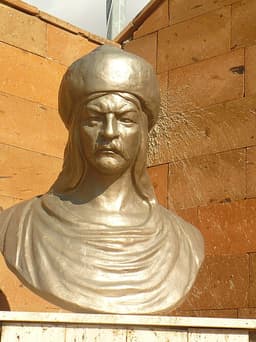
Modu Chanyu
Emperor · Ancient
61.1Total
Basic Information
Born
-626
-234
Died
—
-174
Era
Ancient
Ancient
Nationality
Korea
Xiongnu
Occupation
Emperor
Emperor
Civilization
Eastern
Eastern
Score Comparison
Military (10%)
76.0
77.5
Political (20%)
70.0
62.7
Influence (20%)
58.3
56.7
Legacy (20%)
52.0
40.0
Leadership (15%)
85.0
78.0
Strategy (15%)
61.2
80.3
TOTAL
64.5
61.1
King Munmu — Complete Timeline
660 AD
Battle of HwangsanbeolWar◆ Major
Silla forces under King Munmu (then Prince) allied with Tang China to defeat the Baekje army at Hwangsanbeol. This victory led to the fall of the Baekje kingdom, a key step toward unification.
Three Kingdoms PeriodSilla-Tang AllianceBaekje Conquest
Impact: regional
668 AD
Battle of Salsu RiverWar◆ Major
Silla forces under King Munmu, in coordination with Tang China, defeated the Goguryeo army at the Salsu River. This victory resulted in the fall of Goguryeo, completing the unification of the Three Kingdoms under Silla.
Three Kingdoms PeriodSilla-Tang AllianceGoguryeo Conquest
Impact: regional
670 AD
Silla-Tang WarWar◆ Major
After the fall of Goguryeo, Tang China attempted to establish control over the Korean peninsula. King Munmu led Silla forces in a war against Tang, successfully expelling Chinese forces and securing Silla's dominance over the unified territory.
Silla-Tang WarUnificationIndependence
Impact: regional
676 AD
Establishment of the Unified Silla KingdomPolitical Action
King Munmu formally established the Unified Silla Kingdom after expelling Tang forces. This marked the first time the Korean peninsula was unified under a single indigenous ruler, creating a period of peace and cultural flourishing.
UnificationSilla DynastyKorean History
Impact: regionalconstructive
Modu Chanyu — Complete Timeline
209 BC
Unification of the Xiongnu TribesPolitical Action
Modu Chanyu unified the nomadic tribes of the Mongolian steppe into the Xiongnu Empire after killing his father, Touman. He established a centralized military and political structure, creating a powerful confederation that rivaled Han China.
UnificationXiongnu EmpireNomadic Confederation
Impact: regional
200 BC
Battle of BaidengWar
Modu Chanyu besieged Emperor Gaozu of Han at Baideng (modern Datong, Shanxi) for seven days. The Han emperor was forced to negotiate a peace treaty, agreeing to pay tribute and send a princess for marriage, establishing Xiongnu dominance over northern China.
BattleHan DynastyTribute System
Impact: regional
198 BC
Treaty of HeqinPolitical Action◆ Major
Modu Chanyu formalized the Heqin treaty with the Han Dynasty, which included annual tribute payments, marriage alliances, and the recognition of the Xiongnu as equals. This treaty maintained peace for decades and set a precedent for Han-Xiongnu relations.
TreatyHeqinDiplomacy
Impact: regional
176 BC
Expansion into Central AsiaWar◆ Major
Modu Chanyu expanded Xiongnu control westward, defeating the Yuezhi and other nomadic groups. He extended Xiongnu influence over the Tarim Basin and parts of Central Asia, controlling key trade routes and establishing a vast steppe empire.
ExpansionCentral AsiaYuezhi
Impact: regional
Expert Analysis
Origins
King Munmu (661–681 AD) was born as the son of King Muyeol of Silla, one of the Three Kingdoms of Korea. His birth name was Kim Beop-min. He grew up in a royal court deeply engaged in the complex geopolitics of the Korean peninsula, where Silla, Baekje, and Goguryeo vied for supremacy. His early education focused on military strategy and diplomacy, particularly the alliance with Tang China. In contrast, Modu Chanyu (c. 234–174 BC) was born into the ruling clan of the Xiongnu, a confederation of nomadic tribes on the Mongolian steppe. His father, Touman, initially sent him as a hostage to the Yuezhi to secure peace, but Modu escaped and returned, later killing his father to seize power in 209 BC. This act of parricide set the tone for his ruthless leadership.
Rise to Power
Munmu rose to power through his father's successful campaigns. As crown prince, he commanded Silla forces in the Battle of Hwangsanbeol (660 AD), where Silla-Tang allies defeated Baekje, leading to its fall. After King Muyeol's death in 661, Munmu ascended the throne. He continued the war against Goguryeo, culminating in the Battle of Salsu River (668 AD), where Silla and Tang forces crushed the Goguryeo army, resulting in Goguryeo's collapse. Modu's rise was more dramatic: after escaping the Yuezhi, he trained a loyal band of archers and, in 209 BC, assassinated his father Touman. He then swiftly defeated rival tribes, including the Donghu and Yuezhi, unifying the Xiongnu into a centralized empire. By 200 BC, he had amassed a formidable cavalry force that threatened Han China.
Leadership & Governance
Munmu's leadership was characterized by strategic alliance-building and administrative consolidation. After unifying the peninsula, he faced Tang China's attempt to dominate Korea. In the Silla-Tang War (668–676), Munmu mobilized local resistance and guerrilla tactics, ultimately expelling Tang forces and establishing the Unified Silla Kingdom. He implemented a centralized bureaucracy, adopted Tang-style government structures, and promoted Buddhism to unify the populace. His military score of 76.0 reflects his success in warfare, but his political score of 70.0 shows his governance skills. Modu, scoring 80.3 in strategy, ruled through a decentralized feudal system, dividing the empire into left and right wings under loyal commanders. He established the Heqin treaty (198 BC) with Han China, securing annual tribute and a marriage alliance, which provided economic stability. However, his political score of 62.7 indicates less emphasis on institutional governance compared to Munmu.
Triumph & Tragedy
Munmu's greatest triumph was the unification of the Three Kingdoms, a feat that shaped Korean identity for centuries. His successful expulsion of Tang forces preserved Korean independence. His tragedy was the heavy reliance on Tang during the initial conquests, which led to a costly war and strained resources. Additionally, his legacy includes the controversial decision to dissolve the Silla aristocracy's power, causing internal strife. Modu's triumph was creating the first steppe empire, forcing Han China to treat him as an equal. His siege of Emperor Gaozu at Baideng (200 BC) demonstrated his military prowess. However, his tragedy was the empire's fragility: after his death, internal divisions and Han counterattacks weakened the Xiongnu. His influence score of 56.7 reflects the temporary nature of his empire.
Character & Destiny
Munmu was pragmatic and patient, willing to ally with a foreign power to achieve unification, then turn against that ally when necessary. His leadership score of 85.0 indicates his ability to inspire loyalty and maintain control. He died in 681, reportedly asking to be cremated and his ashes scattered at sea to protect the kingdom. Modu was ruthless and opportunistic, as shown by his parricide and brutal conquests. His strategy score of 80.3 highlights his tactical brilliance, but his character fostered a culture of fear. He died around 174 BC, leaving an empire that relied on his personal authority. Historical assessments note that Munmu's character was more suited to state-building, while Modu excelled in conquest.
Legacy
King Munmu's legacy is profound: he established the Unified Silla Kingdom, which lasted until 935 AD, setting a precedent for Korean unity. His administrative reforms influenced later Korean dynasties. He is remembered as a national hero in South Korea, with monuments like the Great King Munmu underwater tomb. His total score of 64.5 reflects his enduring impact. Modu Chanyu's legacy is more ambiguous: he founded the Xiongnu Empire, which became a model for later steppe confederations like the Mongols. However, his empire did not outlast the Han Dynasty's counteroffensives. His legacy score of 40.0 indicates limited long-term influence compared to Munmu.
Conclusion
King Munmu had a greater overall impact than Modu Chanyu. While Modu's military and strategic scores are slightly higher (77.5 vs 76.0 military; 80.3 vs 61.2 strategy), Munmu's leadership (85.0 vs 78.0) and political acumen (70.0 vs 62.7) enabled him to create a lasting unified state. Munmu's unification of Korea shaped a distinct national identity that persists today, whereas Modu's empire fragmented within a century. The score gap of 3.4 points reflects Munmu's superior legacy. Therefore, King Munmu stands as the more consequential figure.
Rankings
🥇
King MunmuLeader
Mil: 76.0Pol: 70.0Inf: 58.3
64.5
🥈
Modu Chanyu
Mil: 77.5Pol: 62.7Inf: 56.7
61.1
+3.4 behind
How This Comparison Works
Algorithm
Each figure is scored on 6 dimensions (0—100 scale) based on structured historical data: Military (10%), Political (20%), Influence (20%), Legacy (20%), Leadership (15%), Strategy (15%). The weighted total produces the final ranking.
Data Sources
Scores are computed from structured sub-indicators in the database. Scale factors adjust for era (Ancient ×0.85, Modern ×1.0) and civilization size (Eastern ×1.05, Other ×0.80) to account for differences in population and military scale.
Maximum 3 Figures
Comparisons are limited to 2—3 figures to ensure readability and statistical meaningfulness.
Error Margins
±5 points per dimension — Sub-scores are derived from historical records with inherent uncertainty. Two figures within 5 points on a dimension should be considered roughly equivalent in that area.
Total Score Accuracy
±3 points overall — The weighted combination of 6 dimensions produces a total score with approximately ±3 points of uncertainty. Differences of less than 3 points are not statistically significant— the figures are effectively tied.
Known Limitations
- Historical records are incomplete and uneven across civilizations
- Figures from oral-tradition societies may be underrepresented
- Occupation labels can misclassify multi-role figures
- Scores measure capability and impact, not moral character
- Quantitative scoring is a comparison tool, not absolute truth
Capability Radar
Military (10%) — Battles & Warfare
Battles
70
85
Win Rate
75
90
Expansion
85
95
Political (20%) — Governance & Reform
Reform
75
90
Diplomacy
80
85
Economy
65
75
Influence (20%) — Cultural & Global Reach
Cultural
65
70
Global
55
75
Legacy (20%) — Historical Impact
Historical
75
85
Longevity
70
80
Leadership (15%) — Power & Stability
Tenure
70
80
Stability
70
80
Strategy (15%) — Tactics & Innovation
Strategy
80
92
Tactics
65
88
Reform
60
95
Similar Comparisons
Comments & Discussion
No comments yet. Be the first to share your thoughts!