Loading...
This comparison has not been analyzed yet.
One-time AI generation (~1 minute). Scores and timeline are already available below.
Kodandera Subayya Thimayya vs Saw Maung
Kodandera Subayya Thimayya leads by 6.6 pts · 2 figures compared
…
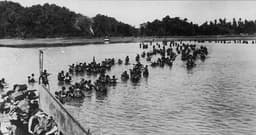
Kodandera Subayya Thimayya
General · Modern
48.7Total

Saw Maung
General · Modern
42.1Total
Basic Information
Born
1906
1928
Died
1965
—
Era
Modern
Modern
Nationality
India
Burma
Occupation
General
General
Civilization
Indian
Eastern
Score Comparison
Military (10%)
47.5
50.0
Political (20%)
42.2
26.4
Influence (20%)
54.9
47.9
Legacy (20%)
41.7
40.0
Leadership (15%)
61.1
50.7
Strategy (15%)
43.3
35.7
TOTAL
48.7
42.1
Kodandera Subayya Thimayya — Complete Timeline
1942 AD
Served in World War II (Burma Campaign)War
Thimayya served with distinction in the Burma Campaign during World War II. He commanded troops and was awarded the Distinguished Service Order for his leadership in combat.
World War IIBurmaDSO
Impact: regional
1957 AD
Served as Chief of Army StaffPolitical Action◆ Major
K. S. Thimayya was appointed Chief of Army Staff of the Indian Army. He served from 1957 to 1961, overseeing the army during a period of tension with China and Pakistan.
Army ChiefLeadershipMilitary
Impact: national
1961 AD
Resigned as Army Chief on PrinciplePolitical Action◆ Major
Thimayya resigned as Army Chief after a dispute with Defence Minister V. K. Krishna Menon over military appointments and policies. His resignation was seen as a principled stand against political interference.
ResignationPrinciplePolitical Interference
Impact: national
1964 AD
Served as Commander of UN Peacekeeping Forces in CyprusWar
After retiring from the Indian Army, Thimayya served as the Commander of the United Nations Peacekeeping Force in Cyprus (UNFICYP). He worked to maintain peace between Greek and Turkish Cypriots.
UN PeacekeepingCyprusInternational
Impact: globalconstructive
Saw Maung — Complete Timeline
1988 AD
Crushed the 8888 UprisingPolitical Action◆ Major
As Chairman of the State Law and Order Restoration Council (SLORC), Saw Maung ordered a violent crackdown on pro-democracy protests across Burma. Thousands of civilians were killed or arrested, effectively ending the 8888 Uprising.
CrackdownProtestAuthoritarianism
Impact: nationaldestructive
Seized Power in Military CoupPolitical Action◆ Major
Saw Maung led a military coup that overthrew the civilian government of President Maung Maung. He established the SLORC, a military junta that ruled Burma with absolute authority, suspending the constitution.
CoupMilitary JuntaSLORC
Impact: nationaldestructive
1989 AD
Renamed Burma to MyanmarPolitical Action◆ Major
The SLORC under Saw Maung officially changed the country's English name from Burma to Myanmar, and the capital Rangoon to Yangon. The move was controversial and not recognized by many democratic nations.
Name ChangeNational IdentitySLORC
Impact: national
1992 AD
Resigned as SLORC ChairmanPolitical Action
Saw Maung resigned as Chairman of the SLORC, reportedly due to health reasons. He was succeeded by General Than Shwe, who continued the military regime's policies.
ResignationLeadership Change
Impact: national
This comparison has not been analyzed yet.
One-time AI generation (~1 minute). Scores and timeline are already available below.
Rankings
🥇
Kodandera Subayya ThimayyaLeader
Mil: 47.5Pol: 42.2Inf: 54.9
48.7
🥈
Saw Maung
Mil: 50.0Pol: 26.4Inf: 47.9
42.1
+6.6 behind
How This Comparison Works
Algorithm
Each figure is scored on 6 dimensions (0—100 scale) based on structured historical data: Military (10%), Political (20%), Influence (20%), Legacy (20%), Leadership (15%), Strategy (15%). The weighted total produces the final ranking.
Data Sources
Scores are computed from structured sub-indicators in the database. Scale factors adjust for era (Ancient ×0.85, Modern ×1.0) and civilization size (Eastern ×1.05, Other ×0.80) to account for differences in population and military scale.
Maximum 3 Figures
Comparisons are limited to 2—3 figures to ensure readability and statistical meaningfulness.
Error Margins
±5 points per dimension — Sub-scores are derived from historical records with inherent uncertainty. Two figures within 5 points on a dimension should be considered roughly equivalent in that area.
Total Score Accuracy
±3 points overall — The weighted combination of 6 dimensions produces a total score with approximately ±3 points of uncertainty. Differences of less than 3 points are not statistically significant— the figures are effectively tied.
Known Limitations
- Historical records are incomplete and uneven across civilizations
- Figures from oral-tradition societies may be underrepresented
- Occupation labels can misclassify multi-role figures
- Scores measure capability and impact, not moral character
- Quantitative scoring is a comparison tool, not absolute truth
Capability Radar
Military (10%) — Battles & Warfare
Battles
20
20
Win Rate
25
25
Expansion
15
10
Political (20%) — Governance & Reform
Reform
25
5
Diplomacy
40
10
Economy
20
5
Influence (20%) — Cultural & Global Reach
Cultural
20
5
Global
20
10
Legacy (20%) — Historical Impact
Historical
25
20
Longevity
15
10
Leadership (15%) — Power & Stability
Tenure
30
40
Stability
35
10
Strategy (15%) — Tactics & Innovation
Strategy
35
20
Tactics
30
15
Reform
40
10
Similar Comparisons
Comments & Discussion
No comments yet. Be the first to share your thoughts!