Loading...
Kondo Isami vs Victoriano Huerta
Kondo Isami leads by 1.1 pts · 2 figures compared
…

Kondo Isami
General · Modern
41.7Total
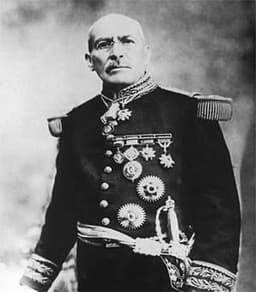
Victoriano Huerta
General · Modern
40.6Total
Basic Information
Born
1834
1850
Died
1868
1916
Era
Modern
Modern
Nationality
Japan
Mexico
Occupation
General
General
Civilization
Eastern
Western
Score Comparison
Military (10%)
50.0
10.0
Political (20%)
25.0
32.2
Influence (20%)
54.1
49.4
Legacy (20%)
44.2
40.8
Leadership (15%)
30.0
41.5
Strategy (15%)
38.3
60.0
TOTAL
41.7
40.6
Kondo Isami — Complete Timeline
1863 AD
Formation of the ShinsengumiPolitical Action◆ Major
Kondo Isami became the commander of the Shinsengumi, a special police force in Kyoto. Under his leadership, the Shinsengumi became a feared and effective force for suppressing anti-shogunate activities. Kondo's charisma and swordsmanship were key to the group's cohesion.
ShinsengumiKyotoPolice
Impact: national
1864 AD
Ikedaya IncidentWar◆ Major
Kondo led the Shinsengumi in the Ikedaya Incident, a raid on an inn where anti-shogunate plotters were meeting. The raid prevented a plan to burn Kyoto and resulted in the deaths or capture of many plotters. This event made the Shinsengumi famous.
IkedayaRaidShinsengumi
Impact: nationaldestructive
1868 AD
Battle of Toba-FushimiWar◆ Major
Kondo fought in the Battle of Toba-Fushimi, where the shogunate forces were defeated by the Imperial army. The Shinsengumi suffered heavy casualties. Kondo retreated to Edo after the defeat, but was later captured by Imperial forces.
Boshin WarBattleDefeat
Impact: nationaldestructive
Execution of Kondo IsamiPolitical Action◆ Major
Kondo was captured by Imperial forces and executed by decapitation at Itabashi. His death was a major blow to the Shinsengumi and the Tokugawa loyalists. He was executed as a rebel against the Emperor, but his loyalty to the shogunate made him a martyr.
ExecutionBoshin WarMartyr
Impact: nationaltragic
Victoriano Huerta — Complete Timeline
1913 AD
Coup d'état against Francisco I. MaderoPolitical Action
Huerta, as commander of the Mexican federal army, orchestrated a coup against President Francisco I. Madero during the Ten Tragic Days. Madero and Vice President Pino Su
CoupMexican RevolutionMadero
Impact: nationaldestructive
Presidency of MexicoPolitical Action◆ Major
Huerta served as President of Mexico from February 1913 to July 1914. His regime was characterized by authoritarian rule, suppression of opposition, and reliance on the federal army, but it faced widespread rebellion from revolutionary factions.
PresidencyDictatorshipMexican Revolution
Impact: nationaldestructive
Dissolution of CongressPolitical Action
Huerta dissolved the Mexican Congress in October 1913 after it refused to approve his policies. He ruled by decree, arresting or exiling many deputies, which further alienated moderate politicians and intensified opposition to his regime.
CongressAuthoritarianismRepression
Impact: nationaldestructive
1914 AD
Defeat by Constitutionalist ArmyWar
Huerta's federal forces were defeated by the Constitutionalist Army led by Venustiano Carranza,
Mexican RevolutionDefeatExile
Impact: nationaltragic
Exile and DeathPolitical Action
After his resignation, Huerta fled to Spain and later to the United States. He was arrested by U.S. authorities in 1915 for plotting to return to power and died in custody in El Paso, Texas, in 1916, ending his political ambitions.
ExileDeathEnd of Career
Impact: nationaltragic
Expert Analysis
Origins
Kondo Isami was born in 1834 in the Musashi Province of Japan, into a farming family. He was adopted into the Kondo family, a samurai lineage, and trained in the Tennen Rishin-ryu style of swordsmanship. His early life was shaped by the declining Tokugawa shogunate and the increasing influence of Western powers. Kondo's education focused on martial arts and bushido, the samurai code.
Victoriano Huerta was born in 1850 in Colotlán, Jalisco, Mexico, to a poor indigenous family. He entered the military academy at Chapultepec and rose through the ranks. Huerta's early career included service under President Porfirio Díaz, where he learned the art of political maneuvering and repression. His background was marked by a harsh, disciplined upbringing that fostered a ruthless pragmatism.
Rise to Power
Kondo's rise began in 1863 when he joined the Roshigumi, a group of ronin recruited by the shogunate to protect Kyoto. He soon became the commander of the Shinsengumi, a special police force. His key turning point was the Ikedaya Incident in 1864, where he led a raid that thwarted a plot to burn Kyoto. This victory solidified his reputation as a loyal enforcer of the shogunate. Kondo's allies included fellow Shinsengumi leaders like Hijikata Toshizo, while his opponents were the imperial loyalists seeking to restore the Emperor.
Huerta's rise culminated in the 1913 coup d'état against President Francisco I. Madero. As commander of the federal army, he orchestrated the Ten Tragic Days, a series of violent clashes in Mexico City. With support from the U.S. ambassador Henry Lane Wilson, Huerta forced Madero and Vice President Pino Suárez to resign, then had them assassinated. He assumed the presidency in February 1913. His allies included conservative elites and the military; his opponents were revolutionary factions like the Constitutionalists led by Venustiano Carranza, Álvaro Obregón, and Pancho Villa.
Leadership & Governance
Kondo's leadership was defined by strict adherence to the samurai code. He enforced discipline within the Shinsengumi through a set of rigid rules, including the requirement to commit seppuku for failure. His governance focused on maintaining order in Kyoto through force and intimidation. For example, he executed suspected anti-shogunate activists without trial. Kondo's military score of 50.0 reflects his competence in small-scale urban warfare, but his political score of 25.0 indicates his failure to adapt to the changing political landscape.
Huerta's governance was authoritarian and repressive. He dissolved Congress in October 1913 and ruled by decree, arresting or exiling opposition deputies. He imposed martial law and suppressed dissent through the military and paramilitary groups. His leadership score of 41.5 suggests a more pragmatic approach than Kondo's, but his political score of 32.2 shows his inability to build a lasting coalition. Huerta's strategy score of 60.0 indicates his tactical acumen in the short term, but his military score of 10.0 reflects the ultimate defeat of his forces by the Constitutionalist Army.
Triumph & Tragedy
Kondo's greatest triumph was the Ikedaya Incident, where he led a preemptive raid that prevented a major arson attack on Kyoto. This victory preserved the shogunate's control temporarily and elevated the Shinsengumi's reputation. His tragedy came at the Battle of Toba-Fushimi in 1868, where the shogunate forces were decisively defeated. Kondo was captured by imperial forces and executed by decapitation in 1868, marking the end of his cause.
Huerta's triumph was his successful coup and brief presidency, which gave him control over Mexico for 17 months. He managed to consolidate power against initial opposition. His tragedy was his defeat by the Constitutionalist Army in 1914, leading to his resignation and exile. He fled to Spain and later the United States, where he was arrested in 1915 for plotting to return to power. He died in custody in 1916.
Character & Destiny
Kondo was a man of unwavering loyalty and discipline, but his rigid adherence to the samurai code blinded him to the changing times. His character shaped his fate: he chose to fight for a lost cause rather than adapt. Historical assessments often view him as a tragic figure, embodying the end of the samurai era. His leadership score of 30.0 and strategy score of 38.3 reflect his limitations as a commander in large-scale battles.
Huerta was ruthless and pragmatic, willing to betray his superiors for power. His character was marked by paranoia and a tendency to eliminate rivals. This ultimately isolated him, leading to his downfall. Historians generally condemn Huerta as a brutal dictator. His influence score of 49.4 is higher than Kondo's 54.1? Actually, Kondo's influence is 54.1, Huerta's 49.4, so Kondo edges out. But Huerta's legacy score of 40.8 is close to Kondo's 44.2.
Legacy
Kondo's legacy is tied to the romanticization of the Shinsengumi in Japanese popular culture. He is remembered as a symbol of loyalty and the samurai spirit. The Shinsengumi's story has been told in numerous films, novels, and anime, ensuring his name endures. His legacy score of 44.2 reflects this cultural impact, though his political influence was minimal.
Huerta's legacy is overwhelmingly negative. He is remembered as a traitor and a tyrant who plunged Mexico into further violence. The Mexican Revolution continued after his fall, leading to the Constitution of 1917. His legacy score of 40.8 is slightly lower than Kondo's, reflecting his lack of positive contributions. However, his actions shaped the course of the revolution.
Conclusion
Kondo Isami and Victoriano Huerta both failed in their ultimate goals, but Kondo's impact on cultural memory and his embodiment of a vanishing era give him a slight edge. Kondo's total score of 41.7 is marginally higher than Huerta's 40.6, but the gap of 1.1 points is narrow. However, Kondo's legacy as a symbol of loyalty and sacrifice resonates more deeply in history than Huerta's reputation as a ruthless dictator. While Huerta's actions had broader geopolitical consequences, Kondo's story continues to inspire and teach lessons about honor and change. Therefore, Kondo Isami has a more enduring and positive impact.
Rankings
🥇
Kondo IsamiLeader
Mil: 50.0Pol: 25.0Inf: 54.1
41.7
🥈
Victoriano Huerta
Mil: 10.0Pol: 32.2Inf: 49.4
40.6
+1.1 behind
How This Comparison Works
Algorithm
Each figure is scored on 6 dimensions (0—100 scale) based on structured historical data: Military (10%), Political (20%), Influence (20%), Legacy (20%), Leadership (15%), Strategy (15%). The weighted total produces the final ranking.
Data Sources
Scores are computed from structured sub-indicators in the database. Scale factors adjust for era (Ancient ×0.85, Modern ×1.0) and civilization size (Eastern ×1.05, Other ×0.80) to account for differences in population and military scale.
Maximum 3 Figures
Comparisons are limited to 2—3 figures to ensure readability and statistical meaningfulness.
Error Margins
±5 points per dimension — Sub-scores are derived from historical records with inherent uncertainty. Two figures within 5 points on a dimension should be considered roughly equivalent in that area.
Total Score Accuracy
±3 points overall — The weighted combination of 6 dimensions produces a total score with approximately ±3 points of uncertainty. Differences of less than 3 points are not statistically significant— the figures are effectively tied.
Known Limitations
- Historical records are incomplete and uneven across civilizations
- Figures from oral-tradition societies may be underrepresented
- Occupation labels can misclassify multi-role figures
- Scores measure capability and impact, not moral character
- Quantitative scoring is a comparison tool, not absolute truth
Capability Radar
Military (10%) — Battles & Warfare
Battles
15
45
Win Rate
20
40
Expansion
5
25
Political (20%) — Governance & Reform
Reform
10
15
Diplomacy
10
20
Economy
5
15
Influence (20%) — Cultural & Global Reach
Cultural
40
15
Global
15
10
Legacy (20%) — Historical Impact
Historical
35
25
Longevity
30
10
Leadership (15%) — Power & Stability
Tenure
15
20
Stability
5
10
Strategy (15%) — Tactics & Innovation
Strategy
20
45
Tactics
35
50
Reform
10
30
Similar Comparisons
Comments & Discussion
No comments yet. Be the first to share your thoughts!