Loading...
This comparison has not been analyzed yet.
One-time AI generation (~1 minute). Scores and timeline are already available below.
Krum the Fearsome vs Robert III of Flanders
Robert III of Flanders leads by 1.7 pts · 2 figures compared
…
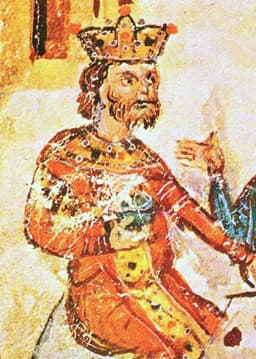
Krum the Fearsome
Emperor · Medieval
51.8Total

Robert III of Flanders
Emperor · Medieval
53.5Total
Basic Information
Born
755
1249
Died
814
1322
Era
Medieval
Medieval
Nationality
Bulgaria
Flanders
Occupation
Emperor
Emperor
Civilization
Western
Western
Score Comparison
Military (10%)
60.0
30.0
Political (20%)
39.4
54.7
Influence (20%)
52.5
54.1
Legacy (20%)
45.8
46.7
Leadership (15%)
67.0
74.0
Strategy (15%)
52.5
60.0
TOTAL
51.8
53.5
Krum the Fearsome — Complete Timeline
810 AD
Enactment of legal code (Krum's laws)Reform◆ Major
Krum introduced a set of laws aimed at centralizing power and unifying the Bulgarian state. These laws included measures against theft, drunkenness, and false oaths, and established a uniform legal system.
Legal ReformBulgarian EmpireGovernance
Impact: nationalconstructive
811 AD
Battle of Pliska (811)War
Krum led the Bulgarian army to a decisive victory over the Byzantine Empire at the Battle of Pliska. Byzantine Emperor Nikephoros I was killed in the battle, and his skull was later used as a drinking cup by Krum.
BattleByzantine-Bulgar WarsEmperor Killed
Impact: regionaldestructive
813 AD
Siege of Constantinople (813)War◆ Major
Krum besieged Constantinople after a series of victories over the Byzantines. He failed to capture the city due to its strong defenses and the death of Krum shortly after, but the siege demonstrated Bulgarian military power.
SiegeByzantine-Bulgar WarsOttoman Wars
Impact: regional
Robert III of Flanders — Complete Timeline
1302 AD
Battle of the Golden SpursWar
Robert III, as commander of the Flemish militia, led the forces of the County of Flanders to victory against the French army near Courtrai. The battle secured Flemish autonomy and established Robert's reputation as the Lion of Flanders.
Flemish IndependenceMedieval WarfareBattle
Impact: regional
1305 AD
Treaty of Athis-sur-OrgePolitical Action◆ Major
Robert III was forced to sign this treaty with King Philip IV of France after the French invasion following the Battle of the Golden Spurs. The treaty imposed heavy indemnities and humiliating terms on Flanders, partially reversing the gains of 1302.
TreatyFrench-Flemish RelationsDiplomacy
Impact: regionaldestructive
1320 AD
Revolt of Maritime FlandersPolitical Action
Robert III faced a rebellion from the coastal regions of Flanders, led by the city of Bruges, against his pro-French policies and tax increases. He suppressed the revolt with military force, reaffirming his authority but deepening internal divisions.
RevoltFlandersInternal Conflict
destructive
This comparison has not been analyzed yet.
One-time AI generation (~1 minute). Scores and timeline are already available below.
Rankings
🥇
Robert III of FlandersLeader
Mil: 30.0Pol: 54.7Inf: 54.1
53.5
🥈
Krum the Fearsome
Mil: 60.0Pol: 39.4Inf: 52.5
51.8
+1.7 behind
How This Comparison Works
Algorithm
Each figure is scored on 6 dimensions (0—100 scale) based on structured historical data: Military (10%), Political (20%), Influence (20%), Legacy (20%), Leadership (15%), Strategy (15%). The weighted total produces the final ranking.
Data Sources
Scores are computed from structured sub-indicators in the database. Scale factors adjust for era (Ancient ×0.85, Modern ×1.0) and civilization size (Eastern ×1.05, Other ×0.80) to account for differences in population and military scale.
Maximum 3 Figures
Comparisons are limited to 2—3 figures to ensure readability and statistical meaningfulness.
Error Margins
±5 points per dimension — Sub-scores are derived from historical records with inherent uncertainty. Two figures within 5 points on a dimension should be considered roughly equivalent in that area.
Total Score Accuracy
±3 points overall — The weighted combination of 6 dimensions produces a total score with approximately ±3 points of uncertainty. Differences of less than 3 points are not statistically significant— the figures are effectively tied.
Known Limitations
- Historical records are incomplete and uneven across civilizations
- Figures from oral-tradition societies may be underrepresented
- Occupation labels can misclassify multi-role figures
- Scores measure capability and impact, not moral character
- Quantitative scoring is a comparison tool, not absolute truth
Capability Radar
Military (10%) — Battles & Warfare
Battles
60
45
Win Rate
55
50
Expansion
55
35
Political (20%) — Governance & Reform
Reform
30
40
Diplomacy
40
55
Economy
35
45
Influence (20%) — Cultural & Global Reach
Cultural
30
40
Global
25
25
Legacy (20%) — Historical Impact
Historical
45
45
Longevity
30
35
Leadership (15%) — Power & Stability
Tenure
50
60
Stability
40
50
Strategy (15%) — Tactics & Innovation
Strategy
60
50
Tactics
65
55
Reform
30
30
Similar Comparisons
Comments & Discussion
No comments yet. Be the first to share your thoughts!