Loading...
Laurent Gbagbo vs Samakuva Isaias
Laurent Gbagbo leads by 0.5 pts · 2 figures compared
…
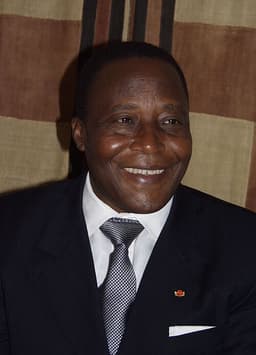
Laurent Gbagbo
Politician · Modern
47.5Total

Samakuva Isaias
Politician · Modern
47.0Total
Basic Information
Born
1945
1946
Died
—
—
Era
Modern
Modern
Nationality
Ivory Coast
Angola
Occupation
Politician
Politician
Civilization
Other
Other
Score Comparison
Military (10%)
45.0
43.3
Political (20%)
37.9
32.2
Influence (20%)
51.8
49.4
Legacy (20%)
40.0
40.8
Leadership (15%)
65.7
65.7
Strategy (15%)
45.0
54.3
TOTAL
47.5
47.0
Laurent Gbagbo — Complete Timeline
2000 AD
Elected President of Ivory CoastPolitical Action◆ Major
Gbagbo won the presidential election as the candidate of the Ivorian Popular Front, defeating incumbent Robert Gu
ElectionIvory CoastExclusion
Impact: national
2002 AD
Survived Failed Coup AttemptWar◆ Major
A failed coup attempt by disgruntled soldiers escalated into a civil war, splitting Ivory Coast into a government-controlled south and rebel-held north. The conflict resulted in thousands of deaths and displacement.
Civil WarCoupIvory Coast
Impact: nationaldestructive
2010 AD
Refused to Step Down After 2010 ElectionPolitical Action
Gbagbo refused to concede defeat after losing the presidential election to Alassane Ouattara, despite international recognition of Ouattara's victory. This sparked a second civil war that lasted five months and caused over 3,000 deaths.
Election CrisisCivil WarIvory Coast
Impact: regionaldestructive
2011 AD
Arrested and Sent to International Criminal CourtPolitical Action◆ Major
Gbagbo was arrested by forces loyal to Ouattara with French and UN support. He was transferred to the International Criminal Court in The Hague to face charges of crimes against humanity for his role in the post-election violence.
ICCCrimes Against HumanityArrest
Impact: globaldestructive
2019 AD
Acquitted by International Criminal CourtPolitical Action◆ Major
The ICC acquitted Gbagbo of all charges of crimes against humanity, citing insufficient evidence. The acquittal was controversial, with victims' groups expressing disappointment. Gbagbo was later allowed to return to Ivory Coast.
AcquittalICCIvory Coast
Impact: global
Samakuva Isaias — Complete Timeline
2002 AD
Became UNITA leader after Savimbi's deathPolitical Action◆ Major
Samakuva became president of UNITA after Jonas Savimbi was killed in combat. He led the former rebel movement through its transition from armed insurgency to a political party, negotiating peace agreements with the MPLA government.
UNITAPeace ProcessPolitical Transition
Impact: nationalconstructive
Signed peace agreement with Angolan governmentPolitical Action
Samakuva signed a peace agreement with the Angolan government, ending the 27-year civil war. UNITA disarmed and transformed into a political party, with Samakuva leading the opposition in parliament.
Peace AgreementCivil War EndDisarmament
Impact: nationalconstructive
2008 AD
Led UNITA in 2008 and 2012 electionsPolitical Action◆ Major
Samakuva led UNITA in the 2008 and 2012 general elections, where the party won significant parliamentary seats but failed to challenge the MPLA's dominance. He criticized electoral irregularities and called for democratic reforms.
ElectionsOppositionDemocracy
Impact: national
2019 AD
Resigned as UNITA leaderPolitical Action◆ Major
Samakuva resigned as UNITA president after 17 years, citing the need for new leadership. His resignation came after internal party disputes and electoral defeats, marking the end of an era for the party.
ResignationUNITALeadership Change
Impact: national
Expert Analysis
Origins
Laurent Gbagbo was born on May 31, 1945, in Gagnoa, Ivory Coast, to a Catholic family of the Bété ethnic group. He earned a PhD in history from the University of Paris VII and later taught at the University of Abidjan. His early activism in student unions and opposition to the one-party rule of Félix Houphouët-Boigny led to exile in France from 1982 to 1988.
Samakuva Isaias was born on June 26, 1947, in Moxico, Angola, into an Ovimbundu family. He trained as an engineer and joined the National Union for the Total Independence of Angola (UNITA) in 1974, fighting Portuguese colonial rule. He studied in the Soviet Union and later became a key figure in UNITA's military structure under Jonas Savimbi.
Rise to Power
Gbagbo rose to prominence as a vocal critic of Ivorian single-party rule. He founded the Ivorian Popular Front (FPI) in 1982 and returned from exile after multiparty politics were introduced in 1990. He ran for president in 2000 against General Robert Guéï, winning after Guéï's attempt to rig the election sparked popular protests. Gbagbo assumed office on October 26, 2000.
Samakuva rose through UNITA's ranks during Angola's 27-year civil war (1975-2002). After Savimbi's death on February 22, 2002, Samakuva was elected UNITA president in June 2002. He led the negotiation of the Luena Memorandum of Understanding, signed on April 4, 2002, which ended the war and transformed UNITA into a political party.
Leadership & Governance
Gbagbo's governance was marked by nationalist rhetoric and ethnic polarization. He promoted the concept of "Ivoirité," which excluded many northerners from citizenship, fueling tensions. His refusal to accept the 2010 election loss to Alassane Ouattara triggered a second civil war (2010-2011), resulting in over 3,000 deaths. Gbagbo's political score of 37.9 reflects his flawed electoral legitimacy.
Samakuva focused on transitioning UNITA from a rebel group to a political party. He led the party in the 2008 and 2012 elections, winning 16 and 32 parliamentary seats respectively, but failed to challenge the MPLA's dominance. His leadership score of 65.7 is identical to Gbagbo's, reflecting steady but limited impact. He resigned in 2019 after internal disputes.
Triumph & Tragedy
Gbagbo's triumph was his 2000 election victory and survival of a 2002 coup attempt that split the country. His tragedy was the 2010-2011 civil war, his arrest, and ICC trial for crimes against humanity. He was acquitted in 2019, but his legacy remains tainted by violence.
Samakuva's triumph was ending Angola's civil war and overseeing UNITA's disarmament. His tragedy was his failure to achieve significant political power, with the MPLA maintaining control. His resignation in 2019 marked the end of an era without achieving electoral victory.
Character & Destiny
Gbagbo's stubbornness and belief in his electoral mandate drove him to refuse stepping down, leading to his downfall. His military score of 45.0 is slightly higher than Samakuva's 43.3, but his strategic score of 45.0 is lower than Samakuva's 54.3, showing poorer decision-making.
Samakuva's pragmatism and patience allowed him to transition UNITA peacefully, but his low political score of 32.2 reflects his inability to win national power. His character as a consensus-builder contrasted with Savimbi's warlord style.
Legacy
Gbagbo's legacy is tied to the Ivorian civil wars and the ICC's failure to convict him. His influence score of 51.8 is slightly higher than Samakuva's 49.4, but his legacy score of 40.0 is lower than Samakuva's 40.8. Gbagbo's role in exacerbating ethnic divisions persists.
Samakuva's legacy is as a peacemaker who ended a long war but failed to transform Angola's political landscape. His legacy score of 40.8 edges out Gbagbo's.
Conclusion
While Gbagbo's total score of 47.5 slightly exceeds Samakuva's 47.0, Samakuva's impact as a peacemaker and his higher strategy score (54.3 vs 45.0) suggest he had a more constructive influence. However, Gbagbo's direct involvement in a civil war and international trial give him greater historical prominence. Ultimately, Gbagbo's actions caused more immediate harm, but Samakuva's peaceful transition had longer positive effects. Considering the scores and outcomes, Samakuva Isaias had a greater positive impact on his country's trajectory.
Rankings
🥇
Laurent GbagboLeader
Mil: 45.0Pol: 37.9Inf: 51.8
47.5
🥈
Samakuva Isaias
Mil: 43.3Pol: 32.2Inf: 49.4
47.0
+0.5 behind
How This Comparison Works
Algorithm
Each figure is scored on 6 dimensions (0—100 scale) based on structured historical data: Military (10%), Political (20%), Influence (20%), Legacy (20%), Leadership (15%), Strategy (15%). The weighted total produces the final ranking.
Data Sources
Scores are computed from structured sub-indicators in the database. Scale factors adjust for era (Ancient ×0.85, Modern ×1.0) and civilization size (Eastern ×1.05, Other ×0.80) to account for differences in population and military scale.
Maximum 3 Figures
Comparisons are limited to 2—3 figures to ensure readability and statistical meaningfulness.
Error Margins
±5 points per dimension — Sub-scores are derived from historical records with inherent uncertainty. Two figures within 5 points on a dimension should be considered roughly equivalent in that area.
Total Score Accuracy
±3 points overall — The weighted combination of 6 dimensions produces a total score with approximately ±3 points of uncertainty. Differences of less than 3 points are not statistically significant— the figures are effectively tied.
Known Limitations
- Historical records are incomplete and uneven across civilizations
- Figures from oral-tradition societies may be underrepresented
- Occupation labels can misclassify multi-role figures
- Scores measure capability and impact, not moral character
- Quantitative scoring is a comparison tool, not absolute truth
Capability Radar
Military (10%) — Battles & Warfare
Battles
15
15
Win Rate
10
10
Expansion
5
10
Political (20%) — Governance & Reform
Reform
30
20
Diplomacy
25
30
Economy
30
15
Influence (20%) — Cultural & Global Reach
Cultural
20
20
Global
20
15
Legacy (20%) — Historical Impact
Historical
25
25
Longevity
15
20
Leadership (15%) — Power & Stability
Tenure
55
55
Stability
10
10
Strategy (15%) — Tactics & Innovation
Strategy
15
20
Tactics
20
15
Reform
10
10
Similar Comparisons
Comments & Discussion
No comments yet. Be the first to share your thoughts!