Loading...
Laurent Kabila vs Shamil Basayev
Shamil Basayev leads by 4.3 pts · 2 figures compared
…

Laurent Kabila
Revolutionary · Modern
38.8Total
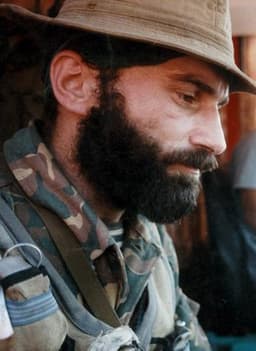
Shamil Basayev
Revolutionary · Modern
43.1Total
Basic Information
Born
1939
1965
Died
—
—
Era
Modern
Modern
Nationality
Congo
Chechnya
Occupation
Revolutionary
Revolutionary
Civilization
Other
Western
Score Comparison
Military (10%)
50.0
40.0
Political (20%)
32.1
35.0
Influence (20%)
43.2
45.5
Legacy (20%)
33.3
35.0
Leadership (15%)
39.0
57.1
Strategy (15%)
39.6
51.7
TOTAL
38.8
43.1
Laurent Kabila — Complete Timeline
1997 AD
Overthrew Mobutu Sese SekoWar
Laurent Kabila led the Alliance of Democratic Forces for the Liberation of Congo (AFDL) in a military campaign that ousted President Mobutu Sese Seko. The rebellion ended Mobutu's 32-year rule and Kabila declared himself president.
CongoRebellionMobutu
Impact: regional
Became President of the Democratic Republic of the CongoPolitical Action◆ Major
After overthrowing Mobutu, Laurent Kabila assumed the presidency of the Democratic Republic of the Congo (DRC). He renamed the country from Zaire back to DRC and began consolidating power.
PresidencyDRCPolitical Change
Impact: national
1998 AD
Initiated Second Congo WarWar
Kabila's decision to expel Rwandan and Ugandan allies from the DRC triggered the Second Congo War, involving multiple African nations. The conflict became the deadliest since World War II, causing millions of deaths.
Second Congo WarRegional ConflictHumanitarian Crisis
Impact: regionaltragic
2001 AD
AssassinatedPolitical Action◆ Major
Laurent Kabila was assassinated by a bodyguard at his presidential palace in Kinshasa. His death occurred amid the ongoing Second Congo War, and his son Joseph Kabila succeeded him as president.
AssassinationSuccessionPolitical Violence
Impact: nationaltragic
Shamil Basayev — Complete Timeline
1995 AD
Budyonnovsk Hospital Hostage CrisisWar◆ Major
Basayev led a raid on the Russian town of Budyonnovsk, taking over 1,000 hostages in a hospital. The crisis ended with a negotiated settlement that allowed him to return to Chechnya. This attack demonstrated Chechen reach into Russia.
Hostage CrisisTerrorismChechnya
Impact: nationaldestructive
1999 AD
Invasion of DagestanWar
Basayev led Chechen and Islamist fighters into Dagestan to support local rebels. This invasion triggered the Second Chechen War as Russia responded with a full-scale military campaign. The invasion failed to gain local support.
DagestanChechnyaInvasion
Impact: regionaldestructive
2002 AD
Moscow Theater Hostage CrisisWar◆ Major
Basayev orchestrated the Moscow theater hostage crisis, where Chechen militants took 850 people hostage. Russian forces ended the siege with gas, killing 130 hostages. The attack increased international condemnation of Chechen rebels.
Hostage CrisisTerrorismMoscow
Impact: nationaldestructive
2004 AD
Beslan School SiegeWar◆ Major
Basayev planned the Beslan school siege, where militants took over 1,100 people hostage. The siege ended in a bloody assault, resulting in 334 deaths, mostly children. This attack was widely condemned globally.
Hostage CrisisTerrorismBeslan
Impact: globaltragic
2006 AD
Killed by Russian ExplosivesWar◆ Major
Basayev was killed in Ingushetia when a truck loaded with explosives detonated. Russian intelligence claimed responsibility. His death removed the most prominent Chechen rebel commander.
AssassinationChechnyaRussia
Impact: regional
Expert Analysis
Origins
Laurent Kabila was born in 1939 in Jadotville, Belgian Congo (now Likasi, DRC). He was educated in France and Tanzania, where he studied political philosophy. His father was a Luba tribal chief, and Kabila became involved in leftist politics early, joining Patrice Lumumba's Mouvement National Congolais. After Lumumba's assassination in 1961, Kabila fled to eastern Congo and later established a Maoist rebel group in the Fizi region. He received support from China and Cuba, but remained a marginal figure for decades.
Shamil Basayev was born in 1965 in Vedeno, Chechnya, then part of the Soviet Union. He came from a Chechen family that had been deported to Kazakhstan in 1944. Basayev studied at a Moscow agricultural institute but dropped out. He worked as a computer salesman and played professional soccer before turning to militancy. In 1991, he participated in the failed coup attempt against Mikhail Gorbachev, then joined the Chechen independence movement.
Rise to Power
Kabila's rise began in 1996 when he became the figurehead of the Alliance of Democratic Forces for the Liberation of Congo (AFDL), a coalition backed by Rwanda and Uganda. The AFDL exploited the chaos after the Rwandan genocide and the weakness of Mobutu Sese Seko's regime. Kabila's forces advanced rapidly, capturing Kinshasa in May 1997. Mobutu fled, and Kabila declared himself president on May 17, 1997. He renamed the country the Democratic Republic of the Congo (DRC) and promised democratic reforms.
Basayev's rise came during the First Chechen War (1994-1996). He gained fame in 1995 by leading the Budyonnovsk hospital hostage crisis, taking over 1,000 hostages. The siege ended with a negotiated withdrawal, and Basayev became a hero in Chechnya. He was appointed prime minister of Chechnya in 1997 but lost the presidency to Aslan Maskhadov. Basayev then turned to Islamist militancy, forming ties with al-Qaeda and other jihadist groups. In 1999, he invaded Dagestan, triggering the Second Chechen War.
Leadership & Governance
Kabila's leadership was authoritarian and erratic. He centralized power, banned political parties, and suppressed dissent. He expelled Rwandan and Ugandan forces in 1998, which sparked the Second Congo War. Kabila's governance was marked by corruption and nepotism; he appointed family members to key posts. He failed to implement economic reforms, and the DRC's economy collapsed. Kabila scored 39.0 in leadership, reflecting his inability to build institutions.
Basayev never held sustained political power. He was a military commander, not a governor. His leadership was charismatic but ruthless, focusing on guerrilla tactics and terror. He organized attacks that killed hundreds of civilians. Basayev scored 57.1 in leadership, higher than Kabila, due to his ability to inspire fighters and plan complex operations. However, his governance score of 35.0 reflects his lack of administrative experience.
Triumph & Tragedy
Kabila's greatest triumph was overthrowing Mobutu, ending a 32-year dictatorship. He restored the name DRC and initially enjoyed popular support. However, his greatest failure was triggering the Second Congo War, which became Africa's deadliest conflict, killing over 5 million people. Kabila lost control of much of the country to rebels and foreign armies. He was assassinated in 2001 by a bodyguard, leaving a legacy of chaos.
Basayev's triumphs include the Budyonnovsk hostage crisis, which forced Russia to negotiate, and the 1996 Chechen victory. He scored 40.0 in military, reflecting his tactical successes. His tragedies were the Beslan school siege in 2004, where 334 died, and the Moscow theater crisis (2002), where 130 hostages died. These attacks turned global opinion against the Chechen cause. Basayev was killed in 2006 by Russian explosives.
Character & Destiny
Kabila was secretive and suspicious, often isolating himself. He relied on foreign backers but distrusted them. His decision to expel Rwandans was impulsive, leading to disaster. He was pragmatic but lacked strategic vision. Historians assess him as a weak leader who failed to transition from rebel to statesman.
Basayev was fanatical and unpredictable. He embraced martyrdom and used extreme violence. His tactics earned him the label of terrorist. He was a skilled tactician but a poor strategist, as his attacks strengthened Russian resolve. His character led to his violent death and the delegitimization of the Chechen cause.
Legacy
Kabila's legacy is mixed. He ended Mobutu's rule but plunged the DRC into war. His son Joseph Kabila succeeded him and stabilized the country somewhat. The DRC remains fragile. Kabila's influence score is 43.2, indicating some impact but limited positive change.
Basayev's legacy is that of a terrorist. He inspired other jihadists but damaged Chechnya's independence movement. Chechnya is now under Russian control. His influence score is 45.5, reflecting his notoriety. Both leaders left negative legacies, but Basayev's actions had a more direct impact on global terrorism.
Conclusion
While Shamil Basayev scored higher overall (43.1 vs 38.8), his impact was more destructive and limited to a regional conflict. Laurent Kabila's actions led to a multi-national war that reshaped Central Africa. Kabila's overthrow of Mobutu was a significant event, but his failure to govern caused immense suffering. Basayev's tactics, though effective in the short term, ultimately failed to achieve Chechen independence. Taking a clear position, Kabila had a greater historical impact because his actions involved multiple countries and millions of lives. However, neither leader left a positive legacy. The comparison shows that revolutionary success does not guarantee effective governance or lasting peace.
Rankings
🥇
Shamil BasayevLeader
Mil: 40.0Pol: 35.0Inf: 45.5
43.1
🥈
Laurent Kabila
Mil: 50.0Pol: 32.1Inf: 43.2
38.8
+4.3 behind
How This Comparison Works
Algorithm
Each figure is scored on 6 dimensions (0—100 scale) based on structured historical data: Military (10%), Political (20%), Influence (20%), Legacy (20%), Leadership (15%), Strategy (15%). The weighted total produces the final ranking.
Data Sources
Scores are computed from structured sub-indicators in the database. Scale factors adjust for era (Ancient ×0.85, Modern ×1.0) and civilization size (Eastern ×1.05, Other ×0.80) to account for differences in population and military scale.
Maximum 3 Figures
Comparisons are limited to 2—3 figures to ensure readability and statistical meaningfulness.
Error Margins
±5 points per dimension — Sub-scores are derived from historical records with inherent uncertainty. Two figures within 5 points on a dimension should be considered roughly equivalent in that area.
Total Score Accuracy
±3 points overall — The weighted combination of 6 dimensions produces a total score with approximately ±3 points of uncertainty. Differences of less than 3 points are not statistically significant— the figures are effectively tied.
Known Limitations
- Historical records are incomplete and uneven across civilizations
- Figures from oral-tradition societies may be underrepresented
- Occupation labels can misclassify multi-role figures
- Scores measure capability and impact, not moral character
- Quantitative scoring is a comparison tool, not absolute truth
Capability Radar
Military (10%) — Battles & Warfare
Battles
25
45
Win Rate
30
40
Expansion
15
15
Political (20%) — Governance & Reform
Reform
10
5
Diplomacy
15
10
Economy
5
5
Influence (20%) — Cultural & Global Reach
Cultural
10
20
Global
15
20
Legacy (20%) — Historical Impact
Historical
20
25
Longevity
10
15
Leadership (15%) — Power & Stability
Tenure
20
10
Stability
5
5
Strategy (15%) — Tactics & Innovation
Strategy
25
35
Tactics
20
55
Reform
10
20
Similar Comparisons
Comments & Discussion
No comments yet. Be the first to share your thoughts!