Loading...
This comparison has not been analyzed yet.
One-time AI generation (~1 minute). Scores and timeline are already available below.
Leopoldo Galtieri vs Phibun
Phibun leads by 16.3 pts · 2 figures compared
…
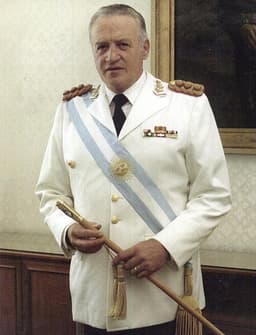
Leopoldo Galtieri
General · Modern
36.2Total

Phibun
General · Modern
52.5Total
Basic Information
Born
1926
1897
Died
—
1964
Era
Modern
Modern
Nationality
Argentina
Thailand
Occupation
General
General
Civilization
Western
Eastern
Score Comparison
Military (10%)
21.2
47.5
Political (20%)
26.4
48.0
Influence (20%)
49.4
58.0
Legacy (20%)
38.3
45.0
Leadership (15%)
30.0
71.0
Strategy (15%)
36.8
41.7
TOTAL
36.2
52.5
Leopoldo Galtieri — Complete Timeline
1981 AD
Appointed President of Argentina by the military juntaPolitical Action◆ Major
On December 22, 1981, Leopoldo Galtieri was appointed President of Argentina by the military junta, replacing Roberto Viola. Galtieri was a hardline general who sought to consolidate power and address economic problems through nationalist policies.
PresidencyMilitary DictatorshipNational Reorganization Process
Impact: national
1982 AD
Launched the Falklands WarWar
On April 2, 1982, Galtieri ordered the Argentine invasion of the Falkland Islands, a British Overseas Territory. The military junta aimed to rally nationalist support and distract from economic crisis. The invasion led to a 10-week war with the United Kingdom.
Falklands WarInvasionNationalism
Impact: globaldestructive
Surrendered to British forces after the Falklands defeatWar◆ Major
On June 14, 1982, Argentine forces surrendered to the British in the Falkland Islands after a decisive defeat. The war resulted in 649 Argentine deaths and the loss of the islands. Galtieri's gamble failed, leading to his downfall.
Falklands WarSurrenderDefeat
Impact: globaltragic
Resigned as President after the Falklands defeatPolitical Action◆ Major
On June 17, 1982, Leopoldo Galtieri resigned as President of Argentina following the military defeat in the Falklands War. His resignation marked the beginning of the end of the military dictatorship, as public outrage and internal dissent grew.
ResignationEnd of DictatorshipFalklands War
Impact: nationaltragic
1986 AD
Convicted for human rights crimes and sentenced to prisonPolitical Action◆ Major
In 1986, Leopoldo Galtieri was convicted by Argentine courts for human rights abuses committed during the Dirty War, including torture and forced disappearances. He was sentenced to 12 years in prison, but was later pardoned in 1989.
Human Rights TrialDirty WarConviction
Impact: nationaldestructive
Phibun — Complete Timeline
1938 AD
Led a coup to become Prime MinisterPolitical Action◆ Major
Phibun (Plaek Phibunsongkhram) became Prime Minister of Thailand after a coup that ousted the previous government. He established a military dictatorship and promoted Thai nationalism.
CoupDictatorshipNationalism
Impact: national
1939 AD
Renamed Siam to ThailandPolitical Action◆ Major
Phibun officially changed the country's name from Siam to Thailand (Prathet Thai), meaning 'Land of the Free'. This was part of his nationalist campaign to unify the Thai people and assert national identity.
NationalismName ChangeIdentity
Impact: nationalconstructive
1941 AD
Allied with Japan during World War IIWar◆ Major
Phibun allied Thailand with Japan after the Japanese invasion of Thailand in December 1941. He declared war on the Allies and allowed Japanese forces to use Thai territory for their campaigns in Southeast Asia.
World War IIAllianceJapan
Impact: regionaldestructive
1944 AD
Resigned after World War IIPolitical Action
Phibun resigned as Prime Minister in 1944 as the tide of war turned against Japan. He was replaced by a civilian government, but he remained influential and later returned to power.
ResignationPost-warPolitical Change
Impact: national
1948 AD
Returned to power in a coupPolitical Action◆ Major
Phibun returned to power through a military coup in 1948, overthrowing the civilian government. He ruled as a military dictator until 1957, aligning Thailand with the United States during the Cold War.
CoupCold WarDictatorship
Impact: national
This comparison has not been analyzed yet.
One-time AI generation (~1 minute). Scores and timeline are already available below.
Rankings
🥇
PhibunLeader
Mil: 47.5Pol: 48.0Inf: 58.0
52.5
🥈
Leopoldo Galtieri
Mil: 21.2Pol: 26.4Inf: 49.4
36.2
+16.3 behind
How This Comparison Works
Algorithm
Each figure is scored on 6 dimensions (0—100 scale) based on structured historical data: Military (10%), Political (20%), Influence (20%), Legacy (20%), Leadership (15%), Strategy (15%). The weighted total produces the final ranking.
Data Sources
Scores are computed from structured sub-indicators in the database. Scale factors adjust for era (Ancient ×0.85, Modern ×1.0) and civilization size (Eastern ×1.05, Other ×0.80) to account for differences in population and military scale.
Maximum 3 Figures
Comparisons are limited to 2—3 figures to ensure readability and statistical meaningfulness.
Error Margins
±5 points per dimension — Sub-scores are derived from historical records with inherent uncertainty. Two figures within 5 points on a dimension should be considered roughly equivalent in that area.
Total Score Accuracy
±3 points overall — The weighted combination of 6 dimensions produces a total score with approximately ±3 points of uncertainty. Differences of less than 3 points are not statistically significant— the figures are effectively tied.
Known Limitations
- Historical records are incomplete and uneven across civilizations
- Figures from oral-tradition societies may be underrepresented
- Occupation labels can misclassify multi-role figures
- Scores measure capability and impact, not moral character
- Quantitative scoring is a comparison tool, not absolute truth
Capability Radar
Military (10%) — Battles & Warfare
Battles
10
20
Win Rate
5
15
Expansion
5
25
Political (20%) — Governance & Reform
Reform
5
40
Diplomacy
10
30
Economy
5
35
Influence (20%) — Cultural & Global Reach
Cultural
10
30
Global
15
30
Legacy (20%) — Historical Impact
Historical
20
40
Longevity
10
20
Leadership (15%) — Power & Stability
Tenure
15
65
Stability
5
25
Strategy (15%) — Tactics & Innovation
Strategy
10
20
Tactics
15
25
Reform
5
30
Similar Comparisons
Comments & Discussion
No comments yet. Be the first to share your thoughts!