Loading...
Li Xiannian vs Wang Jingwei
Li Xiannian leads by 8.4 pts · 2 figures compared
…
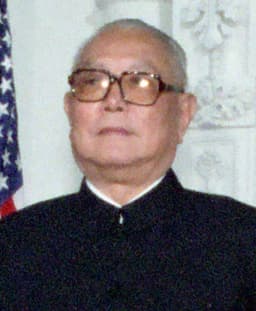
Li Xiannian
Politician · Modern
52.1Total

Wang Jingwei
Politician · Modern
43.7Total
Basic Information
Born
1909
1883
Died
1992
1944
Era
Modern
Modern
Nationality
China
China
Occupation
Politician
Politician
Civilization
Eastern
Eastern
Score Comparison
Military (10%)
11.5
36.6
Political (20%)
60.0
26.4
Influence (20%)
56.4
50.2
Legacy (20%)
50.0
40.0
Leadership (15%)
80.0
55.3
Strategy (15%)
33.7
52.8
TOTAL
52.1
43.7
Li Xiannian — Complete Timeline
1934 AD
Participated in the Long MarchWar◆ Major
Li Xiannian joined the Long March as a political commissar, leading troops through harsh conditions. He later became a key military commander in the Communist forces during the Chinese Civil War.
Long MarchChinese Civil WarMilitary Commander
Impact: national
1954 AD
Served as Minister of FinancePolitical Action◆ Major
Li Xiannian was appointed Minister of Finance, overseeing China's economic planning during the First Five-Year Plan. He implemented Soviet-style central planning and managed the national budget.
Economic PlanningFive-Year PlanFinance
Impact: nationalconstructive
1978 AD
Supported Deng Xiaoping's economic reformsReform◆ Major
Li Xiannian supported Deng Xiaoping's market-oriented reforms, helping to shift China from a planned economy to a more market-based system. He advocated for agricultural decollectivization and foreign investment.
Deng XiaopingEconomic ReformMarket Economy
Impact: nationalconstructive
1983 AD
Became President of the People's Republic of ChinaPolitical Action◆ Major
Li Xiannian was elected President of the PRC, serving until 1988. He was a ceremonial head of state but also a member of the Politburo Standing Committee, influencing economic policy.
PresidencyPRCEconomic Policy
Impact: nationalconstructive
1992 AD
Died in office as PresidentOther
Li Xiannian died while still serving as President of the PRC. His death marked the end of an era of revolutionary-era leaders in Chinese politics.
DeathPresidencyRevolutionary Era
Impact: national
Wang Jingwei — Complete Timeline
1910 AD
Assassination attempt on Prince Regent ZaifengPolitical Action◆ Major
Wang Jingwei attempted to assassinate the Prince Regent Zaifeng in Beijing using a bomb. The plot failed, and Wang was arrested and imprisoned, gaining fame as a revolutionary martyr.
RevolutionaryAssassination AttemptQing Dynasty
Impact: nationaldestructive
1927 AD
Became head of the Kuomintang government in WuhanPolitical Action◆ Major
Wang Jingwei led the left-wing Kuomintang government in Wuhan, opposing Chiang Kai-shek's right-wing faction in Nanjing. This split the KMT and led to the purge of Communists from the Wuhan government.
Kuomintang SplitWuhan GovernmentChinese Civil War
Impact: nationaldestructive
1940 AD
Formed the Wang Jingwei regimePolitical Action◆ Major
Wang Jingwei established a collaborationist government in Nanjing under Japanese occupation, serving as its president. This regime was recognized by the Axis powers and opposed by the Chinese Nationalists and Communists.
CollaborationWorld War IIJapanese Occupation
Impact: nationaldestructive
Signed the Basic Treaty with JapanPolitical Action◆ Major
Wang Jingwei's government signed the Basic Treaty with Japan, which recognized Manchukuo and granted Japan extensive economic and military rights in China. This treaty formalized the collaborationist relationship.
CollaborationTreatyWorld War II
Impact: nationaldestructive
1944 AD
Died in Nagoya, JapanOther◆ Major
Wang Jingwei died in Nagoya, Japan, where he had been receiving medical treatment. His death ended the collaborationist regime, which collapsed after Japan's surrender in 1945.
DeathCollaborationWorld War II
Impact: nationaltragic
Expert Analysis
Origins
Li Xiannian was born on June 23, 1909, in Huang'an, Hubei province, into a poor peasant family. He received minimal formal education but joined the Chinese Communist Party (CCP) in 1927 during the Autumn Harvest Uprising. Wang Jingwei was born on May 4, 1883, in Panyu, Guangdong, into a scholarly family. He studied in Japan and became a follower of Sun Yat-sen, joining the Tongmenghui in 1905. Wang's early background was cosmopolitan, while Li's was rooted in rural poverty.
Rise to Power
Li Xiannian rose through the CCP's military ranks, participating in the Long March (1934-1935) as a political commissar. His key turning point came in 1949 when he was appointed Minister of Finance, overseeing economic planning during the First Five-Year Plan (1953-1957). He became a member of the Politburo in 1956. Wang Jingwei gained fame for his 1910 assassination attempt on Prince Regent Zaifeng, which made him a revolutionary hero. He became head of the left-wing Kuomintang government in Wuhan in 1927, opposing Chiang Kai-shek. However, after Japan invaded China, Wang defected and formed a collaborationist regime in Nanjing in 1940, serving as its president until his death in 1944.
Leadership & Governance
Li Xiannian's leadership style was pragmatic and technocratic. As Minister of Finance, he implemented Soviet-style central planning but later supported Deng Xiaoping's market reforms. He scored 80.0 in leadership, reflecting his ability to adapt and manage economic transitions. Wang Jingwei's leadership was more ideological but ultimately compromised. He scored 55.3 in leadership, as his collaboration with Japan undermined his legitimacy. Wang's regime signed the Basic Treaty with Japan in 1940, granting Japan extensive rights, which alienated many Chinese.
Triumph & Tragedy
Li Xiannian's greatest success was his role in China's economic development, particularly his support for Deng's reforms, which helped lift millions out of poverty. His failure includes the Cultural Revolution period, where he was criticized but managed to survive politically. Wang Jingwei's early triumph was his revolutionary activity; his tragedy was his collaboration, which led to his regime being labeled as a puppet. He died in Nagoya, Japan, in 1944, disgraced by history.
Character & Destiny
Li Xiannian was known for his caution and pragmatism, which allowed him to navigate the CCP's internal politics. His character led him to a steady rise to the presidency, serving from 1983 to 1988. Wang Jingwei was idealistic but ultimately made a fatal miscalculation, believing collaboration could save China from destruction. His decision to collaborate sealed his fate as a traitor in Chinese historiography.
Legacy
Li Xiannian's legacy is that of a key economic planner who helped modernize China. He scored 56.4 in influence and 50.0 in legacy, reflecting his role in shaping China's economic path. Wang Jingwei's legacy is overwhelmingly negative; he is remembered as a traitor. His influence score of 50.2 is inflated by his early revolutionary role, but his legacy score of 40.0 reflects the stigma of collaboration.
Conclusion
Li Xiannian had a greater impact on China's development than Wang Jingwei. Despite Wang's early revolutionary contributions, his collaboration with Japan nullified his positive legacy. Li's pragmatic economic policies, scoring 80.0 in leadership, contributed to China's transformation. Wang's total score of 43.7 is significantly lower than Li's 52.1, supporting the conclusion that Li's influence was more enduring and constructive.
Rankings
🥇
Li XiannianLeader
Mil: 11.5Pol: 60.0Inf: 56.4
52.1
🥈
Wang Jingwei
Mil: 36.6Pol: 26.4Inf: 50.2
43.7
+8.4 behind
How This Comparison Works
Algorithm
Each figure is scored on 6 dimensions (0—100 scale) based on structured historical data: Military (10%), Political (20%), Influence (20%), Legacy (20%), Leadership (15%), Strategy (15%). The weighted total produces the final ranking.
Data Sources
Scores are computed from structured sub-indicators in the database. Scale factors adjust for era (Ancient ×0.85, Modern ×1.0) and civilization size (Eastern ×1.05, Other ×0.80) to account for differences in population and military scale.
Maximum 3 Figures
Comparisons are limited to 2—3 figures to ensure readability and statistical meaningfulness.
Error Margins
±5 points per dimension — Sub-scores are derived from historical records with inherent uncertainty. Two figures within 5 points on a dimension should be considered roughly equivalent in that area.
Total Score Accuracy
±3 points overall — The weighted combination of 6 dimensions produces a total score with approximately ±3 points of uncertainty. Differences of less than 3 points are not statistically significant— the figures are effectively tied.
Known Limitations
- Historical records are incomplete and uneven across civilizations
- Figures from oral-tradition societies may be underrepresented
- Occupation labels can misclassify multi-role figures
- Scores measure capability and impact, not moral character
- Quantitative scoring is a comparison tool, not absolute truth
Capability Radar
Military (10%) — Battles & Warfare
Battles
15
5
Win Rate
16
5
Expansion
22
5
Political (20%) — Governance & Reform
Reform
60
20
Diplomacy
65
15
Economy
70
10
Influence (20%) — Cultural & Global Reach
Cultural
30
15
Global
40
15
Legacy (20%) — Historical Impact
Historical
55
20
Longevity
40
10
Leadership (15%) — Power & Stability
Tenure
75
40
Stability
60
10
Strategy (15%) — Tactics & Innovation
Strategy
23
5
Tactics
29
5
Reform
26
5
Similar Comparisons
Comments & Discussion
No comments yet. Be the first to share your thoughts!