Loading...
Li Zongren vs Robert Nivelle
Li Zongren leads by 19.0 pts · 2 figures compared
…
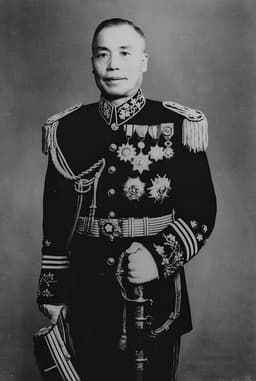
Li Zongren
General · Modern
58.5Total

Robert Nivelle
General · Modern
39.5Total
Basic Information
Born
1890
1856
Died
1969
1924
Era
Modern
Modern
Nationality
China
France
Occupation
General
General
Civilization
Eastern
Western
Score Comparison
Military (10%)
65.0
25.9
Political (20%)
53.8
26.4
Influence (20%)
58.0
52.5
Legacy (20%)
52.0
45.0
Leadership (15%)
72.0
40.4
Strategy (15%)
56.8
25.0
TOTAL
58.5
39.5
Li Zongren — Complete Timeline
1921 AD
Command of the Guangxi ArmyPolitical Action◆ Major
Li Zongren became a commander in the Guangxi Army and helped unify Guangxi province under the New Guangxi Clique. He established a powerful regional base that rivaled other warlords.
Guangxi CliqueMilitary CommandWarlord Era
Impact: regional
1926 AD
Alliance with the Nationalist GovernmentPolitical Action◆ Major
Li Zongren allied the Guangxi Clique with Chiang Kai-shek's Nationalist government during the Northern Expedition. His forces played a key role in defeating warlords and unifying China under KMT rule.
Northern ExpeditionAllianceKMT
Impact: nationalconstructive
1938 AD
Battle of TaierzhuangWar
Li Zongren commanded Chinese forces to a major victory over the Japanese at the Battle of Taierzhuang during the Second Sino-Japanese War. This was the first significant Chinese victory of the war and boosted national morale.
Second Sino-Japanese WarBattleVictory
Impact: nationalconstructive
1949 AD
Acting Presidency of the Republic of ChinaPolitical Action◆ Major
Li Zongren served as Acting President of the Republic of China after Chiang Kai-shek's resignation during the Chinese Civil War. He attempted to negotiate peace with the Communists but failed, leading to the KMT's retreat to Taiwan.
Chinese Civil WarPresidencyKMT
Impact: nationaltragic
Exile to the United StatesPolitical Action
After the Communist victory, Li Zongren fled to the United States, where he lived in exile. He criticized Chiang Kai-shek's leadership and advocated for a reformed KMT, but remained politically marginalized.
ExileChinese Civil WarPolitics
Impact: nationaltragic
Robert Nivelle — Complete Timeline
1917 AD
Nivelle OffensiveWar
Nivelle, as Commander-in-Chief of the French Army, launched a massive offensive on the Chemin des Dames. The attack failed to achieve a breakthrough and resulted in enormous French casualties, leading to widespread mutinies.
World War IWestern FrontOffensive
Impact: nationaldestructive
Replaced After the MutiniesPolitical Action◆ Major
Following the failure of his offensive and the resulting mutinies, Nivelle was removed from command and replaced by Philippe P
World War ICommandDismissal
Impact: national
Expert Analysis
Origins
Li Zongren was born in 1890 in Guilin, Guangxi, China, into a farming family. He received a traditional Confucian education before entering the Guangxi Military Academy in 1908. His early career was shaped by the chaos of the Warlord Era, as he joined the Old Guangxi Clique and later formed the New Guangxi Clique with Bai Chongxi and Huang Shaoxiong. Li's military acumen and political pragmatism allowed him to consolidate control over Guangxi by 1925, establishing a base that would support his later national ambitions.
Robert Nivelle was born in 1856 in Tulle, France, to a French father and English mother. He attended the École Polytechnique and began his military career as an artillery officer. Nivelle served in French colonial campaigns in China and Algeria, and during World War I, he commanded at the Battle of Verdun in 1916. His aggressive tactics and initial successes there, including the recapture of Fort Douaumont, earned him a reputation as a decisive leader, leading to his appointment as Commander-in-Chief of the French Army in December 1916.
Rise to Power
Li Zongren's rise began with his role in the Guangxi Pacification Campaign (1924-1925), where he defeated the Old Guangxi Clique and unified the province. He then allied with Chiang Kai-shek's Nationalist government during the Northern Expedition (1926-1928), commanding the 7th Army. Li's forces played a key role in capturing Wuhan and defeating the warlord Sun Chuanfang. After the Northern Expedition, he served as chairman of the Guangxi provincial government and commanded the 4th Route Army. His influence peaked during the Second Sino-Japanese War, when he led Chinese forces at the Battle of Taierzhuang in 1938, scoring a 65.0 in military score.
Robert Nivelle's rise was fueled by his success at Verdun. In December 1916, he replaced General Joseph Joffre as Commander-in-Chief of the French Army. Nivelle promised a quick and decisive victory with a massive offensive on the Chemin des Dames, using new artillery tactics. His confidence and oratory skills won over French politicians, including Prime Minister Aristide Briand. However, his plan was based on flawed intelligence and underestimated German defenses.
Leadership & Governance
Li Zongren's leadership style was pragmatic and focused on regional autonomy. As a warlord, he governed Guangxi with a mix of military control and administrative reform, implementing policies that improved local infrastructure and education. During the Second Sino-Japanese War, he coordinated multiple regional armies under the Nationalist banner, demonstrating diplomatic skill. His political score of 53.8 reflects his ability to navigate the complex factionalism of Republican China. However, his leadership was often reactive, and he struggled to assert his authority nationally.
Robert Nivelle's leadership was characterized by overconfidence and inflexibility. He ignored warnings from subordinates about German defenses and maintained the offensive despite heavy casualties. His governance approach was top-down, with little consultation. After the Nivelle Offensive failed in April 1917, resulting in 187,000 French casualties, widespread mutinies broke out among French soldiers. Nivelle's leadership score of 40.4 and strategy score of 25.0 reflect his catastrophic decision-making.
Triumph & Tragedy
Li Zongren's greatest triumph was the Battle of Taierzhuang (March-April 1938), where his forces defeated the Japanese 10th Division, inflicting over 10,000 casualties. This victory boosted Chinese morale and proved that Chinese forces could stand against the Japanese. However, his tragedy came during the Chinese Civil War. As acting President of the Republic of China in 1949, he attempted to negotiate peace with the Communists but failed. He then fled to the United States, living in exile until 1965. His legacy score of 52.0 reflects his mixed impact.
Robert Nivelle's triumph was his early command at Verdun, where he recaptured Fort Douaumont in October 1916. However, his tragedy was the Nivelle Offensive of 1917, which failed to achieve its objectives and led to massive casualties and mutinies. He was removed from command in May 1917 and replaced by Philippe Pétain. Nivelle's military score of 25.9 and total score of 39.5 place him among the least effective generals.
Character & Destiny
Li Zongren was a pragmatic and cautious leader, often balancing between military action and political negotiation. His character allowed him to survive the turbulent Warlord Era and even reach the presidency, but his indecision during the Civil War led to his downfall. Historians describe him as a capable regional leader who lacked the ruthlessness to compete on the national stage.
Robert Nivelle was overly confident and ambitious, traits that led to his rapid rise and fall. His failure to adapt to the realities of trench warfare and his dismissal of dissenting opinions sealed his fate. He is often cited as an example of the dangers of hubris in military command.
Legacy
Li Zongren's legacy is primarily as a Chinese nationalist who contributed to the war effort against Japan. His victory at Taierzhuang is still celebrated in China. After returning from exile in 1965, he lived in mainland China until his death in 1969, but his political influence was minimal. He scored 58.0 in influence.
Robert Nivelle's legacy is overwhelmingly negative. His name is synonymous with failed offensives and military incompetence. The Nivelle Offensive is a case study in poor planning and leadership. His influence score of 52.5 is relatively high due to the historical significance of his failure.
Conclusion
Li Zongren had a greater overall impact than Robert Nivelle, as reflected in his total score of 58.5 versus Nivelle's 39.5. While Nivelle's failure was historically significant, Li's military victory at Taierzhuang had a tangible effect on the course of World War II in Asia. Li's leadership score of 72.0 far exceeds Nivelle's 40.4, and his ability to govern and maintain power over decades demonstrates greater capability. Therefore, Li Zongren is the more impactful figure.
Rankings
🥇
Li ZongrenLeader
Mil: 65.0Pol: 53.8Inf: 58.0
58.5
🥈
Robert Nivelle
Mil: 25.9Pol: 26.4Inf: 52.5
39.5
+19.0 behind
How This Comparison Works
Algorithm
Each figure is scored on 6 dimensions (0—100 scale) based on structured historical data: Military (10%), Political (20%), Influence (20%), Legacy (20%), Leadership (15%), Strategy (15%). The weighted total produces the final ranking.
Data Sources
Scores are computed from structured sub-indicators in the database. Scale factors adjust for era (Ancient ×0.85, Modern ×1.0) and civilization size (Eastern ×1.05, Other ×0.80) to account for differences in population and military scale.
Maximum 3 Figures
Comparisons are limited to 2—3 figures to ensure readability and statistical meaningfulness.
Error Margins
±5 points per dimension — Sub-scores are derived from historical records with inherent uncertainty. Two figures within 5 points on a dimension should be considered roughly equivalent in that area.
Total Score Accuracy
±3 points overall — The weighted combination of 6 dimensions produces a total score with approximately ±3 points of uncertainty. Differences of less than 3 points are not statistically significant— the figures are effectively tied.
Known Limitations
- Historical records are incomplete and uneven across civilizations
- Figures from oral-tradition societies may be underrepresented
- Occupation labels can misclassify multi-role figures
- Scores measure capability and impact, not moral character
- Quantitative scoring is a comparison tool, not absolute truth
Capability Radar
Military (10%) — Battles & Warfare
Battles
65
15
Win Rate
60
10
Expansion
60
5
Political (20%) — Governance & Reform
Reform
45
5
Diplomacy
60
10
Economy
40
5
Influence (20%) — Cultural & Global Reach
Cultural
40
10
Global
40
15
Legacy (20%) — Historical Impact
Historical
55
30
Longevity
45
20
Leadership (15%) — Power & Stability
Tenure
55
30
Stability
35
5
Strategy (15%) — Tactics & Innovation
Strategy
68
10
Tactics
70
20
Reform
55
5
Similar Comparisons
Comments & Discussion
No comments yet. Be the first to share your thoughts!