Loading...
This comparison has not been analyzed yet.
One-time AI generation (~1 minute). Scores and timeline are already available below.
Li Zongren vs Vasily Chuikov
Vasily Chuikov leads by 4.3 pts · 2 figures compared
…
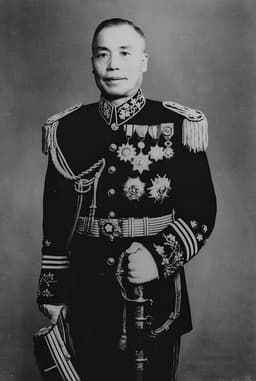
Li Zongren
General · Modern
58.5Total

Vasily Chuikov
General · Modern
62.8Total
Basic Information
Born
1890
1900
Died
1969
1982
Era
Modern
Modern
Nationality
China
USSR
Occupation
General
General
Civilization
Eastern
Western
Score Comparison
Military (10%)
65.0
78.0
Political (20%)
53.8
68.0
Influence (20%)
58.0
65.0
Legacy (20%)
52.0
55.0
Leadership (15%)
72.0
48.8
Strategy (15%)
56.8
75.0
TOTAL
58.5
62.8
Li Zongren — Complete Timeline
1921 AD
Command of the Guangxi ArmyPolitical Action◆ Major
Li Zongren became a commander in the Guangxi Army and helped unify Guangxi province under the New Guangxi Clique. He established a powerful regional base that rivaled other warlords.
Guangxi CliqueMilitary CommandWarlord Era
Impact: regional
1926 AD
Alliance with the Nationalist GovernmentPolitical Action◆ Major
Li Zongren allied the Guangxi Clique with Chiang Kai-shek's Nationalist government during the Northern Expedition. His forces played a key role in defeating warlords and unifying China under KMT rule.
Northern ExpeditionAllianceKMT
Impact: nationalconstructive
1938 AD
Battle of TaierzhuangWar
Li Zongren commanded Chinese forces to a major victory over the Japanese at the Battle of Taierzhuang during the Second Sino-Japanese War. This was the first significant Chinese victory of the war and boosted national morale.
Second Sino-Japanese WarBattleVictory
Impact: nationalconstructive
1949 AD
Acting Presidency of the Republic of ChinaPolitical Action◆ Major
Li Zongren served as Acting President of the Republic of China after Chiang Kai-shek's resignation during the Chinese Civil War. He attempted to negotiate peace with the Communists but failed, leading to the KMT's retreat to Taiwan.
Chinese Civil WarPresidencyKMT
Impact: nationaltragic
Exile to the United StatesPolitical Action
After the Communist victory, Li Zongren fled to the United States, where he lived in exile. He criticized Chiang Kai-shek's leadership and advocated for a reformed KMT, but remained politically marginalized.
ExileChinese Civil WarPolitics
Impact: nationaltragic
Vasily Chuikov — Complete Timeline
1942 AD
Defense of StalingradWar
Chuikov commanded the 62nd Army during the Battle of Stalingrad. His forces held the city against the German 6th Army through intense urban combat, preventing its capture and enabling the Soviet counteroffensive.
World War IIStalingradUrban Combat
Impact: global
1944 AD
Operation BagrationWar◆ Major
Chuikov's 8th Guards Army participated in Operation Bagration, the Soviet offensive that destroyed German Army Group Center. His forces advanced through Belarus and into Poland, contributing to the liberation of Minsk.
World War IIOffensiveBelarus
Impact: regional
1945 AD
Battle of BerlinWar◆ Major
Chuikov's 8th Guards Army led the assault on Berlin, fighting through the city to the Reichstag. He accepted the surrender of German forces in Berlin on May 2, 1945.
World War IIBerlinSurrender
Impact: global
1960 AD
Appointment as Commander-in-Chief of Soviet Ground ForcesPolitical Action
Chuikov was appointed Commander-in-Chief of the Soviet Ground Forces. He held this position until 1964, overseeing the modernization of the army during the Cold War.
Cold WarGround ForcesLeadership
Impact: national
This comparison has not been analyzed yet.
One-time AI generation (~1 minute). Scores and timeline are already available below.
Rankings
🥇
Vasily ChuikovLeader
Mil: 78.0Pol: 68.0Inf: 65.0
62.8
🥈
Li Zongren
Mil: 65.0Pol: 53.8Inf: 58.0
58.5
+4.3 behind
How This Comparison Works
Algorithm
Each figure is scored on 6 dimensions (0—100 scale) based on structured historical data: Military (10%), Political (20%), Influence (20%), Legacy (20%), Leadership (15%), Strategy (15%). The weighted total produces the final ranking.
Data Sources
Scores are computed from structured sub-indicators in the database. Scale factors adjust for era (Ancient ×0.85, Modern ×1.0) and civilization size (Eastern ×1.05, Other ×0.80) to account for differences in population and military scale.
Maximum 3 Figures
Comparisons are limited to 2—3 figures to ensure readability and statistical meaningfulness.
Error Margins
±5 points per dimension — Sub-scores are derived from historical records with inherent uncertainty. Two figures within 5 points on a dimension should be considered roughly equivalent in that area.
Total Score Accuracy
±3 points overall — The weighted combination of 6 dimensions produces a total score with approximately ±3 points of uncertainty. Differences of less than 3 points are not statistically significant— the figures are effectively tied.
Known Limitations
- Historical records are incomplete and uneven across civilizations
- Figures from oral-tradition societies may be underrepresented
- Occupation labels can misclassify multi-role figures
- Scores measure capability and impact, not moral character
- Quantitative scoring is a comparison tool, not absolute truth
Capability Radar
Military (10%) — Battles & Warfare
Battles
65
85
Win Rate
60
80
Expansion
60
60
Political (20%) — Governance & Reform
Reform
45
50
Diplomacy
60
50
Economy
40
40
Influence (20%) — Cultural & Global Reach
Cultural
40
65
Global
40
65
Legacy (20%) — Historical Impact
Historical
55
75
Longevity
45
60
Leadership (15%) — Power & Stability
Tenure
55
55
Stability
35
50
Strategy (15%) — Tactics & Innovation
Strategy
68
85
Tactics
70
90
Reform
55
70
Similar Comparisons
Comments & Discussion
No comments yet. Be the first to share your thoughts!