Loading...
Lon Nol vs Napoleon Bonaparte
Napoleon Bonaparte leads by 29.4 pts · 2 figures compared
…
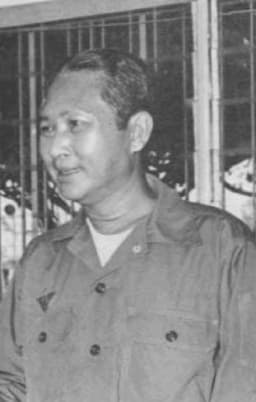
Lon Nol
General · Modern
41.5Total

Napoleon Bonaparte
General · Modern
70.9Total
Basic Information
Born
1913
1769
Died
1985
1821
Era
Modern
Modern
Nationality
Cambodia
France
Occupation
General
General
Civilization
Eastern
Western
Score Comparison
Military (10%)
25.9
94.0
Political (20%)
30.8
72.0
Influence (20%)
47.9
40.0
Legacy (20%)
38.3
80.0
Leadership (15%)
61.1
78.0
Strategy (15%)
35.7
90.0
TOTAL
41.5
70.9
Lon Nol — Complete Timeline
1970 AD
Coup against Norodom SihanoukPolitical Action
Lon Nol led a military coup that overthrew King Sihanouk while he was abroad. He established the Khmer Republic, ending the monarchy and aligning Cambodia with the United States during the Vietnam War.
CoupKhmer RepublicUS alliance
Impact: nationaldestructive
Declaration of the Khmer RepublicPolitical Action◆ Major
Lon Nol officially proclaimed the Khmer Republic, abolishing the monarchy. He became president and implemented a pro-American, anti-communist regime, which led to civil war with the Khmer Rouge and North Vietnamese forces.
RepublicRegime changeCivil War
Impact: national
1975 AD
Fall of Phnom PenhWar
Lon Nol's government collapsed as Khmer Rouge forces captured Phnom Penh. He fled into exile in the United States, ending the Khmer Republic and leading to the establishment of Democratic Kampuchea under Pol Pot.
Khmer Rouge victoryExileRegime collapse
Impact: nationaltragic
Napoleon Bonaparte — Complete Timeline
1799 AD
Coup of 18 BrumaireOther◆ Major
Napoleon Bonaparte, with support from his brother Lucien and key political figures, overthrew the Directory in a bloodless coup. He established the Consulate with himself as First Consul, effectively becoming the ruler of France. This event ended the French Revolution's most unstable period.
French RevolutionCoupRise to Power
Impact: regional
1804 AD
Promulgation of the Napoleonic CodeOther◆ Major
Napoleon enacted the Civil Code of the French, known as the Napoleonic Code, a comprehensive set of laws that replaced the fragmented feudal legal systems. The code established legal equality, protected property rights, and secularized law. It became the basis for legal systems in many European and world countries.
Legal ReformNapoleonic CodeCivil Law
Impact: globalconstructive
1805 AD
Battle of AusterlitzWar◆ Major
Napoleon's Grande Arm
Napoleonic WarsBattleDecisive Victory
Impact: global
1812 AD
Invasion of RussiaWar◆ Major
Napoleon led the Grande Arm
Napoleonic WarsInvasionDisaster
Impact: globaldestructive
1815 AD
Battle of WaterlooWar◆ Major
Napoleon's French army was defeated by the combined forces of the Duke of Wellington's Anglo-Allied army and Gebhard Leberecht von Bl
Napoleonic WarsBattleFinal Defeat
Impact: globaldestructive
Expert Analysis
lon-nol-vs-napoleon-bonaparte
# The General’s Gambit: Napoleon and Lon Nol, Two Men Who Bet Everything on War
On a June evening in 1815, Napoleon Bonaparte stood on a muddy field near Waterloo, watching his Imperial Guard charge into the mouths of British cannons. He had staked everything on this single, desperate gamble. A century and a half later, on an April morning in 1975, Lon Nol boarded a plane at Phnom Penh’s airport, leaving behind a city that would fall within hours to the Khmer Rouge. Two generals, two empires, two endings—one immortalized in bronze, the other almost forgotten. What separates a legend from a footnote? The answer lies not in their ambitions, which were equally vast, but in the worlds they inherited and the choices they made.
Origins
Napoleon Bonaparte was born in 1769 on the rugged island of Corsica, a place that had only recently become French. His family was minor nobility, poor enough to know hunger but proud enough to dream. The French Revolution, erupting when he was twenty, shattered the old order and opened paths that had been sealed for centuries. A young artillery officer could rise not by birth but by brilliance. Napoleon’s era was one of upheaval, but also of opportunity—a continent in flux, where a man with a cannon and a vision could redraw maps.
Lon Nol was born in 1913 in Prey Veng, Cambodia, then part of French Indochina. His father was a minor official, his family connected to the royal court, but Cambodia was a sleepy backwater of empire. The world wars that reshaped Europe barely touched the Mekong. When Napoleon was twenty-five, he was conquering Italy. When Lon Nol was twenty-five, he was a provincial governor, administering a colony that had not known war in generations. His era was one of stagnation, not revolution—a place where ambition had narrow channels.
Rise to Power
Napoleon’s ascent was a cascade of victories. At twenty-four, he crushed a royalist uprising in Paris with a “whiff of grapeshot.” At twenty-six, he led a ragged army across the Alps into Italy and dismantled the Austrian Empire piece by piece. Each victory was a stepping stone; each battle, a negotiation for power. By 1804, at thirty-five, he crowned himself Emperor of the French, not by inheritance but by popular vote. His path was built on the wreckage of old regimes.
Lon Nol’s rise was slower, quieter, and more bureaucratic. He served as a military commander under Prince Norodom Sihanouk, the charismatic king who navigated Cold War pressures with deft neutrality. For years, Lon Nol was a loyal soldier, rising through ranks in a system where loyalty mattered more than genius. Then, in 1970, while Sihanouk was abroad in Moscow, Lon Nol struck. With backing from the United States, he led a coup that abolished the monarchy and declared the Khmer Republic. It was not a triumph of strategy but of timing—a palace coup, not a revolution.
Leadership & Governance
Napoleon governed as he conquered: with relentless energy and a belief in order. His Napoleonic Code standardized French law, abolished feudal privileges, and established merit-based advancement. He built roads, founded banks, and centralized education. He was a reformer who believed that law could shape society. But he was also a tyrant who suppressed dissent, censored the press, and crowned himself emperor. His genius lay in balancing progress with control.
Lon Nol governed a nation unraveling. The Khmer Republic was born in crisis: the Vietnam War bled into Cambodia, American bombing devastated the countryside, and the Khmer Rouge grew stronger by the day. Lon Nol was not a reformer but a caretaker, propped up by American aid and paralyzed by indecision. He declared martial law, but his army was corrupt, his bureaucracy inept. While Napoleon built a state, Lon Nol watched his state dissolve.
Triumph & Tragedy
Napoleon’s greatest moment was Austerlitz in 1805, where he crushed the combined armies of Russia and Austria, a victory so complete that it ended the Third Coalition. His empire stretched from Spain to Poland. His tragedy was the invasion of Russia in 1812, a catastrophic campaign that destroyed his Grande Armée and shattered the myth of his invincibility. He was exiled to Elba, returned for a Hundred Days, and then met final defeat at Waterloo in 1815.
Lon Nol’s triumph was the coup itself—a moment when he seized power and seemed to have outmaneuvered Sihanouk. But it was a hollow victory. His tragedy was the fall of Phnom Penh in 1975, when the Khmer Rouge marched into the capital. Lon Nol fled to the United States, where he lived in obscurity until his death in 1985. His regime left no monuments, only ruins.
Character & Destiny
Napoleon was driven by an insatiable hunger for glory. “Impossible is a word to be found only in the dictionary of fools,” he said. He believed in destiny, in his own myth, and he shaped history with the force of his will. But that same will made him blind to limits. He could not stop, could not consolidate, could not share power.
Lon Nol was a man of lesser appetite. He was a general who had never won a major battle, a politician who never commanded a following. He seized power not out of vision but out of opportunity, and he governed not with strategy but with desperation. His character was cautious, his ambition modest. He was a man out of his depth, swept away by forces he could not control.
Legacy
Napoleon’s legacy is written in the laws of Europe, the borders of nations, and the code of modern governance. He is remembered as a genius and a tyrant, a reformer and a conqueror. His name is a byword for ambition.
Lon Nol’s legacy is the Khmer Rouge. By overthrowing Sihanouk, he destroyed the fragile stability that had kept Cambodia neutral. His regime’s weakness allowed Pol Pot’s forces to grow. He is remembered, if at all, as a tragic footnote—the man who opened the door to genocide.
Conclusion
Two generals, two centuries, two worlds. Napoleon built an empire that reshaped Europe; Lon Nol destroyed a kingdom that collapsed into darkness. The difference is not just talent but timing. Napoleon rode the wave of revolution; Lon Nol was drowned by the tides of war. One man’s ambition created a legend; another’s failure created a tragedy. In the end, history does not judge by intention but by consequence. And the difference between a conqueror and a casualty is often just the luck of the draw.
Rankings
🥇
Napoleon BonaparteLeader
Mil: 94.0Pol: 72.0Inf: 40.0
70.9
🥈
Lon Nol
Mil: 25.9Pol: 30.8Inf: 47.9
41.5
+29.4 behind
How This Comparison Works
Algorithm
Each figure is scored on 6 dimensions (0—100 scale) based on structured historical data: Military (10%), Political (20%), Influence (20%), Legacy (20%), Leadership (15%), Strategy (15%). The weighted total produces the final ranking.
Data Sources
Scores are computed from structured sub-indicators in the database. Scale factors adjust for era (Ancient ×0.85, Modern ×1.0) and civilization size (Eastern ×1.05, Other ×0.80) to account for differences in population and military scale.
Maximum 3 Figures
Comparisons are limited to 2—3 figures to ensure readability and statistical meaningfulness.
Error Margins
±5 points per dimension — Sub-scores are derived from historical records with inherent uncertainty. Two figures within 5 points on a dimension should be considered roughly equivalent in that area.
Total Score Accuracy
±3 points overall — The weighted combination of 6 dimensions produces a total score with approximately ±3 points of uncertainty. Differences of less than 3 points are not statistically significant— the figures are effectively tied.
Known Limitations
- Historical records are incomplete and uneven across civilizations
- Figures from oral-tradition societies may be underrepresented
- Occupation labels can misclassify multi-role figures
- Scores measure capability and impact, not moral character
- Quantitative scoring is a comparison tool, not absolute truth
Capability Radar
Military (10%) — Battles & Warfare
Battles
15
95
Win Rate
10
90
Expansion
5
95
Political (20%) — Governance & Reform
Reform
10
95
Diplomacy
15
80
Economy
5
85
Influence (20%) — Cultural & Global Reach
Cultural
5
85
Global
10
90
Legacy (20%) — Historical Impact
Historical
15
95
Longevity
5
90
Leadership (15%) — Power & Stability
Tenure
40
85
Stability
5
70
Strategy (15%) — Tactics & Innovation
Strategy
15
95
Tactics
20
98
Reform
10
92
Similar Comparisons
Comments & Discussion
LEGIONNAIRE_CRITIC6/17/2026
Calling Lon Nol a "general" is generous—he was a puppet propped up by the CIA who couldn't even hold his own cocktail party, let alone a country. Napoleon at least built a legal code that still matters. Lon Nol's legacy is a failed coup and a refugee crisis. Different leagues, different planets. History remembers the man who rewrote Europe, not the one who lost Cambodia in a weekend.
STEAM_PUNK_HISTORIAN6/17/2026
Waterloo was a tactical masterstroke that failed; Phnom Penh was a strategic vacuum that imploded. Napoleon lost because of rain and Prussian timing; Lon Nol lost because his army was paid in rice shortages. One man's gamble was at least data-driven—he studied Austerlitz. The other just read CIA telegrams. Don't conflate ambition with competence. Bet big, but know your multipliers.
传奇拆解师6/17/2026
拿破仑是革命之子,而隆诺只是殖民产的傀儡。前者在1821年圣赫勒拿岛写回忆录时,欧洲还在颤抖;后者在1975年飞往夏威夷时,连卫兵都懒得拦。一个用民法典缝合破碎的法国,一个用美元买不到忠诚的将军。历史不会平等评判——你让人记住的是你建造了什么,而不是你逃得有多快。
数据怀疑论者6/17/2026
比较军事天才和街头政客?荒谬。拿破仑在奥斯特利茨赢了三次战役,隆诺连一次像样的撤离都组织不了。看数字:1815年法国GDP是柬埔寨1970年的20倍,人口差15倍。不同资源池、不同对手、不同赌注。不要拿历史决定论来美化失误——这是规模的暴政,不是勇气的胜利。
FATE_SPECTROGRAPH6/17/2026
Both men bet on war, but one bet on a future he could build, the other on a past he could restore. Napoleon's marshals died for him; Lon Nol's generals fled first. The real difference? Napoleon's fall gave us the Concert of Europe; Lon Nol's gave us the Killing Fields. That's not judgment—that's consequence. History doesn't punish ambition; it punishes strategy.