Loading...
This comparison has not been analyzed yet.
One-time AI generation (~1 minute). Scores and timeline are already available below.
Marcos Perez Jimenez vs Yonai Mitsumasa
Yonai Mitsumasa leads by 3.9 pts · 2 figures compared
…

Marcos Perez Jimenez
General · Modern
53.9Total
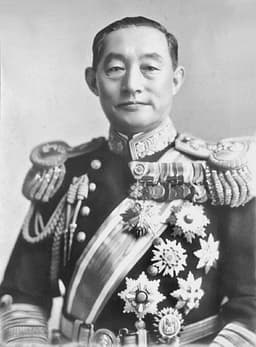
Yonai Mitsumasa
General · Modern
57.8Total
Basic Information
Born
1914
1880
Died
2001
1948
Era
Modern
Modern
Nationality
Venezuela
Japan
Occupation
General
General
Civilization
Western
Eastern
Score Comparison
Military (10%)
50.0
50.0
Political (20%)
53.8
68.0
Influence (20%)
54.1
55.7
Legacy (20%)
42.5
48.3
Leadership (15%)
71.0
72.0
Strategy (15%)
60.0
57.5
TOTAL
53.9
57.8
Marcos Perez Jimenez — Complete Timeline
1948 AD
Participation in the 1948 coupPolitical Action◆ Major
Pérez Jiménez was a key military officer in the coup that overthrew President Rómulo Gallegos. He served as defense minister in the subsequent junta, consolidating his power within the military.
CoupMilitaryPower Consolidation
Impact: nationaldestructive
1952 AD
Assumption of presidencyPolitical Action
Pérez Jiménez assumed the presidency after a rigged election in 1952. He dissolved the constituent assembly and ruled as a dictator, suppressing political opposition and controlling the media.
DictatorshipElection FraudPresidency
Impact: nationaldestructive
1953 AD
Construction of Caracas infrastructureReform◆ Major
Pérez Jiménez launched a massive public works program, building highways, housing projects, and the Caracas subway. These projects modernized the capital but were financed by oil revenue and often involved corruption.
InfrastructureUrban DevelopmentOil Revenue
Impact: nationalconstructive
Repression of political opponentsPolitical Action◆ Major
Pérez Jiménez's regime used the National Security Police (SN) to arrest, torture, and exile political opponents. Thousands were imprisoned, and the regime maintained control through fear and censorship.
RepressionHuman RightsDictatorship
Impact: nationaldestructive
1958 AD
Overthrow and exilePolitical Action
Pérez Jiménez was overthrown by a civilian-military uprising on January 23, 1958. He fled to the Dominican Republic and later to Spain, where he lived in exile until his death.
CoupExileEnd of Dictatorship
Impact: national
Yonai Mitsumasa — Complete Timeline
1940 AD
Opposition to War with the AlliesPolitical Action◆ Major
As Prime Minister in 1940, Yonai Mitsumasa opposed signing the Tripartite Pact with Germany and Italy, arguing it would lead to war with the United States and Britain. His resistance delayed the alliance but ultimately failed, and he was forced to resign.
Tripartite PactOppositionForeign Policy
Impact: globalconstructive
Resignation Over Tripartite PactPolitical Action◆ Major
Yonai resigned as Prime Minister in July 1940 after the army forced his hand over the Tripartite Pact. His resignation cleared the way for the pro-Axis cabinet of Konoe Fumimaro, which signed the pact in September 1940.
ResignationAxis Alliance
Impact: nationaltragic
Service as Prime MinisterPolitical Action◆ Major
Yonai Mitsumasa became Prime Minister in January 1940, succeeding Abe Nobuyuki. His cabinet pursued a neutral foreign policy and sought to avoid war, but faced intense pressure from the military to align with Germany.
Prime MinisterNeutrality
Impact: national
1945 AD
Post-War Role as Deputy Prime MinisterPolitical Action◆ Major
After Japan's surrender, Yonai served as Deputy Prime Minister in the Higashikuni and Shidehara cabinets from 1945 to 1946. He oversaw the demobilization of the Japanese military and cooperated with the Allied occupation authorities.
Post-WarOccupationDemobilization
Impact: nationalconstructive
This comparison has not been analyzed yet.
One-time AI generation (~1 minute). Scores and timeline are already available below.
Rankings
🥇
Yonai MitsumasaLeader
Mil: 50.0Pol: 68.0Inf: 55.7
57.8
🥈
Marcos Perez Jimenez
Mil: 50.0Pol: 53.8Inf: 54.1
53.9
+3.9 behind
How This Comparison Works
Algorithm
Each figure is scored on 6 dimensions (0—100 scale) based on structured historical data: Military (10%), Political (20%), Influence (20%), Legacy (20%), Leadership (15%), Strategy (15%). The weighted total produces the final ranking.
Data Sources
Scores are computed from structured sub-indicators in the database. Scale factors adjust for era (Ancient ×0.85, Modern ×1.0) and civilization size (Eastern ×1.05, Other ×0.80) to account for differences in population and military scale.
Maximum 3 Figures
Comparisons are limited to 2—3 figures to ensure readability and statistical meaningfulness.
Error Margins
±5 points per dimension — Sub-scores are derived from historical records with inherent uncertainty. Two figures within 5 points on a dimension should be considered roughly equivalent in that area.
Total Score Accuracy
±3 points overall — The weighted combination of 6 dimensions produces a total score with approximately ±3 points of uncertainty. Differences of less than 3 points are not statistically significant— the figures are effectively tied.
Known Limitations
- Historical records are incomplete and uneven across civilizations
- Figures from oral-tradition societies may be underrepresented
- Occupation labels can misclassify multi-role figures
- Scores measure capability and impact, not moral character
- Quantitative scoring is a comparison tool, not absolute truth
Capability Radar
Military (10%) — Battles & Warfare
Battles
15
20
Win Rate
20
15
Expansion
10
10
Political (20%) — Governance & Reform
Reform
55
40
Diplomacy
40
70
Economy
65
30
Influence (20%) — Cultural & Global Reach
Cultural
30
25
Global
25
40
Legacy (20%) — Historical Impact
Historical
35
50
Longevity
20
30
Leadership (15%) — Power & Stability
Tenure
60
55
Stability
30
45
Strategy (15%) — Tactics & Innovation
Strategy
30
55
Tactics
25
40
Reform
40
50
Similar Comparisons
Comments & Discussion
No comments yet. Be the first to share your thoughts!