Loading...
Marouf al-Bakhit vs Napoleon Bonaparte
Napoleon Bonaparte leads by 29.3 pts · 2 figures compared
…
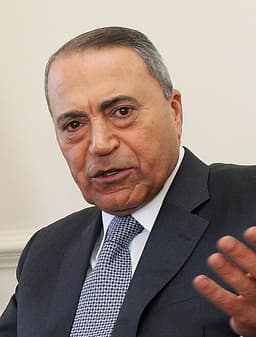
Marouf al-Bakhit
General · Modern
41.6Total

Napoleon Bonaparte
General · Modern
70.9Total
Basic Information
Born
1947
1769
Died
—
1821
Era
Modern
Modern
Nationality
Jordan
France
Occupation
General
General
Civilization
Middle Eastern
Western
Score Comparison
Military (10%)
10.2
94.0
Political (20%)
61.3
72.0
Influence (20%)
48.6
40.0
Legacy (20%)
38.3
80.0
Leadership (15%)
40.0
78.0
Strategy (15%)
36.8
90.0
TOTAL
41.6
70.9
Marouf al-Bakhit — Complete Timeline
2005 AD
Appointed Prime Minister of JordanPolitical Action◆ Major
King Abdullah II appointed Marouf al-Bakhit as Prime Minister of Jordan in November 2005, following the 2005 Amman bombings. Al-Bakhit, a former intelligence chief, was tasked with restoring security and stability.
JordanPrime MinisterAppointment
Impact: national
2007 AD
Resigned as Prime MinisterPolitical Action
Marouf al-Bakhit resigned as Prime Minister of Jordan in November 2007 after parliamentary elections. His resignation followed criticism of economic policies and political reforms.
JordanPrime MinisterResignation
Impact: national
2011 AD
Appointed Prime Minister for Second TermPolitical Action◆ Major
King Abdullah II appointed Marouf al-Bakhit as Prime Minister again in February 2011, during the Arab Spring protests. Al-Bakhit was tasked with implementing political reforms to address public demands.
JordanArab SpringPrime Minister
Impact: national
Resigned as Prime Minister for Second TermPolitical Action
Marouf al-Bakhit resigned as Prime Minister in October 2011, after failing to satisfy protesters' demands for faster political reforms. His resignation marked the end of his second term.
JordanArab SpringResignation
Impact: national
Napoleon Bonaparte — Complete Timeline
1799 AD
Coup of 18 BrumaireOther◆ Major
Napoleon Bonaparte, with support from his brother Lucien and key political figures, overthrew the Directory in a bloodless coup. He established the Consulate with himself as First Consul, effectively becoming the ruler of France. This event ended the French Revolution's most unstable period.
French RevolutionCoupRise to Power
Impact: regional
1804 AD
Promulgation of the Napoleonic CodeOther◆ Major
Napoleon enacted the Civil Code of the French, known as the Napoleonic Code, a comprehensive set of laws that replaced the fragmented feudal legal systems. The code established legal equality, protected property rights, and secularized law. It became the basis for legal systems in many European and world countries.
Legal ReformNapoleonic CodeCivil Law
Impact: globalconstructive
1805 AD
Battle of AusterlitzWar◆ Major
Napoleon's Grande Arm
Napoleonic WarsBattleDecisive Victory
Impact: global
1812 AD
Invasion of RussiaWar◆ Major
Napoleon led the Grande Arm
Napoleonic WarsInvasionDisaster
Impact: globaldestructive
1815 AD
Battle of WaterlooWar◆ Major
Napoleon's French army was defeated by the combined forces of the Duke of Wellington's Anglo-Allied army and Gebhard Leberecht von Bl
Napoleonic WarsBattleFinal Defeat
Impact: globaldestructive
Expert Analysis
Napoleon Bonaparte vs Marouf al-Bakhit
### The General and the Governor
One commanded the Grande Armée, the most formidable fighting force Europe had ever seen, and rewrote the laws of a continent. The other managed the delicate politics of a small desert kingdom, his name known to few beyond its borders. Napoleon Bonaparte and Marouf al-Bakhit both bore the title of general, yet their worlds could not have been more different. What separates a man who reshapes history from one who merely navigates its currents? The answer lies not in rank, but in ambition, circumstance, and the terrifying weight of opportunity.
### Origins
Napoleon Bonaparte was born in 1769 on the Mediterranean island of Corsica, a place only recently annexed by France. His family was minor nobility, impoverished and resentful of their new rulers. This marginality forged in him a fierce drive to prove himself. He entered a French military academy at nine, an outsider mocked for his accent and small stature. The world he grew up in was one of revolution and chaos—the old order of kings and aristocrats was collapsing, and a young artillery officer could rise faster than ever before.
Marouf al-Bakhit was born in 1947 in Salt, Jordan, a town of dusty hills and quiet loyalty to the Hashemite throne. His Jordan was a young nation, carved from the British Mandate, surrounded by enemies and dependent on fragile alliances. Where Napoleon’s world was being torn apart, al-Bakhit’s was being built. He studied political science in the United States and later joined the intelligence service, learning the art of information and control. His era was not one of revolution, but of stability maintained by the king’s shrewd hand.
### Rise to Power
Napoleon’s ascent was meteoric. At 24, he was a captain; at 26, a general after his decisive victory at the Siege of Toulon in 1793. By 1799, he had seized control of France in a coup d’état, becoming First Consul. His path was carved by cannon fire and personal genius—he was not appointed; he took. The Directory was corrupt, the nation exhausted, and Napoleon offered order wrapped in glory.
Al-Bakhit’s rise was the opposite: a slow, careful climb through the ranks of loyalty. He served as Jordan’s ambassador to Israel and later as director of the General Intelligence Department, the kingdom’s feared security apparatus. In November 2005, after al-Qaeda bombed three hotels in Amman, killing 60 people, King Abdullah II appointed him Prime Minister. The king needed a security man to restore order, not a visionary to transform the state. Al-Bakhit’s power was a gift from the throne, not a prize seized from the battlefield.
### Leadership & Governance
Napoleon governed as he conquered: with energy, brilliance, and absolute control. He centralized the French state, created the Napoleonic Code—a legal framework that influenced civil law across Europe—and reformed education, banking, and the military. His leadership was personal and charismatic. He rode with his soldiers, shared their rations, and inspired a devotion that bordered on worship. His political wisdom, however, was flawed. He crowned himself Emperor in 1804, alienated republicans, and made enemies of every European power. His military genius—scored at 94—was matched only by his strategic blindness in overextending his empire.
Al-Bakhit governed as a manager, not a monarch. His political score of 63 reflects a man who implemented policies rather than created them. As Prime Minister, he faced the impossible task of satisfying a population demanding democratic reform while serving a king determined to preserve his authority. During the Arab Spring of 2011, he was reappointed to calm protests, but he offered only slow, cautious change. He resigned in October 2011, having failed to quell the unrest. His leadership score of 77.9 suggests competence, but within narrow bounds—he was a caretaker, not a creator.
### Triumph & Tragedy
Napoleon’s triumphs were continental. He defeated Austria, Prussia, and Russia in brilliant campaigns—Austerlitz in 1805 remains a masterpiece of military strategy. He redrew the map of Europe, installed his brothers on thrones, and made Paris the capital of a new empire. His tragedy was his own ambition. The invasion of Russia in 1812 destroyed his Grand Army; 600,000 men marched east, fewer than 100,000 returned. Exiled to Elba, he escaped and ruled for 100 days, only to be crushed at Waterloo in 1815. He died in 1821 on the remote island of Saint Helena, a prisoner of the British.
Al-Bakhit’s triumphs were quieter. He prevented Jordan from descending into the chaos that engulfed Iraq and Syria. His intelligence background helped thwart further attacks after 2005. His tragedy was his irrelevance. He was a placeholder for a system that never intended real change. His legacy score of 50 is a blunt verdict: he is remembered, if at all, as a man who managed a crisis he did not create and could not solve.
### Character & Destiny
Napoleon’s character was a force of nature—restless, arrogant, and brilliant. “Impossible is a word to be found only in the dictionary of fools,” he said. He believed he could shape destiny, and for a decade, he almost did. His downfall came from the same traits that lifted him: he could not stop. He needed enemies to conquer, glory to chase. His personality was his fate.
Al-Bakhit’s character was cautious, loyal, and pragmatic. He understood that in Jordan, power flows from the king, and that no prime minister can act independently. He was not a fool; he was a realist. His destiny was not to change history, but to survive it. Where Napoleon would have burned the palace to the ground, al-Bakhit would have repaired the roof.
### Legacy
Napoleon’s legacy is written in stone and law. The Napoleonic Code governs millions, his military tactics are still studied, and his name is synonymous with ambition and genius. His scores—Military 94, Influence 82—reflect a man who shaped the modern world. But he also left a trail of war, death, and a restored monarchy in France. He is both hero and tyrant.
Al-Bakhit’s legacy is a footnote. His total score of 56.3 places him among the forgotten. He did not conquer, reform, or inspire. He served. In Jordan, he may be remembered as a loyal servant who kept the ship steady through a storm. But history does not reward steadiness; it rewards transformation.
### Conclusion
Standing at the extremes of the same profession, Napoleon and al-Bakhit reveal a profound truth about power. One was a volcano, the other a stone wall. The volcano reshapes the landscape, but it also destroys. The wall holds firm, but it never moves. Neither is better—only different, shaped by different eras, different ambitions, and different definitions of success. In the end, the general who conquered an empire and the general who served a king both did what their world demanded. The difference is that Napoleon’s world demanded everything, and al-Bakhit’s demanded only enough.
Rankings
🥇
Napoleon BonaparteLeader
Mil: 94.0Pol: 72.0Inf: 40.0
70.9
🥈
Marouf al-Bakhit
Mil: 10.2Pol: 61.3Inf: 48.6
41.6
+29.3 behind
How This Comparison Works
Algorithm
Each figure is scored on 6 dimensions (0—100 scale) based on structured historical data: Military (10%), Political (20%), Influence (20%), Legacy (20%), Leadership (15%), Strategy (15%). The weighted total produces the final ranking.
Data Sources
Scores are computed from structured sub-indicators in the database. Scale factors adjust for era (Ancient ×0.85, Modern ×1.0) and civilization size (Eastern ×1.05, Other ×0.80) to account for differences in population and military scale.
Maximum 3 Figures
Comparisons are limited to 2—3 figures to ensure readability and statistical meaningfulness.
Error Margins
±5 points per dimension — Sub-scores are derived from historical records with inherent uncertainty. Two figures within 5 points on a dimension should be considered roughly equivalent in that area.
Total Score Accuracy
±3 points overall — The weighted combination of 6 dimensions produces a total score with approximately ±3 points of uncertainty. Differences of less than 3 points are not statistically significant— the figures are effectively tied.
Known Limitations
- Historical records are incomplete and uneven across civilizations
- Figures from oral-tradition societies may be underrepresented
- Occupation labels can misclassify multi-role figures
- Scores measure capability and impact, not moral character
- Quantitative scoring is a comparison tool, not absolute truth
Capability Radar
Military (10%) — Battles & Warfare
Battles
5
95
Win Rate
5
90
Expansion
5
95
Political (20%) — Governance & Reform
Reform
30
95
Diplomacy
40
80
Economy
30
85
Influence (20%) — Cultural & Global Reach
Cultural
10
85
Global
10
90
Legacy (20%) — Historical Impact
Historical
10
95
Longevity
10
90
Leadership (15%) — Power & Stability
Tenure
40
85
Stability
35
70
Strategy (15%) — Tactics & Innovation
Strategy
10
95
Tactics
10
98
Reform
10
92
Similar Comparisons
Comments & Discussion
Corsican Conqueror6/16/2026
Comparing Napoleon to a Jordanian prime minister is like comparing a hurricane to a desert breeze. Napoleon didn't just command armies; he revolutionized warfare with corps organization and the meritocratic Legion of Honor. Al-Bakhit managed a cabinet. One reshaped Europe's map in a decade; the other kept Jordan stable for a few years. This isn't a comparison—it's a category error. Military history judges by scale, and Napoleon's scale is continental. Al-Bakhit's is provincial.
沙漠掌权者6/16/2026
说拿破仑和巴希特将军都是将军,真是侮辱了“将军”这个词。拿破仑在奥斯特里茨战役中以少胜多,击溃俄奥联军,而巴希特的最大成就不过是平息了约旦的几次街头抗议。一个是改变世界历史的军事天才,一个是小国王室的政治工具。把两人放一起比较,暴露了说话者对历史真实力量格局的完全无知。
Data Skeptic Dave6/16/2026
This comparison feels like comparing Einstein to a high school physics teacher. The analysis wants to find common ground in their "generalship," but the actual command scales differ by orders of magnitude. Napoleon led over 600,000 men into Russia; al-Bakhit might have commanded a few thousand. One wrote the Code Napoleon that still influences civil law; the other? His Wikipedia page is a stub. The data doesn't lie: historical impact is not a democratic concept.
古典学者老林6/16/2026
从古典军事思想看,拿破仑是凯撒和亚历山大的真正传人,他的战役被写入西点军校教材,至今仍是战略经典。而巴希特?他只是在一个不稳定的边陲小国维持秩序,就像罗马帝国末期那些地方总督,名字消失在历史的灰尘里。拿破仑的野心是征服世界,巴希特的野心是保住饭碗。这根本不是同一类人,硬拉一起比较,就像拿帕特农神庙跟路边厕所比建筑艺术。
Revisionist Realist6/16/2026
Actually, this comparison reveals more than you think. Both men rose from marginal backgrounds—Napoleon from Corsican obscurity, al-Bakhit from Salt's dusty hills. Both navigated political minefields: Napoleon through revolutionary France, al-Bakhit through Jordan's tribal and royal politics. The difference isn't talent but context. Put al-Bakhit in 1799 Paris with Napoleon's opportunities, and who knows? History's randomness, not inherent greatness, separates them. Stop romanticizing the "great