Loading...
Matsukata Masayoshi vs Tanzan Ishibashi
Matsukata Masayoshi leads by 15.8 pts · 2 figures compared
…
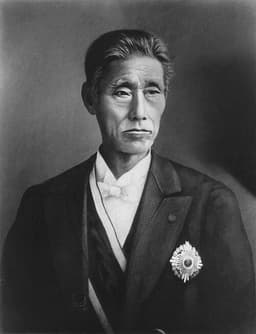
Matsukata Masayoshi
Politician · Modern
56.3Total

Tanzan Ishibashi
Politician · Modern
40.5Total
Basic Information
Born
1835
1884
Died
1924
1973
Era
Modern
Modern
Nationality
Japan
Japan
Occupation
Politician
Politician
Civilization
Eastern
Eastern
Score Comparison
Military (10%)
10.4
12.9
Political (20%)
78.0
48.0
Influence (20%)
58.0
51.8
Legacy (20%)
54.0
41.7
Leadership (15%)
80.0
38.1
Strategy (15%)
35.5
29.4
TOTAL
56.3
40.5
Matsukata Masayoshi — Complete Timeline
1881 AD
Matsukata Fiscal PolicyReform◆ Major
As Finance Minister, Matsukata implemented the Matsukata Fiscal Policy, a series of deflationary measures to combat inflation and stabilize the currency. He established the Bank of Japan in 1882 and introduced a new tax system. These policies laid the foundation for Japan's modern economy.
FinanceReformEconomy
Impact: nationalconstructive
1891 AD
Served as Prime MinisterPolitical Action◆ Major
Matsukata Masayoshi served as the fourth Prime Minister of Japan from 1891 to 1892. His first term was marked by political instability and economic challenges. He was known for his conservative fiscal policies.
Prime MinisterGovernmentPolitics
Impact: national
1896 AD
Second Term as Prime MinisterPolitical Action◆ Major
Matsukata served a second term as Prime Minister from 1896 to 1898. His second term was also short and marked by political conflicts. He focused on foreign policy, including the Triple Intervention after the First Sino-Japanese War.
Prime MinisterGovernmentPolitics
Impact: national
1897 AD
Established the Gold StandardReform◆ Major
Matsukata, as Finance Minister, led Japan's adoption of the gold standard in 1897. This move stabilized the yen and facilitated foreign trade and investment. It was a key step in Japan's integration into the global economy.
Gold StandardFinanceEconomy
Impact: globalconstructive
Tanzan Ishibashi — Complete Timeline
1956 AD
Appointed Prime Minister of JapanPolitical Action◆ Major
Tanzan Ishibashi became Prime Minister of Japan on December 23, 1956, succeeding Ichiro Hatoyama. His appointment came after winning the LDP presidential election. Ishibashi's tenure was brief, lasting only 65 days, due to his poor health. He prioritized economic growth and improved relations with China.
Prime MinisterLDPJapan
Impact: national
1957 AD
Promoted Trade Relations with ChinaPolitical Action
Ishibashi advocated for expanding trade with the People's Republic of China, despite U.S. opposition and the Cold War context. He supported the fourth Japan-China private trade agreement in 1957. His efforts laid groundwork for future economic ties, though full normalization did not occur until 1972.
China TradeDiplomacyEconomic Relations
Impact: regionalconstructive
Resigned Due to IllnessOther◆ Major
Ishibashi resigned as Prime Minister on February 25, 1957, after suffering a stroke. His resignation was the shortest tenure of any post-war Japanese prime minister. He was succeeded by Nobusuke Kishi. Ishibashi's brief term limited his ability to implement major policies.
ResignationHealthJapan
Impact: nationaltragic
Expert Analysis
Origins
Matsukata Masayoshi was born on February 25, 1835, in Kagoshima, Satsuma Domain (now Kagoshima Prefecture), into a samurai family. He studied at the domain school and later became a bureaucrat in the Meiji government, working under Okubo Toshimichi. His early career focused on finance and taxation, eventually leading to his role as Finance Minister.
Tanzan Ishibashi was born on September 12, 1884, in Tokyo, into a Buddhist priest's family. He studied philosophy at Waseda University and became a journalist and economist. He served as a financial journalist and later entered politics, becoming a member of the Liberal Democratic Party.
Rise to Power
Matsukata rose to prominence through his expertise in fiscal policy. He became Finance Minister in 1881 and implemented the Matsukata Fiscal Policy (1881-1885), a series of deflationary measures to curb inflation and stabilize the currency. This success earned him the position of Prime Minister in 1891. His first term (1891-1892) was short and turbulent, but he returned for a second term (1896-1898).
Ishibashi rose to power after World War II. He served as Minister of Finance under Prime Minister Ichiro Hatoyama from 1954 to 1956. He advocated for economic growth and normalized relations with the Soviet Union. In December 1956, he won the LDP presidential election and became Prime Minister, succeeding Hatoyama.
Leadership & Governance
Matsukata's leadership was characterized by fiscal conservatism. As Finance Minister, he cut government spending, increased taxes, and established the Bank of Japan in 1882. His policies caused a severe deflationary recession but ultimately stabilized the economy. As Prime Minister, he focused on foreign policy, including the Anglo-Japanese Treaty of Commerce and Navigation in 1894. He scored 80.0 in leadership, reflecting his decisive but controversial economic measures.
Ishibashi's governance style was progressive and internationalist. He promoted trade with China and the Soviet Union, despite U.S. opposition. However, his tenure as Prime Minister lasted only 2 months due to a stroke. He scored 38.1 in leadership, hampered by his short term and illness. His political score of 48.0 reflects limited legislative achievements.
Triumph & Tragedy
Matsukata's greatest triumph was the Matsukata Fiscal Policy, which ended hyperinflation and laid the foundation for Japan's modern financial system. He also led Japan's adoption of the gold standard in 1897, which stabilized the yen and boosted foreign trade. His tragedy was his political instability: both prime ministerial terms were short and marked by conflicts with the Diet. His deflationary policies caused hardship for farmers and small businesses, leading to social unrest.
Ishibashi's triumph was his advocacy for China trade, which eventually expanded despite Cold War tensions. He also normalized relations with the Soviet Union in 1956. His tragedy was his premature resignation due to illness, cutting short any potential reforms. His legacy is largely symbolic as a rare progressive leader in post-war Japan.
Character & Destiny
Matsukata was meticulous, stubborn, and fiscally orthodox. His character shaped his economic policy, prioritizing long-term stability over short-term pain. His destiny was to be remembered as a "great finance minister" but a mediocre prime minister. Historians note that his policies were necessary but harsh.
Ishibashi was idealistic and intellectually curious, but his health failed him. His character led him to challenge U.S. policy on China, but his short tenure prevented significant impact. He is often seen as a "what if" figure in Japanese history.
Legacy
Matsukata's legacy endures through Japan's modern financial system. The Bank of Japan, the gold standard, and his fiscal policies set the stage for Japan's industrialization. He scored 54.0 in legacy, reflecting his lasting but not transformative impact.
Ishibashi's legacy is more modest. He is remembered for his early advocacy of China relations, which later leaders pursued. His short term means his legacy score of 41.7 is lower. He is not widely known outside Japan.
Conclusion
Matsukata Masayoshi had a greater impact on Japan than Tanzan Ishibashi. With a total score of 56.3 versus 40.5, Matsukata's economic reforms shaped Japan's trajectory for decades. While Ishibashi's ideas were forward-thinking, his lack of implementation limits his influence. Matsukata's fiscal policies, despite their pain, were crucial for Japan's modernization, giving him a clear edge in historical significance.
Rankings
🥇
Matsukata MasayoshiLeader
Mil: 10.4Pol: 78.0Inf: 58.0
56.3
🥈
Tanzan Ishibashi
Mil: 12.9Pol: 48.0Inf: 51.8
40.5
+15.8 behind
How This Comparison Works
Algorithm
Each figure is scored on 6 dimensions (0—100 scale) based on structured historical data: Military (10%), Political (20%), Influence (20%), Legacy (20%), Leadership (15%), Strategy (15%). The weighted total produces the final ranking.
Data Sources
Scores are computed from structured sub-indicators in the database. Scale factors adjust for era (Ancient ×0.85, Modern ×1.0) and civilization size (Eastern ×1.05, Other ×0.80) to account for differences in population and military scale.
Maximum 3 Figures
Comparisons are limited to 2—3 figures to ensure readability and statistical meaningfulness.
Error Margins
±5 points per dimension — Sub-scores are derived from historical records with inherent uncertainty. Two figures within 5 points on a dimension should be considered roughly equivalent in that area.
Total Score Accuracy
±3 points overall — The weighted combination of 6 dimensions produces a total score with approximately ±3 points of uncertainty. Differences of less than 3 points are not statistically significant— the figures are effectively tied.
Known Limitations
- Historical records are incomplete and uneven across civilizations
- Figures from oral-tradition societies may be underrepresented
- Occupation labels can misclassify multi-role figures
- Scores measure capability and impact, not moral character
- Quantitative scoring is a comparison tool, not absolute truth
Capability Radar
Military (10%) — Battles & Warfare
Battles
15
16
Win Rate
19
16
Expansion
21
20
Political (20%) — Governance & Reform
Reform
75
30
Diplomacy
70
55
Economy
85
20
Influence (20%) — Cultural & Global Reach
Cultural
40
20
Global
50
20
Legacy (20%) — Historical Impact
Historical
60
25
Longevity
55
15
Leadership (15%) — Power & Stability
Tenure
65
15
Stability
70
10
Strategy (15%) — Tactics & Innovation
Strategy
22
20
Tactics
29
29
Reform
26
30
Similar Comparisons
Comments & Discussion
No comments yet. Be the first to share your thoughts!