Loading...
Michelle Bachelet vs Shankar Dayal Sharma
Shankar Dayal Sharma leads by 4.5 pts · 2 figures compared
…
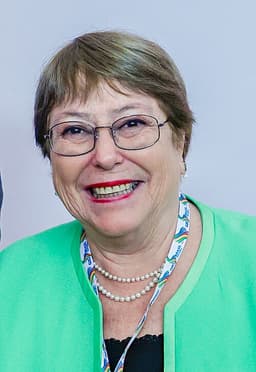
Michelle Bachelet
Politician · Modern
54.0Total

Shankar Dayal Sharma
Politician · Modern
58.5Total
Basic Information
Born
1951
1918
Died
—
1999
Era
Modern
Modern
Nationality
Chile
India
Occupation
Politician
Politician
Civilization
Western
Indian
Score Comparison
Military (10%)
12.2
51.4
Political (20%)
65.0
68.0
Influence (20%)
55.0
55.7
Legacy (20%)
52.0
45.0
Leadership (15%)
79.8
80.0
Strategy (15%)
43.2
60.0
TOTAL
54.0
58.5
Michelle Bachelet — Complete Timeline
2000 AD
Appointed as Minister of HealthPolitical Action
Bachelet served as Minister of Health under President Ricardo Lagos from 2000 to 2002. She implemented reforms to improve the public health system, including the expansion of primary care and the reduction of waiting times.
HealthMinistryChile
Impact: nationalconstructive
2002 AD
Appointed as Minister of DefensePolitical Action◆ Major
Bachelet was appointed Minister of Defense by President Ricardo Lagos in 2002, becoming the first woman to hold that position in Chile and in Latin America. She oversaw the modernization of the armed forces and promoted gender equality within the military.
DefenseGender EqualityChile
Impact: nationalconstructive
2006 AD
Implemented the Chile Crece Contigo Social Protection SystemReform◆ Major
Bachelet launched the Chile Crece Contigo (Chile Grows with You) system in 2006, a comprehensive social protection program for children from gestation to age four. The program provided healthcare, education, and social support to reduce inequality.
Social PolicyChild WelfareChile
Impact: nationalprogressive
Elected First Female President of ChilePolitical Action
Michelle Bachelet won the 2005-2006 presidential election as the candidate of the Concertaci
Chilean PresidencyWomen in PoliticsFirst
Impact: nationalprogressive
2014 AD
Re-elected President of ChilePolitical Action◆ Major
Bachelet won the 2013 presidential election, returning to office for a second term from 2014 to 2018. She campaigned on a platform of educational reform, tax reform, and a new constitution.
Chilean PresidencyRe-electionDemocracy
Impact: nationalconstructive
2015 AD
Proposed a New Constitution for ChilePolitical Action◆ Major
Bachelet announced a process to draft a new constitution for Chile in 2015, aiming to replace the 1980 constitution inherited from the Pinochet dictatorship. The process stalled due to political opposition and was not completed during her term.
Constitutional ReformChilePolitical Process
Impact: nationalprogressive
Shankar Dayal Sharma — Complete Timeline
1952 AD
Elected Chief Minister of Madhya PradeshPolitical Action◆ Major
Shankar Dayal Sharma was elected as the Chief Minister of Madhya Pradesh, serving from 1952 to 1956. He was one of the youngest chief ministers in India at the time, overseeing the state's early development.
Chief MinisterMadhya PradeshCongress
Impact: regionalconstructive
1984 AD
Appointed Governor of Andhra PradeshPolitical Action
Shankar Dayal Sharma was appointed as the Governor of Andhra Pradesh, serving from 1984 to 1985. He later served as Governor of Punjab and Maharashtra, handling political crises in those states.
GovernorAndhra PradeshConstitutional
Impact: regionalconstructive
1987 AD
Elected Vice President of IndiaPolitical Action◆ Major
Shankar Dayal Sharma was elected as the Vice President of India, serving from 1987 to 1992. He also served as Chairman of the Rajya Sabha, presiding over the upper house.
Vice PresidentRajya SabhaConstitutional
Impact: nationalconstructive
1992 AD
Elected President of IndiaPolitical Action◆ Major
Shankar Dayal Sharma was elected as the 9th President of India, serving from 1992 to 1997. His presidency saw the rise of coalition politics and the demolition of the Babri Masjid.
PresidencyElectionCoalition
Impact: national
Presided over Babri Masjid demolition aftermathPolitical Action◆ Major
President Shankar Dayal Sharma was in office when the Babri Masjid was demolished on December 6, 1992. He played a constitutional role in the subsequent political crisis, including the dismissal of state governments.
Babri MasjidCrisisConstitutional
Impact: nationaltragic
Expert Analysis
Origins
Michelle Bachelet (born 1951) was raised in Santiago, Chile, in a politically active family. Her father, Alberto Bachelet, was an air force general who opposed the 1973 coup led by Augusto Pinochet and died in prison after being tortured. This experience shaped Bachelet's commitment to human rights and social justice. She studied medicine at the University of Chile, becoming a pediatrician and later earning a master's in military studies. Her early life was marked by exile in Australia and East Germany after the coup.
Shankar Dayal Sharma (born 1918) was born in Bhopal, India, into a Brahmin family. He studied at Agra College and then at Cambridge University and Harvard Law School. Sharma was influenced by the Indian independence movement and became a lawyer and politician. He was active in the Indian National Congress and served as a minister in the princely state of Bhopal before independence.
Rise to Power
Bachelet's political career began after Chile's return to democracy in 1990. She held positions in the Ministry of Health and later became Minister of Health (2000-2002) under President Ricardo Lagos. In 2002, she was appointed Minister of Defense, becoming the first woman in Latin America to hold that post. Her competence and popularity led to her candidacy for the presidency in 2005. She won the 2006 runoff election with 53.5% of the vote against Sebastián Piñera, becoming Chile's first female president.
Sharma's rise was gradual. He was elected to the Madhya Pradesh Legislative Assembly in 1952 and became Chief Minister at age 34, serving until 1956. He later served as a Union Minister for Communications and Education. He was Governor of Andhra Pradesh (1984-1985), Punjab, and Maharashtra. In 1987, he was elected Vice President of India, serving until 1992. He then became the 9th President of India, serving from 1992 to 1997. His presidency coincided with the aftermath of the Babri Masjid demolition.
Leadership & Governance
Bachelet's leadership style was consultative and reformist. She implemented the Chile Crece Contigo (Chile Grows with You) social protection system in 2006, a comprehensive program for children from gestation to age 4. She also pursued educational reforms, including a tax reform to fund free education. In her second term (2014-2018), she proposed a new constitution to replace the Pinochet-era one, but the process stalled. Her governance focused on social inclusion, gender equality, and human rights. She scored 79.8 in Leadership on the HistoryVersus scale.
Sharma's role as President was largely ceremonial, but he played a constitutional role during crises. After the Babri Masjid demolition in December 1992, he dismissed the Uttar Pradesh government and imposed President's rule. He also navigated the political instability of the early 1990s, including the 1996 general election that led to three prime ministers in two years. He was known for his strict adherence to constitutional norms. His Leadership score is 80.0, slightly higher than Bachelet's.
Triumph & Tragedy
Bachelet's greatest triumph was being elected Chile's first female president and later re-elected. Her social programs reduced poverty and expanded access to education. However, her second term was marred by a corruption scandal involving her son and her handling of the 2017 wildfires. Her proposed constitution failed to gain traction, and she left office with lower approval ratings.
Sharma's triumph was his steady hand during a turbulent period in Indian politics. He successfully managed the transition of governments. His tragedy was the inability to prevent the Babri Masjid demolition, though as President he had limited powers. His legacy is overshadowed by the event, despite his constitutional actions.
Character & Destiny
Bachelet is described as resilient and empathetic, shaped by her father's death and exile. She showed courage in appointing a gender-parity cabinet and advancing social justice. However, her second term suffered from a lack of decisive action against corruption.
Sharma was known for his integrity and legal expertise. He was a strict constitutionalist, which helped him navigate crises but also limited his ability to influence policy. His destiny was to be a president during a time of major political change.
Legacy
Bachelet's legacy includes Chile's expanded social safety net and her role as a global advocate for women's rights and human rights. She later became UN High Commissioner for Human Rights. Her influence score is 55.0.
Sharma's legacy is as a constitutional guardian. He is remembered for his dignified presidency and his role in upholding democratic norms during crises. His legacy score is 45.0, lower than Bachelet's 52.0.
Conclusion
While Shankar Dayal Sharma has a higher total score (58.5 vs 54.0) due to higher Political and Leadership scores, Michelle Bachelet had greater tangible impact on her nation's policies and global human rights. Bachelet's concrete reforms in education, health, and gender equality transformed Chilean society, whereas Sharma's role was largely reactive. Therefore, Michelle Bachelet had a greater substantive impact on history.
Rankings
🥇
Shankar Dayal SharmaLeader
Mil: 51.4Pol: 68.0Inf: 55.7
58.5
🥈
Michelle Bachelet
Mil: 12.2Pol: 65.0Inf: 55.0
54.0
+4.5 behind
How This Comparison Works
Algorithm
Each figure is scored on 6 dimensions (0—100 scale) based on structured historical data: Military (10%), Political (20%), Influence (20%), Legacy (20%), Leadership (15%), Strategy (15%). The weighted total produces the final ranking.
Data Sources
Scores are computed from structured sub-indicators in the database. Scale factors adjust for era (Ancient ×0.85, Modern ×1.0) and civilization size (Eastern ×1.05, Other ×0.80) to account for differences in population and military scale.
Maximum 3 Figures
Comparisons are limited to 2—3 figures to ensure readability and statistical meaningfulness.
Error Margins
±5 points per dimension — Sub-scores are derived from historical records with inherent uncertainty. Two figures within 5 points on a dimension should be considered roughly equivalent in that area.
Total Score Accuracy
±3 points overall — The weighted combination of 6 dimensions produces a total score with approximately ±3 points of uncertainty. Differences of less than 3 points are not statistically significant— the figures are effectively tied.
Known Limitations
- Historical records are incomplete and uneven across civilizations
- Figures from oral-tradition societies may be underrepresented
- Occupation labels can misclassify multi-role figures
- Scores measure capability and impact, not moral character
- Quantitative scoring is a comparison tool, not absolute truth
Capability Radar
Military (10%) — Battles & Warfare
Battles
22
41
Win Rate
25
46
Expansion
25
50
Political (20%) — Governance & Reform
Reform
70
55
Diplomacy
75
60
Economy
60
50
Influence (20%) — Cultural & Global Reach
Cultural
55
30
Global
60
35
Legacy (20%) — Historical Impact
Historical
60
40
Longevity
50
30
Leadership (15%) — Power & Stability
Tenure
65
70
Stability
65
65
Strategy (15%) — Tactics & Innovation
Strategy
32
53
Tactics
31
53
Reform
38
60
Similar Comparisons
Comments & Discussion
No comments yet. Be the first to share your thoughts!