Loading...
This comparison has not been analyzed yet.
One-time AI generation (~1 minute). Scores and timeline are already available below.
Midhat Pasha vs Surya Bahadur Thapa
Midhat Pasha leads by 18.9 pts · 2 figures compared
…
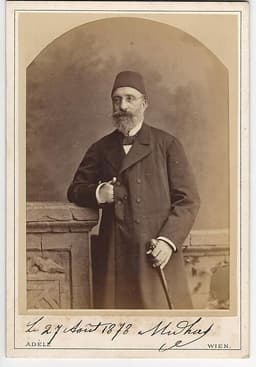
Midhat Pasha
Politician · Modern
64.3Total

Surya Bahadur Thapa
Politician · Modern
45.4Total
Basic Information
Born
1822
1928
Died
1884
—
Era
Modern
Modern
Nationality
Ottoman Empire
Nepal
Occupation
Politician
Politician
Civilization
Middle Eastern
Indian
Score Comparison
Military (10%)
10.0
21.0
Political (20%)
78.0
68.0
Influence (20%)
82.0
49.4
Legacy (20%)
72.0
41.7
Leadership (15%)
62.0
40.0
Strategy (15%)
38.3
43.4
TOTAL
64.3
45.4
Midhat Pasha — Complete Timeline
1864 AD
Governorship of the Danube VilayetReform◆ Major
As governor of the Danube Vilayet from 1864 to 1868, Midhat Pasha implemented extensive reforms. He built roads, bridges, and schools, established a provincial bank, and promoted agricultural development. His administration became a model for Tanzimat provincial governance.
GovernorshipReformInfrastructure
Impact: regionalconstructive
1872 AD
Appointment as Grand VizierPolitical Action◆ Major
Midhat Pasha was appointed Grand Vizier for the first time in 1872. He had previously served as governor of the Danube Vilayet and was known for his reformist ideas. His tenure was short-lived due to opposition from conservative factions and the sultan.
AppointmentReformOttoman Politics
Impact: nationalconstructive
1876 AD
Proclamation of the Ottoman Constitution of 1876Reform
Midhat Pasha was the chief architect of the first Ottoman Constitution, proclaimed on December 23, 1876. The constitution established a bicameral parliament, guaranteed civil liberties, and limited the sultan's powers. It was a landmark in Ottoman modernization, though it was suspended in 1878.
ConstitutionReformParliament
Impact: nationalprogressive
1881 AD
Exile and TrialPolitical Action◆ Major
Midhat Pasha was arrested in 1881 on charges of involvement in the murder of Sultan Abd
ExileTrialExecution
Impact: nationaltragic
Surya Bahadur Thapa — Complete Timeline
1979 AD
First Term as Prime Minister of NepalPolitical Action◆ Major
Thapa became Prime Minister for the first time under the Panchayat system, serving from 1979 to 1983. He focused on economic development and maintaining the monarchy's authority.
Prime MinisterPanchayatMonarchy
Impact: national
1990 AD
Formation of Rastriya Prajatantra Party (RPP)Political Action
Thapa founded the Rastriya Prajatantra Party (RPP) after the end of the Panchayat system. The party advocated for constitutional monarchy and conservative values.
Political PartyMonarchyConservatism
Impact: national
2003 AD
Fifth Term as Prime MinisterPolitical Action◆ Major
Thapa served his fifth and final term as Prime Minister during the civil war. His government faced criticism for human rights abuses and failure to negotiate with Maoist rebels.
Prime MinisterCivil WarHuman Rights
Impact: nationaldestructive
This comparison has not been analyzed yet.
One-time AI generation (~1 minute). Scores and timeline are already available below.
Rankings
🥇
Midhat PashaLeader
Mil: 10.0Pol: 78.0Inf: 82.0
64.3
🥈
Surya Bahadur Thapa
Mil: 21.0Pol: 68.0Inf: 49.4
45.4
+18.9 behind
How This Comparison Works
Algorithm
Each figure is scored on 6 dimensions (0—100 scale) based on structured historical data: Military (10%), Political (20%), Influence (20%), Legacy (20%), Leadership (15%), Strategy (15%). The weighted total produces the final ranking.
Data Sources
Scores are computed from structured sub-indicators in the database. Scale factors adjust for era (Ancient ×0.85, Modern ×1.0) and civilization size (Eastern ×1.05, Other ×0.80) to account for differences in population and military scale.
Maximum 3 Figures
Comparisons are limited to 2—3 figures to ensure readability and statistical meaningfulness.
Error Margins
±5 points per dimension — Sub-scores are derived from historical records with inherent uncertainty. Two figures within 5 points on a dimension should be considered roughly equivalent in that area.
Total Score Accuracy
±3 points overall — The weighted combination of 6 dimensions produces a total score with approximately ±3 points of uncertainty. Differences of less than 3 points are not statistically significant— the figures are effectively tied.
Known Limitations
- Historical records are incomplete and uneven across civilizations
- Figures from oral-tradition societies may be underrepresented
- Occupation labels can misclassify multi-role figures
- Scores measure capability and impact, not moral character
- Quantitative scoring is a comparison tool, not absolute truth
Capability Radar
Military (10%) — Battles & Warfare
Battles
0
24
Win Rate
0
28
Expansion
0
28
Political (20%) — Governance & Reform
Reform
85
40
Diplomacy
70
55
Economy
60
45
Influence (20%) — Cultural & Global Reach
Cultural
55
20
Global
55
15
Legacy (20%) — Historical Impact
Historical
70
30
Longevity
60
20
Leadership (15%) — Power & Stability
Tenure
65
65
Stability
40
30
Strategy (15%) — Tactics & Innovation
Strategy
0
33
Tactics
0
38
Reform
10
41
Similar Comparisons
Comments & Discussion
No comments yet. Be the first to share your thoughts!