Loading...
Midhat Pasha vs William Pitt the Elder
William Pitt the Elder leads by 5.9 pts · 2 figures compared
…
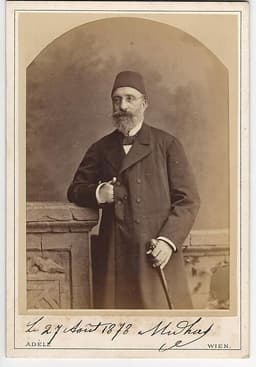
Midhat Pasha
Politician · Modern
64.3Total
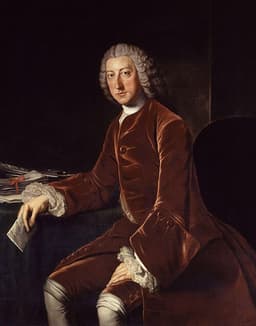
William Pitt the Elder
Politician · Modern
70.2Total
Basic Information
Born
1822
1708
Died
1884
1778
Era
Modern
Modern
Nationality
Ottoman Empire
United Kingdom
Occupation
Politician
Politician
Civilization
Middle Eastern
Western
Score Comparison
Military (10%)
10.0
67.3
Political (20%)
78.0
72.0
Influence (20%)
82.0
68.0
Legacy (20%)
72.0
68.0
Leadership (15%)
62.0
80.0
Strategy (15%)
38.3
67.2
TOTAL
64.3
70.2
Midhat Pasha — Complete Timeline
1864 AD
Governorship of the Danube VilayetReform◆ Major
As governor of the Danube Vilayet from 1864 to 1868, Midhat Pasha implemented extensive reforms. He built roads, bridges, and schools, established a provincial bank, and promoted agricultural development. His administration became a model for Tanzimat provincial governance.
GovernorshipReformInfrastructure
Impact: regionalconstructive
1872 AD
Appointment as Grand VizierPolitical Action◆ Major
Midhat Pasha was appointed Grand Vizier for the first time in 1872. He had previously served as governor of the Danube Vilayet and was known for his reformist ideas. His tenure was short-lived due to opposition from conservative factions and the sultan.
AppointmentReformOttoman Politics
Impact: nationalconstructive
1876 AD
Proclamation of the Ottoman Constitution of 1876Reform
Midhat Pasha was the chief architect of the first Ottoman Constitution, proclaimed on December 23, 1876. The constitution established a bicameral parliament, guaranteed civil liberties, and limited the sultan's powers. It was a landmark in Ottoman modernization, though it was suspended in 1878.
ConstitutionReformParliament
Impact: nationalprogressive
1881 AD
Exile and TrialPolitical Action◆ Major
Midhat Pasha was arrested in 1881 on charges of involvement in the murder of Sultan Abd
ExileTrialExecution
Impact: nationaltragic
William Pitt the Elder — Complete Timeline
1756 AD
Led Britain in Seven Years' WarWar
William Pitt the Elder served as Secretary of State from 1756 to 1761, directing British strategy in the Seven Years' War. His policies focused on naval supremacy and colonial campaigns, leading to victories in Canada, India, and the Caribbean.
Seven Years' WarColonial EmpireMilitary Strategy
Impact: global
1759 AD
Conquest of QuebecWar◆ Major
Under Pitt's direction, British forces under General James Wolfe captured Quebec City on September 13, 1759, after the Battle of the Plains of Abraham. This victory secured British control over Canada and marked a turning point in the Seven Years' War.
Seven Years' WarCanadaMilitary Victory
Impact: global
1766 AD
Became Prime MinisterPolitical Action
Pitt was appointed Prime Minister on July 30, 1766, forming a government. However, his health declined and he was elevated to the House of Lords as Earl of Chatham, which weakened his political base. His second ministry was less effective than his wartime leadership.
Prime MinisterGovernment18th Century
Impact: national
Opposed American TaxationPolitical Action◆ Major
Pitt argued for the repeal of the Stamp Act in 1766, asserting that Parliament had no right to tax the American colonies without representation. His speech in the Commons helped secure repeal, though he maintained Parliament's authority to legislate for the colonies.
American ColoniesTaxationParliamentary Debate
Impact: global
Expert Analysis
Midhat Pasha vs William Pitt the Elder
# The Commoner and the Reformer: Two Visions of Power in an Age of Empire
In the winter of 1766, William Pitt the Elder stood before the House of Commons and declared that Parliament had no right to tax the American colonies. Across the Atlantic, in the Ottoman capital of Constantinople, a young bureaucrat named Midhat Pasha was beginning his ascent through a very different system of power. One man was the architect of British global supremacy; the other would become the father of Ottoman constitutionalism. Both sought to reform empires, yet their fates could not have been more different. Pitt died in honor, his name synonymous with victory. Midhat Pasha died in exile, strangled on the orders of a sultan he had tried to save.
Origins
William Pitt was born in 1708 into a political family, but one that operated outside the inner circles of the British aristocracy. His grandfather had been governor of Madras, his father a member of Parliament, yet the Pitt name carried the stain of trade and colonial commerce rather than ancient lineage. This outsider status shaped Pitt’s identity. He cultivated the persona of the “Great Commoner,” a man who spoke for the nation against the corruptions of the court and the dominance of the landed elite.
Midhat Pasha, born Ahmed Şefik in 1822 in Constantinople, came from a similarly modest background by Ottoman standards. His father was a religious judge, a *kadi*, and the family belonged to the *ilmiye*—the scholarly class that served the state. But the Ottoman Empire of the 1820s was a world in crisis. The Janissaries had just been destroyed, the Greek War of Independence had exposed the empire’s military weakness, and the reforms of the Tanzimat were still a generation away. Midhat grew up breathing the air of decline, and he would spend his life trying to reverse it.
Rise to Power
Pitt’s entry onto the political stage came through the power of oratory. He entered Parliament in 1735 and quickly made himself heard, attacking the government’s handling of the War of the Austrian Succession. His moment arrived in 1756, when Britain was reeling from military disasters in the Seven Years’ War. King George II, distrustful of Pitt’s populism, was forced to appoint him Secretary of State. Pitt understood that the war was not about Europe alone—it was a global struggle for empire. He poured resources into the navy, sent expeditions to North America and India, and found generals like James Wolfe who could execute his vision.
Midhat Pasha rose through the Ottoman bureaucracy, not through speeches but through administration. His governorship of the Danube Vilayet from 1864 to 1868 was a masterclass in state-building. He built roads, bridges, and schools; he reformed tax collection; he created a provincial council that gave local notables a voice. The Danube Vilayet became a model of what the Tanzimat reforms could achieve. In 1872, he was appointed Grand Vizier for the first time, but his reformist zeal put him at odds with the conservative court and the sultan’s inner circle.
Leadership & Governance
Pitt governed through vision and delegation. He did not command armies himself, but he chose commanders and gave them clear objectives. His strategy for the Seven Years’ War was simple: attack France where it was weakest, in its colonies, while subsidizing Frederick the Great to tie down French armies in Europe. The result was the conquest of Quebec on September 13, 1759—a victory that secured British control of North America. Pitt’s political genius lay in his ability to inspire a nation. He made the war a popular cause, rallying merchants, farmers, and soldiers alike behind the flag.
Midhat Pasha governed through institutions. He believed that the Ottoman Empire could only survive if it became a modern constitutional state, where the sultan’s power was limited by law and where all subjects—Muslim and Christian, Turk and Arab—were equal before the constitution. In 1876, he achieved what no Ottoman reformer had done before: he forced Sultan Abdülhamid II to proclaim the first Ottoman Constitution. For a brief moment, it seemed that the sick man of Europe might recover. But the constitution was a fragile thing, born of crisis and dependent on the sultan’s goodwill.
Triumph & Tragedy
Pitt’s greatest triumph was the Treaty of Paris in 1763, which ended the Seven Years’ War and made Britain the dominant colonial power in the world. Canada, Florida, and India fell under British control. Pitt was hailed as the savior of the nation. Yet his tragedy came later. When he became Prime Minister in 1766, his health was failing, and his political touch deserted him. He accepted a peerage as the Earl of Chatham, abandoning the “Great Commoner” identity that had been his strength. He grew increasingly erratic and isolated, and his later years were marked by bouts of madness and depression.
Midhat Pasha’s triumph was equally fleeting. The Constitution of 1876 lasted barely two years before Sultan Abdülhamid II suspended it and dissolved the parliament. Midhat was arrested in 1881 on trumped-up charges of involvement in the murder of Sultan Abdülaziz. He was tried, sentenced to death, and then exiled to Taif in Arabia. There, in 1884, he was strangled by the sultan’s agents. The man who had tried to save the Ottoman Empire with a constitution died at the hands of the very autocracy he sought to reform.
Character & Destiny
Pitt was a man of grand gestures and fiery rhetoric. He believed in the power of will and the righteousness of British imperial destiny. His confidence was infectious, but it also made him inflexible. He could not adapt to the politics of peace, and his stubbornness contributed to his political downfall. Midhat Pasha was a technocrat and a pragmatist. He believed in the power of systems and laws. But in an empire where the sultan held absolute power, the rule of law was only as strong as the ruler’s willingness to obey it. Midhat’s tragedy was that he tried to impose constitutional order on a system that was fundamentally personal and arbitrary.
Legacy
William Pitt the Elder is remembered as one of Britain’s greatest war leaders. His name adorns cities and counties across the English-speaking world. His son, William Pitt the Younger, would become Prime Minister and continue the family tradition of leadership. Pitt’s legacy is one of empire, victory, and the belief that a single man of vision can change the course of history.
Midhat Pasha’s legacy is more complex. He is revered in modern Turkey as a pioneer of democracy and constitutionalism, a martyr to the cause of reform. The constitution he wrote was revived in 1908 and remained the basis of Ottoman governance until the empire’s end. Yet his failure also serves as a warning: reforms imposed from above, without the support of a strong civil society or a willing ruler, are fragile. Midhat built a house of cards, and the sultan blew it down.
Conclusion
Two reformers, two empires, two fates. Pitt succeeded because he worked within a system that allowed for popular mobilization and parliamentary debate. Midhat failed because he worked within a system that did not. The difference was not one of talent or vision—both men were extraordinary—but of context. Pitt’s Britain was already a constitutional monarchy; Midhat’s Ottoman Empire was still an autocracy. The Great Commoner could appeal to the people because the people had a voice. The Ottoman reformer could only appeal to the sultan, and the sultan chose silence. In the end, the fate of reformers is determined not only by what they do, but by the ground upon which they stand.
Rankings
🥇
William Pitt the ElderLeader
Mil: 67.3Pol: 72.0Inf: 68.0
70.2
🥈
Midhat Pasha
Mil: 10.0Pol: 78.0Inf: 82.0
64.3
+5.9 behind
How This Comparison Works
Algorithm
Each figure is scored on 6 dimensions (0—100 scale) based on structured historical data: Military (10%), Political (20%), Influence (20%), Legacy (20%), Leadership (15%), Strategy (15%). The weighted total produces the final ranking.
Data Sources
Scores are computed from structured sub-indicators in the database. Scale factors adjust for era (Ancient ×0.85, Modern ×1.0) and civilization size (Eastern ×1.05, Other ×0.80) to account for differences in population and military scale.
Maximum 3 Figures
Comparisons are limited to 2—3 figures to ensure readability and statistical meaningfulness.
Error Margins
±5 points per dimension — Sub-scores are derived from historical records with inherent uncertainty. Two figures within 5 points on a dimension should be considered roughly equivalent in that area.
Total Score Accuracy
±3 points overall — The weighted combination of 6 dimensions produces a total score with approximately ±3 points of uncertainty. Differences of less than 3 points are not statistically significant— the figures are effectively tied.
Known Limitations
- Historical records are incomplete and uneven across civilizations
- Figures from oral-tradition societies may be underrepresented
- Occupation labels can misclassify multi-role figures
- Scores measure capability and impact, not moral character
- Quantitative scoring is a comparison tool, not absolute truth
Capability Radar
Military (10%) — Battles & Warfare
Battles
0
60
Win Rate
0
75
Expansion
0
80
Political (20%) — Governance & Reform
Reform
85
75
Diplomacy
70
80
Economy
60
70
Influence (20%) — Cultural & Global Reach
Cultural
55
60
Global
55
75
Legacy (20%) — Historical Impact
Historical
70
80
Longevity
60
70
Leadership (15%) — Power & Stability
Tenure
65
70
Stability
40
65
Strategy (15%) — Tactics & Innovation
Strategy
0
85
Tactics
0
65
Reform
10
70
Similar Comparisons
Comments & Discussion
No comments yet. Be the first to share your thoughts!