Loading...
This comparison has not been analyzed yet.
One-time AI generation (~1 minute). Scores and timeline are already available below.
Mikael Imru vs Roosevelt Skerrit
Roosevelt Skerrit leads by 15.8 pts · 2 figures compared
…
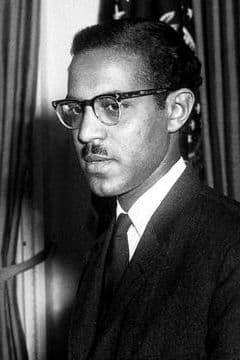
Mikael Imru
Politician · Modern
36.6Total

Roosevelt Skerrit
Politician · Modern
52.4Total
Basic Information
Born
1929
1972
Died
—
—
Era
Modern
Modern
Nationality
Ethiopia
Dominica
Occupation
Politician
Politician
Civilization
Other
Western
Score Comparison
Military (10%)
26.4
48.1
Political (20%)
25.0
68.0
Influence (20%)
47.1
51.0
Legacy (20%)
37.5
42.5
Leadership (15%)
34.6
66.0
Strategy (15%)
38.7
41.4
TOTAL
36.6
52.4
Mikael Imru — Complete Timeline
1974 AD
Appointed Prime Minister under DergPolitical Action◆ Major
Mikael Imru was appointed prime minister of Ethiopia by the Derg in August 1974, serving as a civilian figurehead during the early military regime. He held the position for only a few months before being replaced.
DergTransitional GovernmentEthiopia
Impact: national
Dismissed as Prime MinisterPolitical Action◆ Major
The Derg dismissed Mikael Imru from the prime ministership in November 1974, as the military consolidated power and eliminated civilian leaders. He was subsequently arrested and imprisoned.
DergPolitical PrisonerEthiopia
Impact: nationaltragic
Roosevelt Skerrit — Complete Timeline
2004 AD
Became Prime Minister of DominicaPolitical Action◆ Major
Roosevelt Skerrit became Prime Minister of Dominica on January 8, 2004, at age 31, following the death of Prime Minister Pierre Charles. He was the youngest head of government in the world at the time.
LeadershipCaribbean Politics
Impact: national
Established diplomatic relations with ChinaPolitical Action◆ Major
Skerrit's government switched diplomatic recognition from Taiwan to the People's Republic of China in March 2004, securing Chinese investment and aid for Dominica. This realignment affected Dominica's foreign policy and economic relations.
Foreign PolicyChina RelationsDiplomacy
Impact: national
2014 AD
Implemented Citizenship by Investment ProgramReform◆ Major
Skerrit's government expanded Dominica's Citizenship by Investment Program, allowing foreign investors to obtain citizenship in exchange for contributions to the country's economic development. The program became a major source of revenue for Dominica.
Economic PolicyInvestmentCitizenship
Impact: nationalconstructive
2017 AD
Survived Hurricane MariaOther◆ Major
Hurricane Maria struck Dominica on September 18, 2017, as a Category 5 storm, causing widespread destruction and killing 31 people. Skerrit's government led the recovery effort, with the prime minister personally appealing for international aid.
Natural DisasterRecoveryCaribbean
Impact: nationaltragic
2022 AD
Won fifth consecutive general electionPolitical Action◆ Major
Skerrit's Dominica Labour Party won the general election on December 6, 2022, securing 19 of 21 seats. This victory extended his tenure as prime minister to over 18 years, making him one of the longest-serving leaders in the Caribbean.
ElectionPolitical DominanceCaribbean
Impact: national
This comparison has not been analyzed yet.
One-time AI generation (~1 minute). Scores and timeline are already available below.
Rankings
🥇
Roosevelt SkerritLeader
Mil: 48.1Pol: 68.0Inf: 51.0
52.4
🥈
Mikael Imru
Mil: 26.4Pol: 25.0Inf: 47.1
36.6
+15.8 behind
How This Comparison Works
Algorithm
Each figure is scored on 6 dimensions (0—100 scale) based on structured historical data: Military (10%), Political (20%), Influence (20%), Legacy (20%), Leadership (15%), Strategy (15%). The weighted total produces the final ranking.
Data Sources
Scores are computed from structured sub-indicators in the database. Scale factors adjust for era (Ancient ×0.85, Modern ×1.0) and civilization size (Eastern ×1.05, Other ×0.80) to account for differences in population and military scale.
Maximum 3 Figures
Comparisons are limited to 2—3 figures to ensure readability and statistical meaningfulness.
Error Margins
±5 points per dimension — Sub-scores are derived from historical records with inherent uncertainty. Two figures within 5 points on a dimension should be considered roughly equivalent in that area.
Total Score Accuracy
±3 points overall — The weighted combination of 6 dimensions produces a total score with approximately ±3 points of uncertainty. Differences of less than 3 points are not statistically significant— the figures are effectively tied.
Known Limitations
- Historical records are incomplete and uneven across civilizations
- Figures from oral-tradition societies may be underrepresented
- Occupation labels can misclassify multi-role figures
- Scores measure capability and impact, not moral character
- Quantitative scoring is a comparison tool, not absolute truth
Capability Radar
Military (10%) — Battles & Warfare
Battles
19
31
Win Rate
22
34
Expansion
29
34
Political (20%) — Governance & Reform
Reform
10
55
Diplomacy
20
60
Economy
10
50
Influence (20%) — Cultural & Global Reach
Cultural
5
20
Global
5
25
Legacy (20%) — Historical Impact
Historical
10
30
Longevity
5
25
Leadership (15%) — Power & Stability
Tenure
15
70
Stability
5
45
Strategy (15%) — Tactics & Innovation
Strategy
33
36
Tactics
34
38
Reform
38
45
Similar Comparisons
Comments & Discussion
No comments yet. Be the first to share your thoughts!