Loading...
Mobutu Sese Seko vs Wilhelm Keitel
Mobutu Sese Seko leads by 0.5 pts · 2 figures compared
…
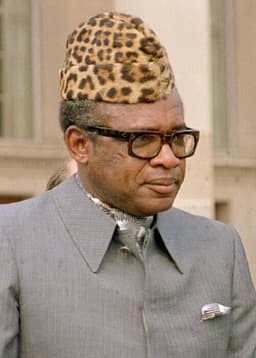
Mobutu Sese Seko
General · Modern
46.6Total

Wilhelm Keitel
General · Modern
46.1Total
Basic Information
Born
1930
1882
Died
—
1946
Era
Modern
Modern
Nationality
Congo
Germany
Occupation
General
General
Civilization
Other
Western
Score Comparison
Military (10%)
10.2
55.0
Political (20%)
37.9
29.3
Influence (20%)
56.4
52.5
Legacy (20%)
45.0
42.5
Leadership (15%)
80.0
57.6
Strategy (15%)
25.0
38.3
TOTAL
46.6
46.1
Mobutu Sese Seko — Complete Timeline
1965 AD
Seized power in coup d'étatPolitical Action
Mobutu, as army chief of staff, led a bloodless coup against President Joseph Kasa-Vubu on November 24, 1965. He suspended the constitution, assumed full executive powers, and began a 32-year dictatorship, initially as president of the Democratic Republic of the Congo.
Coup d'étatDictatorshipCentralization
Impact: nationaldestructive
1971 AD
Renamed country to Zaire and implemented AuthenticityCultural◆ Major
Mobutu renamed the Democratic Republic of the Congo to Zaire and launched the Authenticity campaign. He forced citizens to adopt African names, banned Western clothing, and promoted traditional culture. The country's name, flag, and currency were changed to reflect African identity.
Cultural PolicyNationalismAfricanization
Impact: national
1973 AD
Nationalized foreign-owned businessesPolitical Action◆ Major
Mobutu's Zairianization policy seized foreign-owned plantations, mines, and businesses, transferring them to political allies and family members. The policy led to economic collapse, corruption, and a sharp decline in production, forcing partial reversal by 1977.
NationalizationEconomic DeclineCorruption
Impact: nationaldestructive
1997 AD
Overthrown in the First Congo WarWar
A coalition of Rwandan, Ugandan, and Congolese rebel forces led by Laurent Kabila advanced across Zaire. Mobutu, suffering from cancer, fled the capital Kinshasa on May 16, 1997. He died in exile in Morocco four months later, ending his 32-year rule.
OverthrowCivil WarExile
Impact: regionaltragic
Wilhelm Keitel — Complete Timeline
1938 AD
Appointment as Chief of the OKWPolitical Action◆ Major
Keitel was appointed Chief of the Oberkommando der Wehrmacht (OKW), the high command of the German armed forces. In this role, he served as Hitler's primary military advisor and was responsible for coordinating military operations. He became known for his unquestioning loyalty to Hitler.
World War IIMilitary CommandNazi Germany
Impact: global
1941 AD
Signing of the Commissar OrderWar◆ Major
Keitel signed the Commissar Order, which ordered the execution of Soviet political commissars captured during Operation Barbarossa. This order violated international law and contributed to the brutal nature of the war on the Eastern Front.
World War IIWar CrimesEastern Front
Impact: regionaldestructive
Signing of the Night and Fog DecreePolitical Action◆ Major
Keitel signed the Night and Fog Decree, which authorized the disappearance of resistance fighters in occupied territories. Victims were arrested and secretly transported to Germany, where they were executed or imprisoned without trial. This decree was later classified as a war crime.
World War IIWar CrimesOccupation
Impact: regionaldestructive
1945 AD
Surrender of GermanyPolitical Action◆ Major
Keitel signed the unconditional surrender of Germany on May 8, 1945, in Berlin. He represented the German armed forces at the signing ceremony. This act formally ended World War II in Europe.
World War IISurrenderEnd of War
Impact: globaltragic
1946 AD
Nuremberg Trial and ExecutionPolitical Action◆ Major
Keitel was tried at the International Military Tribunal in Nuremberg for conspiracy, crimes against peace, war crimes, and crimes against humanity. He was found guilty on all counts and sentenced to death. He was executed by hanging on October 16, 1946.
Nuremberg TrialsWar CrimesExecution
Impact: globaltragic
Expert Analysis
Origins
Mobutu Sese Seko was born on October 14, 1930, in Lisala, Belgian Congo. His mother, a maid, and his father, a cook, died when Mobutu was young. He was raised by an uncle and attended missionary schools, later joining the Belgian colonial army (Force Publique) as a clerk. He rose through the ranks and became a journalist, eventually befriending Patrice Lumumba.
Wilhelm Keitel was born on September 22, 1882, in Helmscherode, Germany, to a landowning family. He joined the Prussian Army in 1901 and served in World War I. After the war, he remained in the Reichswehr, rising through staff positions. He married Lisa Fontaine, and his son Karl-Heinz became a Wehrmacht officer.
Rise to Power
Mobutu's rise began in 1960 when Congo gained independence. He served as Prime Minister Lumumba's secretary of state for defense, but in September 1960, he led a coup against Lumumba, backed by the CIA. He installed a provisional government and later became army chief. On November 24, 1965, he seized power in a bloodless coup against President Joseph Kasa-Vubu, suspending the constitution and assuming full powers.
Keitel's rise came through his loyalty to Hitler. In 1938, after the Blomberg-Fritsch affair, Hitler appointed Keitel as Chief of the Oberkommando der Wehrmacht (OKW). Keitel's sycophantic nature and organizational skills made him indispensable. He coordinated military operations but never commanded troops. His influence grew as he became Hitler's primary military advisor, though he rarely challenged Hitler's decisions.
Leadership & Governance
Mobutu ruled Zaire (renamed from Congo in 1971) as a personalist dictatorship. He centralized power, abolished political parties, and created a single party, the Popular Movement of the Revolution. He implemented 'Authenticity,' forcing citizens to adopt African names and discard Western clothing. He nationalized foreign businesses in 1973, giving them to allies, which led to economic collapse. His leadership score of 80.0 reflects his ability to maintain control, but his political score of 37.9 shows his governance was chaotic and corrupt.
Keitel's leadership was characterized by obedience to Hitler. He signed orders that violated international law, such as the Commissar Order (1941) and the Night and Fog Decree (1941). He rarely opposed Hitler, even when military decisions were disastrous. His leadership score of 57.6 indicates competence in administration but moral failure. His military score of 55.0 reflects his role in planning operations, but his strategy score of 38.3 shows he was not an independent strategist.
Triumph & Tragedy
Mobutu's triumphs include maintaining power for 32 years, surviving numerous coup attempts, and projecting African nationalism. He hosted the 1974 Muhammad Ali vs George Foreman 'Rumble in the Jungle.' His tragedies: economic devastation (inflation reached 10,000% in the 1990s), massive corruption (he amassed a fortune of $5 billion while infrastructure crumbled), and his overthrow in 1997 during the First Congo War, fleeing into exile.
Keitel's triumphs include organizing the German war machine efficiently and overseeing the surrender of Germany in 1945. His tragedies: signing criminal orders that led to mass murders, his unquestioning loyalty to Hitler, and his execution at Nuremberg on October 16, 1946. He was found guilty of war crimes and crimes against humanity.
Character & Destiny
Mobutu was charismatic and cunning, using patronage and fear to stay in power. He was known for his leopard-skin hat and grand speeches. His character led to his downfall: his greed alienated the West, and his neglect of the army allowed rebels to advance. His destiny was to die in exile in Morocco in 1997.
Keitel was diligent and obedient, often described as 'Lackey' by fellow officers. He lacked moral courage, which led him to implement Nazi atrocities. His destiny was to be hanged as a war criminal, a rare example of high-level accountability.
Legacy
Mobutu's legacy is mixed. He is remembered for his authoritarian rule and the collapse of Zaire. His influence score of 56.4 reflects his impact on post-colonial Africa, but his legacy score of 45.0 shows his regime is viewed negatively. Zaire was renamed back to the Democratic Republic of Congo after his fall, and the country continues to suffer from instability.
Keitel's legacy is that of a war criminal. He is studied as an example of bureaucratic obedience. His influence score of 52.5 is due to his role in the Nazi military structure. The Nuremberg Trials established the principle that military leaders can be held accountable for following illegal orders.
Conclusion
While Mobutu Sese Seko scored slightly higher overall (46.6 vs 46.1), his impact was more destructive in terms of long-term economic and social damage to a nation. Keitel's actions were part of a larger criminal enterprise that caused tens of millions of deaths. However, Mobutu's 32-year reign of corruption and mismanagement arguably had a more prolonged negative effect on the Congo. But in terms of historical weight, Keitel's role in Nazi atrocities and the legal precedent set by his execution gives him a more significant legacy. Therefore, Keitel had greater impact, but Mobutu's regime was a disaster of a different scale for his country.
Rankings
🥇
Mobutu Sese SekoLeader
Mil: 10.2Pol: 37.9Inf: 56.4
46.6
🥈
Wilhelm Keitel
Mil: 55.0Pol: 29.3Inf: 52.5
46.1
+0.5 behind
How This Comparison Works
Algorithm
Each figure is scored on 6 dimensions (0—100 scale) based on structured historical data: Military (10%), Political (20%), Influence (20%), Legacy (20%), Leadership (15%), Strategy (15%). The weighted total produces the final ranking.
Data Sources
Scores are computed from structured sub-indicators in the database. Scale factors adjust for era (Ancient ×0.85, Modern ×1.0) and civilization size (Eastern ×1.05, Other ×0.80) to account for differences in population and military scale.
Maximum 3 Figures
Comparisons are limited to 2—3 figures to ensure readability and statistical meaningfulness.
Error Margins
±5 points per dimension — Sub-scores are derived from historical records with inherent uncertainty. Two figures within 5 points on a dimension should be considered roughly equivalent in that area.
Total Score Accuracy
±3 points overall — The weighted combination of 6 dimensions produces a total score with approximately ±3 points of uncertainty. Differences of less than 3 points are not statistically significant— the figures are effectively tied.
Known Limitations
- Historical records are incomplete and uneven across civilizations
- Figures from oral-tradition societies may be underrepresented
- Occupation labels can misclassify multi-role figures
- Scores measure capability and impact, not moral character
- Quantitative scoring is a comparison tool, not absolute truth
Capability Radar
Military (10%) — Battles & Warfare
Battles
5
30
Win Rate
5
25
Expansion
5
40
Political (20%) — Governance & Reform
Reform
20
10
Diplomacy
40
20
Economy
10
10
Influence (20%) — Cultural & Global Reach
Cultural
30
10
Global
40
35
Legacy (20%) — Historical Impact
Historical
40
40
Longevity
30
15
Leadership (15%) — Power & Stability
Tenure
85
55
Stability
10
5
Strategy (15%) — Tactics & Innovation
Strategy
10
30
Tactics
10
20
Reform
15
15
Similar Comparisons
Comments & Discussion
No comments yet. Be the first to share your thoughts!