Loading...
This comparison has not been analyzed yet.
One-time AI generation (~1 minute). Scores and timeline are already available below.
Muhammad al-Mahdi as-Senussi vs Taksin
Taksin leads by 16.8 pts · 2 figures compared
…

Muhammad al-Mahdi as-Senussi
Emperor · Modern
51.0Total
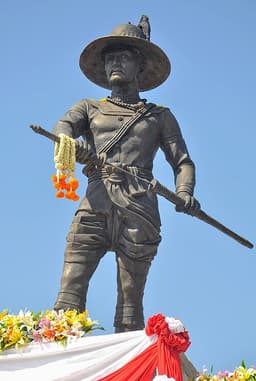
Taksin
Emperor · Modern
67.8Total
Basic Information
Born
1844
1734
Died
1902
1782
Era
Modern
Modern
Nationality
Libya
Thailand
Occupation
Emperor
Emperor
Civilization
Middle Eastern
Eastern
Score Comparison
Military (10%)
10.2
81.2
Political (20%)
68.0
70.0
Influence (20%)
55.0
62.0
Legacy (20%)
49.2
56.0
Leadership (15%)
68.0
85.0
Strategy (15%)
35.7
69.1
TOTAL
51.0
67.8
Muhammad al-Mahdi as-Senussi — Complete Timeline
1837 AD
Founding of the Senussi OrderCultural
Muhammad al-Mahdi as-Senussi's father, Muhammad ibn Ali as-Senussi, founded the Senussi order in Mecca. After his father's death in 1859, al-Mahdi became the order's leader and expanded it significantly.
Religious OrderSufism
Impact: regionalconstructive
1895 AD
Establishment of Senussi Capital at KufraPolitical Action◆ Major
Al-Mahdi moved the Senussi headquarters to the Kufra oasis in southeastern Libya in 1895. This location became the spiritual and administrative center of the order, facilitating expansion into central Africa.
ExpansionAdministration
Impact: regionalconstructive
1900 AD
Resistance Against French Colonial ExpansionWar◆ Major
Al-Mahdi led Senussi resistance against French colonial forces advancing from Chad into the Sahara. The conflict resulted in Senussi military defeats and loss of territory, but solidified the order's anti-colonial stance.
Colonial ResistanceWar
Impact: regionaltragic
1902 AD
Death and SuccessionPolitical Action◆ Major
Al-Mahdi died in 1902 at Kufra. His son, Ahmed Sharif as-Senussi, succeeded him as leader of the order, continuing the anti-colonial struggle and later supporting the Ottoman Empire in World War I.
SuccessionLeadership
Impact: regional
Taksin — Complete Timeline
1767 AD
Fall of AyutthayaWar
Burmese forces sacked and destroyed the city of Ayutthaya, ending the 417-year-old Ayutthaya kingdom. General Taksin escaped the fall and began organizing resistance against the Burmese occupation.
Burmese WarAyutthaya FallThai History
Impact: regionaltragic
Battle of Bang KungWar◆ Major
Taksin led a naval and land force to defeat a Burmese garrison at Bang Kung. This victory allowed him to establish a base at Chanthaburi and begin the reconquest of Siam.
Burmese WarResistanceThai Independence
Impact: national
1768 AD
Founding of the Thonburi KingdomPolitical Action
Taksin established Thonburi as the new capital of Siam, founding the Thonburi kingdom. He was crowned king and began the process of reunifying the country after the fall of Ayutthaya.
Thonburi KingdomThai HistoryReunification
Impact: nationalconstructive
1770 AD
Reunification of SiamWar◆ Major
King Taksin defeated rival warlords and regional powers, reunifying Siam under his rule. He also repelled Burmese invasions and expanded Thai influence into Laos and Cambodia.
ReunificationBurmese WarThai Expansion
Impact: regionalconstructive
1782 AD
Deposition and ExecutionPolitical Action◆ Major
King Taksin was deposed in a coup led by General Chao Phraya Chakri (later Rama I). He was executed shortly after, ending the Thonburi kingdom. The Chakri dynasty then established the Rattanakosin kingdom with Bangkok as its capital.
CoupChakri DynastyThonburi End
Impact: nationaltragic
This comparison has not been analyzed yet.
One-time AI generation (~1 minute). Scores and timeline are already available below.
Rankings
🥇
TaksinLeader
Mil: 81.2Pol: 70.0Inf: 62.0
67.8
🥈
Muhammad al-Mahdi as-Senussi
Mil: 10.2Pol: 68.0Inf: 55.0
51.0
+16.8 behind
How This Comparison Works
Algorithm
Each figure is scored on 6 dimensions (0—100 scale) based on structured historical data: Military (10%), Political (20%), Influence (20%), Legacy (20%), Leadership (15%), Strategy (15%). The weighted total produces the final ranking.
Data Sources
Scores are computed from structured sub-indicators in the database. Scale factors adjust for era (Ancient ×0.85, Modern ×1.0) and civilization size (Eastern ×1.05, Other ×0.80) to account for differences in population and military scale.
Maximum 3 Figures
Comparisons are limited to 2—3 figures to ensure readability and statistical meaningfulness.
Error Margins
±5 points per dimension — Sub-scores are derived from historical records with inherent uncertainty. Two figures within 5 points on a dimension should be considered roughly equivalent in that area.
Total Score Accuracy
±3 points overall — The weighted combination of 6 dimensions produces a total score with approximately ±3 points of uncertainty. Differences of less than 3 points are not statistically significant— the figures are effectively tied.
Known Limitations
- Historical records are incomplete and uneven across civilizations
- Figures from oral-tradition societies may be underrepresented
- Occupation labels can misclassify multi-role figures
- Scores measure capability and impact, not moral character
- Quantitative scoring is a comparison tool, not absolute truth
Capability Radar
Military (10%) — Battles & Warfare
Battles
15
75
Win Rate
10
80
Expansion
20
72
Political (20%) — Governance & Reform
Reform
55
68
Diplomacy
50
60
Economy
40
62
Influence (20%) — Cultural & Global Reach
Cultural
50
60
Global
35
50
Legacy (20%) — Historical Impact
Historical
45
65
Longevity
40
55
Leadership (15%) — Power & Stability
Tenure
60
65
Stability
45
55
Strategy (15%) — Tactics & Innovation
Strategy
25
82
Tactics
20
78
Reform
30
70
Similar Comparisons
Comments & Discussion
No comments yet. Be the first to share your thoughts!