Loading...
Muhammadu Buhari vs Suchinda Kraprayoon
Muhammadu Buhari leads by 14.4 pts · 2 figures compared
…
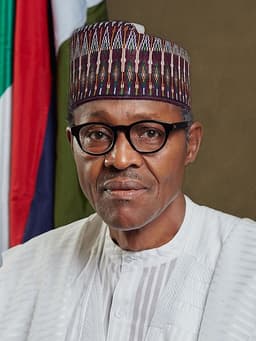
Muhammadu Buhari
General · Modern
51.5Total
Suchinda Kraprayoon
General · Modern
37.1Total
Basic Information
Born
1942
1933
Died
—
—
Era
Modern
Modern
Nationality
Nigeria
Thailand
Occupation
General
General
Civilization
Other
Eastern
Score Comparison
Military (10%)
22.6
10.2
Political (20%)
68.0
27.9
Influence (20%)
53.3
47.1
Legacy (20%)
43.3
37.5
Leadership (15%)
72.0
45.0
Strategy (15%)
41.0
39.6
TOTAL
51.5
37.1
Muhammadu Buhari — Complete Timeline
1983 AD
1983 Nigerian coup d'étatPolitical Action
Major General Muhammadu Buhari led a military coup that overthrew the civilian government of President Shehu Shagari. Buhari cited corruption and economic mismanagement as justifications, and he became the head of state.
CoupMilitary RuleCorruption
Impact: nationaldestructive
1984 AD
War Against Indiscipline (WAI)Reform◆ Major
Buhari launched the War Against Indiscipline, a campaign to enforce discipline and order in Nigerian society. It included harsh penalties for minor offenses, such as queue-jumping, and was criticized for human rights abuses.
DisciplineSocial PolicyHuman Rights
Impact: nationaldestructive
1985 AD
Overthrow by Ibrahim BabangidaPolitical Action◆ Major
Buhari was overthrown in a palace coup led by his Chief of Army Staff, Ibrahim Babangida. Babangida cited Buhari's authoritarian style and failure to address the economy as reasons for the coup.
CoupOverthrowBabangida
Impact: national
2015 AD
Anti-corruption campaignReform◆ Major
Buhari launched a high-profile anti-corruption campaign, targeting government officials and recovering stolen assets. The campaign was praised internationally but criticized for being selective and politically motivated.
Anti-CorruptionReformGovernance
Impact: nationalconstructive
Election as President of NigeriaPolitical Action
Buhari won the 2015 Nigerian presidential election, defeating incumbent Goodluck Jonathan. This was the first time an opposition candidate had defeated a sitting president in Nigeria's history, marking a democratic milestone.
ElectionDemocracyOpposition Victory
Impact: nationalprogressive
Suchinda Kraprayoon — Complete Timeline
1991 AD
Leadership of the 1991 Thai Coup d'ÉtatPolitical Action◆ Major
General Suchinda Kraprayoon led the National Peace Keeping Council in a bloodless coup that overthrew Prime Minister Chatichai Choonhavan. The coup was justified by claims of corruption and political instability, establishing a military junta.
CoupMilitary JuntaPower Seizure
Impact: nationaldestructive
1992 AD
Appointment as Prime MinisterPolitical Action◆ Major
After a general election, Suchinda was appointed Prime Minister despite not being an elected MP. His appointment sparked widespread protests, as it was seen as a continuation of military rule and a violation of democratic principles.
Prime MinisterControversyMilitary Rule
Impact: nationaldestructive
Black May 1992 Uprising and ResignationPolitical Action
Massive pro-democracy protests in Bangkok, led by Chamlong Srimuang, demanded Suchinda's resignation. The military crackdown resulted in dozens of deaths. King Bhumibol intervened, leading to Suchinda's resignation and the restoration of civilian government.
UprisingBlack MayResignation
Impact: nationaltragic
Expert Analysis
Muhammadu Buhari vs Suchinda Kraprayoon
# The General Who Came Back
In May 1992, Bangkok’s streets ran with blood. Soldiers fired into crowds of unarmed protesters, killing dozens, as General Suchinda Kraprayoon sat in the prime minister’s office, his grip on power crumbling. Twenty-three years earlier, in a very different part of the world, another general named Muhammadu Buhari had watched his own regime fall in a palace coup, exiled from power for three decades. Yet while Suchinda’s story ended in disgrace, Buhari’s took an astonishing turn: he returned to win a democratic election and lead his country again. Why did one general vanish into history’s footnotes while the other became a symbol of redemption?
Origins
Suchinda Kraprayoon was born in 1933 into Thailand’s military elite. He graduated from the Chulachomklao Royal Military Academy, part of a generation that saw the army as the guardian of the nation—a role it had played since the 1932 revolution that ended absolute monarchy. Thailand’s political culture was one of frequent coups and fragile democracies, where generals often stepped in to “restore order.” Suchinda absorbed this ethos: the military, not messy elections, kept Thailand stable.
Muhammadu Buhari, born in 1942 in Daura, northern Nigeria, came from a different world. His father was a village chief, his upbringing rooted in Fulani Muslim traditions. He joined the Nigerian Army in 1962, just two years after independence, and trained in Britain, India, and the United States. Nigeria’s early years were scarred by coups, civil war, and oil-boom corruption. Buhari watched his country lurch from one crisis to another, and he came to believe that only strong, disciplined leadership could save it.
Rise to Power
Suchinda’s path was conventional for a Thai general. He rose through the army’s ranks, serving in the Korean and Vietnam Wars, and by 1990 he was commander-in-chief. When Prime Minister Chatichai Choonhavan’s civilian government became mired in corruption allegations, Suchinda saw an opportunity. On February 23, 1991, he led the National Peace Keeping Council in a bloodless coup, ousting Chatichai and installing a junta. The coup was widely popular—Thais were tired of graft.
Buhari’s rise was more dramatic. On December 31, 1983, as Nigeria’s economy collapsed under President Shehu Shagari’s mismanagement, Major General Buhari struck. The coup was swift and bloodless, and Buhari justified it as a “corrective” measure. He was 41 years old, stern and austere, a man who wore his integrity like armor. Nigeria, he believed, needed a firm hand.
Leadership & Governance
Both men governed with an iron fist, but their styles diverged sharply. Suchinda, after the 1991 coup, promised elections within a year. He kept his word: in March 1992, a general election was held. But when the results produced a parliament divided among civilian parties, Suchinda’s military allies maneuvered to appoint him prime minister—even though he had not run for office. It was a classic Thai maneuver: the general would rule from behind a democratic facade. His governance was cautious, focused on economic stability, but he had no real reform agenda.
Buhari’s rule was far more aggressive. In 1984, he launched the War Against Indiscipline (WAI), a campaign to enforce order in every corner of Nigerian life. Citizens were arrested for littering, for failing to queue properly, for arriving late to work. Civil servants faced detention for corruption. The WAI was brutal in its simplicity: Buhari believed that Nigeria’s problems stemmed from a lack of discipline, and he would impose it by decree. He also jailed journalists and political opponents, suspending the constitution. His government was efficient but repressive—a military regime in full flower.
Triumph & Tragedy
Suchinda’s triumph was brief. His appointment as prime minister in April 1992 sparked immediate protests. The opposition, led by former general-turned-democracy activist Chamlong Srimuang, mobilized massive crowds in Bangkok. On May 17, the military cracked down, killing scores of protesters in what became known as Black May. The violence shocked Thailand. King Bhumibol Adulyadej intervened, summoning Suchinda and Chamlong to the palace. Days later, Suchinda resigned, his career in ruins. He had lasted only a few weeks as prime minister.
Buhari’s tragedy came earlier. On August 27, 1985, his chief of army staff, Ibrahim Babangida, overthrew him in a palace coup. Babangida accused Buhari of being “rigid” and “intolerant.” Buhari was imprisoned for three years, then released. For three decades, he faded into obscurity—a former dictator whom many Nigerians remembered as a stern, honest man but a failed leader.
Character & Destiny
Yet here is where their stories diverge. Suchinda, after Black May, was a pariah. He retreated from public life, his reputation forever stained by the blood of protesters. He had gambled on military force and lost. His character—aloof, authoritarian, unwilling to compromise—left him no path back.
Buhari, by contrast, had a different fate. His reputation for integrity, even in dictatorship, survived. When Nigeria’s democracy faltered in the 2010s under President Goodluck Jonathan, many Nigerians looked back at Buhari’s regime with nostalgia—not for its repression, but for its honesty. In 2015, at age 72, Buhari ran for president as the opposition candidate. He won, defeating Jonathan in the first peaceful transfer of power in Nigerian history. His anti-corruption campaign, launched that same year, targeted government officials and recovered stolen assets. The old general had returned, this time as a democrat.
Legacy
Suchinda’s legacy is a warning. In Thailand, he is remembered as the man who triggered Black May, a symbol of military overreach. The 1992 uprising ultimately strengthened Thai democracy—until the 2006 and 2014 coups proved the lesson was temporary. His score of 52.4 in Legacy reflects a figure who failed to adapt.
Buhari’s legacy is more complex. His military rule was harsh, but his democratic return gave him a second chance. His anti-corruption drive was genuine, if uneven, and his peaceful transfer of power in 2023, when he stepped down after two terms, was historic. Yet his economic record was poor, and his security failures—particularly against Boko Haram—tarnished his later years. His Legacy score of 56.7 is modest, but his Leadership score of 77.5 reflects a man who, unlike Suchinda, learned to lead within a democracy.
Conclusion
What separates these two generals is not their ambitions—both wanted order—but their relationship with time. Suchinda tried to force history, and history broke him. Buhari was forced to wait, and when he returned, he had changed. In the end, the general who came back understood something the one who didn’t never grasped: that power, to endure, must eventually be shared.
Rankings
🥇
Muhammadu BuhariLeader
Mil: 22.6Pol: 68.0Inf: 53.3
51.5
🥈
Suchinda Kraprayoon
Mil: 10.2Pol: 27.9Inf: 47.1
37.1
+14.4 behind
How This Comparison Works
Algorithm
Each figure is scored on 6 dimensions (0—100 scale) based on structured historical data: Military (10%), Political (20%), Influence (20%), Legacy (20%), Leadership (15%), Strategy (15%). The weighted total produces the final ranking.
Data Sources
Scores are computed from structured sub-indicators in the database. Scale factors adjust for era (Ancient ×0.85, Modern ×1.0) and civilization size (Eastern ×1.05, Other ×0.80) to account for differences in population and military scale.
Maximum 3 Figures
Comparisons are limited to 2—3 figures to ensure readability and statistical meaningfulness.
Error Margins
±5 points per dimension — Sub-scores are derived from historical records with inherent uncertainty. Two figures within 5 points on a dimension should be considered roughly equivalent in that area.
Total Score Accuracy
±3 points overall — The weighted combination of 6 dimensions produces a total score with approximately ±3 points of uncertainty. Differences of less than 3 points are not statistically significant— the figures are effectively tied.
Known Limitations
- Historical records are incomplete and uneven across civilizations
- Figures from oral-tradition societies may be underrepresented
- Occupation labels can misclassify multi-role figures
- Scores measure capability and impact, not moral character
- Quantitative scoring is a comparison tool, not absolute truth
Capability Radar
Military (10%) — Battles & Warfare
Battles
10
5
Win Rate
10
5
Expansion
5
5
Political (20%) — Governance & Reform
Reform
30
5
Diplomacy
25
10
Economy
20
5
Influence (20%) — Cultural & Global Reach
Cultural
25
5
Global
25
5
Legacy (20%) — Historical Impact
Historical
30
10
Longevity
20
5
Leadership (15%) — Power & Stability
Tenure
45
10
Stability
15
5
Strategy (15%) — Tactics & Innovation
Strategy
15
10
Tactics
15
10
Reform
20
5
Similar Comparisons
Comments & Discussion
RomanRes6/16/2026
The real lesson here isn't about redemption but about the differing consequences of state violence. Suchinda's soldiers killed hundreds of unarmed protesters in Black May 1992, and he couldn't escape that stain—he fled to Germany in disgrace. Buhari, meanwhile, killed far more during his military rule, especially in the 1984 coup against Maitatsine rebels where thousands died. The difference? Nigeria's collective memory is shorter, and ethnic politics overshadow accountability. Both were brutal,