Loading...
Mustafa Kemal Ataturk vs Yuan Shikai
Mustafa Kemal Ataturk leads by 20.0 pts · 2 figures compared
…
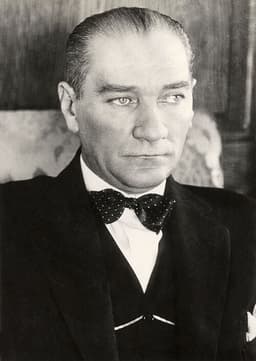
Mustafa Kemal Ataturk
Politician · Modern
80.0Total
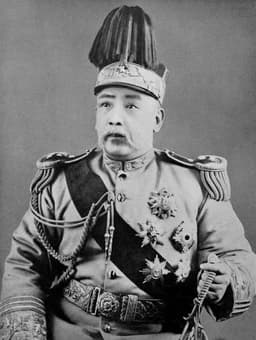
Yuan Shikai
Politician · Modern
60.0Total
Basic Information
Born
1881
1859
Died
1938
1916
Era
Modern
Modern
Nationality
Turkey
China
Occupation
Politician
Politician
Civilization
Middle Eastern
Eastern
Score Comparison
Military (10%)
75.0
45.0
Political (20%)
85.0
72.0
Influence (20%)
75.0
57.2
Legacy (20%)
90.0
54.0
Leadership (15%)
80.0
72.0
Strategy (15%)
65.0
61.2
TOTAL
80.0
60.0
Mustafa Kemal Ataturk — Complete Timeline
1915 AD
Battle of GallipoliWar
As a colonel, Mustafa Kemal commanded Ottoman forces at Gallipoli, successfully repelling Allied landings. His leadership at critical points like Chunuk Bair made him a national hero and laid the foundation for his political career.
World War IOttoman EmpireMilitary Victory
Impact: regional
1919 AD
Turkish War of IndependenceWar
Kemal organized and led the Turkish National Movement against the Allied occupation of Anatolia and the Treaty of S
Independence WarNational MovementAnkara
Impact: nationalconstructive
1922 AD
Abolition of the SultanatePolitical Action◆ Major
The Grand National Assembly of Turkey, under Kemal's leadership, abolished the Ottoman Sultanate, ending 600 years of imperial rule. This severed the link with the old regime and paved the way for the proclamation of the Republic.
SultanateRepublicPolitical Reform
Impact: nationalprogressive
1923 AD
Proclamation of the Republic of TurkeyPolitical Action
Kemal declared Turkey a republic, becoming its first president. He moved the capital to Ankara and initiated a series of radical reforms to modernize and secularize the state, including the adoption of a new legal code and the Latin alphabet.
RepublicModernizationSecularism
Impact: globalprogressive
1925 AD
Adoption of the Hat LawReform◆ Major
Kemal introduced the Hat Law, banning the fez and encouraging Western-style hats. This was part of his broader cultural revolution to secularize and Westernize Turkish society, symbolizing the break with Ottoman traditions.
Cultural ReformSecularismWesternization
Impact: nationalprogressive
1934 AD
Granting of Women's SuffrageReform◆ Major
Kemal's government granted women the right to vote and stand for election in national elections, ahead of many European countries. This reform was part of his commitment to gender equality and modernization of Turkish society.
Women's RightsSuffrageModernization
Impact: nationalprogressive
Yuan Shikai — Complete Timeline
1901 AD
Command of the Beiyang ArmyReform◆ Major
Yuan Shikai took command of the Beiyang Army, the most modern military force in late Qing China. He expanded and trained the army, which became the basis for his political power and later dominated Chinese politics.
Military reformBeiyang Army
Impact: national
1912 AD
Appointed First President of the Republic of ChinaPolitical Action
Yuan Shikai became the first president of the Republic of China after negotiating the abdication of the Qing emperor. He used his control of the Beiyang Army to pressure the revolutionary government into accepting his leadership.
PresidencyRepublic of China
Impact: national
1915 AD
Declaration of the Empire of ChinaPolitical Action◆ Major
Yuan Shikai declared himself emperor of the Empire of China, attempting to restore the monarchy. This move sparked widespread opposition from provincial leaders and foreign powers, leading to the collapse of his regime.
Monarchy restorationPolitical crisis
Impact: nationaldestructive
Signing of the Twenty-One DemandsPolitical Action◆ Major
Yuan Shikai accepted most of Japan's Twenty-One Demands, which expanded Japanese influence in China. The agreement granted Japan economic rights in Manchuria and Shandong, and was seen as a national humiliation.
DiplomacyJapanese imperialism
Impact: globaltragic
1916 AD
Death and Collapse of the Beiyang GovernmentPolitical Action◆ Major
Yuan Shikai died of uremia, leaving no clear successor. His death led to the fragmentation of the Beiyang Army into warlord factions, plunging China into a period of civil war and political instability.
Warlord eraPolitical fragmentation
Impact: nationaltragic
Expert Analysis
Yuan Shikai vs Mustafa Kemal Ataturk
# The Reformer and the Emperor: Atatürk, Yuan Shikai, and the Fate of Empires
In the winter of 1915, two men stood at the crossroads of history, each facing the collapse of a centuries-old empire. On the Gallipoli Peninsula, a young Ottoman colonel named Mustafa Kemal watched British warships massing offshore, knowing that his command could decide the fate of Istanbul. Half a world away, in Beijing, Yuan Shikai presided over a hollowed-out Qing dynasty, its dragon throne trembling under the weight of foreign gunboats and internal decay. Both men would rise from the ashes of empire to shape new nations. One would forge a republic that endures; the other would shatter into infamy. Why did their paths diverge so dramatically?
Origins
Mustafa Kemal was born in 1881 in Salonica, a multicultural port city in the fading Ottoman Empire. His mother, Zübeyde, was a devout Muslim; his father, Ali Rıza, a minor customs official who died when Mustafa was young. From childhood, Kemal absorbed two worlds: the religious conservatism of his mother and the secular ambition encouraged by his father’s memory. He entered military school at twelve, where he learned not just tactics but the ideas of the French Enlightenment—Rousseau, Voltaire, the belief that reason could remake society. The Ottoman Empire was the “sick man of Europe,” disintegrating under nationalist revolts. For Kemal, the lesson was clear: tradition had failed.
Yuan Shikai, born in 1859 in Henan province, came from a different soil. His family were minor gentry, but his uncle’s military connections opened doors. Yuan failed the civil service exams twice—a humiliation that marked him. Unlike Kemal, who embraced Western ideas, Yuan learned power in the raw: bribery, patronage, the manipulation of warlords. He rose through the Qing military bureaucracy, commanding the Beiyang Army, the most modern force in China. But modernization for Yuan was a tool, not a creed. The Qing dynasty had been humiliated in the Opium Wars and the Boxer Rebellion. Yuan saw that China needed strength, not revolution.
Rise to Power
Kemal’s ascent came through war. At Gallipoli in 1915, he ordered his troops to dig in on the ridges, famously telling them, “I don’t order you to attack; I order you to die.” That defiance stopped the Allied landing and made him a national hero. But the Ottoman Empire was collapsing anyway. After World War I, the Allied powers occupied Istanbul and carved up Anatolia under the Treaty of Sèvres. Kemal refused to accept defeat. In 1919, he traveled to Samsun and organized the Turkish National Movement, rallying peasants and officers against the occupation. He turned defeat into a war of independence.
Yuan Shikai’s path was quieter and more treacherous. In 1901, he took command of the Beiyang Army, using it as his personal power base. When the Qing dynasty fell in 1912, the revolutionaries in the south were weak. Yuan negotiated the abdication of the child emperor Puyi, promising him a pension and protection. In return, the revolutionaries made Yuan the first president of the Republic of China. He had not fought for the republic; he had inherited it. His power lay not in popular support but in the loyalty of his generals.
Leadership & Governance
As president, Atatürk moved fast. In 1923, he proclaimed the Republic of Turkey, moving the capital from Istanbul to Ankara—a symbolic break from the Ottoman past. He abolished the sultanate, then the caliphate, replacing Islamic law with Swiss civil codes. In 1925, the Hat Law banned the fez, ordering men to wear Western-style hats. Women gained the right to vote in 1934, earlier than in France or Italy. Atatürk believed that modernization required a total break: language, dress, law, education—all must be remade. He was ruthless: he suppressed Kurdish revolts, silenced opponents, and ruled through a single party. But his reforms were systematic, and they stuck.
Yuan Shikai governed differently. He preserved the old imperial bureaucracy, staffed with Qing officials. He did not abolish Confucian ceremonies or traditional dress. Instead, he consolidated power through patronage, placing Beiyang loyalists in every province. In 1915, facing Japan’s Twenty-One Demands, Yuan accepted most of them—granting Japan economic control over Manchuria and Shandong—to buy time. He hoped to strengthen China before challenging foreign powers. But the demands enraged nationalists, who saw him as a traitor. That same year, Yuan made his fatal gamble: he declared himself emperor of the Empire of China, restoring the monarchy under a new dynasty.
Triumph & Tragedy
Atatürk’s greatest triumph was survival. Against the Allied occupation, he built a nation from the wreckage of an empire. The Turkish War of Independence ended in 1923 with the Treaty of Lausanne, which recognized Turkey’s borders. His tragedy came later: the cultural reforms alienated religious conservatives, and his single-party rule stifled democracy. But he died in 1938 in his bed, still president, his republic intact.
Yuan Shikai’s triumph was his rise itself—from a failed exam-taker to the most powerful man in China. But his declaration of empire in 1915 was a disaster. Provincial governors rebelled; the Beiyang Army fractured. Within months, Yuan was forced to cancel the monarchy. He died in 1916 of uremia, broken and reviled. His death left a vacuum: the Beiyang Army split into warlord factions, plunging China into a decade of civil war.
Character & Destiny
Atatürk was a visionary who believed in the power of ideas. He once said, “A nation which makes no effort to advance, which does not march forward, is a nation which will be trampled upon.” His ruthlessness was strategic—he broke the past to save the future.
Yuan Shikai was a pragmatist who believed only in power. He saw the republic as a mask for his ambition. “I am not a revolutionary,” he told his generals. “I am a restorer of order.” But order without legitimacy collapses. His character—cautious, calculating, cynical—could not inspire loyalty beyond his lifetime.
Legacy
Atatürk is remembered as the father of modern Turkey. His portrait hangs in every government office; his reforms are the bedrock of the Turkish state. His legacy score of 73.0 reflects a nation that still debates his authoritarianism but honors his vision. Yuan Shikai’s legacy is darker. He is seen as a warlord who betrayed the republic, a figure whose ambition doomed China to chaos. His score of 65.9 reflects that judgment.
Conclusion
Both men faced the same question: How do you build a nation from a dying empire? Atatürk answered with revolution—burn the old world, build a new one. Yuan Shikai answered with restoration—preserve the old forms, fill them with new power. The difference was not just in their methods but in their souls. Atatürk believed that a nation must be remade from within; Yuan believed it could be commanded from above. One left a republic; the other left a vacuum. Their stories remind us that leadership is not just about seizing power—it is about knowing what to do with it.
Rankings
🥇
Mustafa Kemal AtaturkLeader
Mil: 75.0Pol: 85.0Inf: 75.0
80.0
🥈
Yuan Shikai
Mil: 45.0Pol: 72.0Inf: 57.2
60.0
+20.0 behind
How This Comparison Works
Algorithm
Each figure is scored on 6 dimensions (0—100 scale) based on structured historical data: Military (10%), Political (20%), Influence (20%), Legacy (20%), Leadership (15%), Strategy (15%). The weighted total produces the final ranking.
Data Sources
Scores are computed from structured sub-indicators in the database. Scale factors adjust for era (Ancient ×0.85, Modern ×1.0) and civilization size (Eastern ×1.05, Other ×0.80) to account for differences in population and military scale.
Maximum 3 Figures
Comparisons are limited to 2—3 figures to ensure readability and statistical meaningfulness.
Error Margins
±5 points per dimension — Sub-scores are derived from historical records with inherent uncertainty. Two figures within 5 points on a dimension should be considered roughly equivalent in that area.
Total Score Accuracy
±3 points overall — The weighted combination of 6 dimensions produces a total score with approximately ±3 points of uncertainty. Differences of less than 3 points are not statistically significant— the figures are effectively tied.
Known Limitations
- Historical records are incomplete and uneven across civilizations
- Figures from oral-tradition societies may be underrepresented
- Occupation labels can misclassify multi-role figures
- Scores measure capability and impact, not moral character
- Quantitative scoring is a comparison tool, not absolute truth
Capability Radar
Military (10%) — Battles & Warfare
Battles
85
45
Win Rate
90
55
Expansion
60
50
Political (20%) — Governance & Reform
Reform
98
55
Diplomacy
85
70
Economy
75
50
Influence (20%) — Cultural & Global Reach
Cultural
90
40
Global
80
35
Legacy (20%) — Historical Impact
Historical
95
65
Longevity
85
40
Leadership (15%) — Power & Stability
Tenure
85
60
Stability
70
30
Strategy (15%) — Tactics & Innovation
Strategy
85
65
Tactics
88
60
Reform
80
80
Similar Comparisons
Comments & Discussion
历史侦探6/16/2026
俩人都在1915年赌局势,结果天差地别。袁宋教仁案后靠武力逼国会选他当大总统,凯末尔在安卡拉开大国民议会靠舌战群儒夺权。数据对比:袁1913年掌握4省地盘,凯末尔1919年只剩安卡拉一城。起点低的反而赢了,因为凯末尔懂民心,袁只懂枪杆子。历史不认票数,认选择。
GALLIPOLI_GUNNER6/16/2026
Ataturk proved his mettle at Gallipoli, while Yuan Shikai was a backroom schemer who bribed his way to power. Kemal personally led from the front lines, repelling the Allied invasion and earning a nation's trust. Yuan, by contrast, dissolved parliament, assassinated rivals, and declared himself emperor—only to die in disgrace 83 days later. The difference is simple: one fought for his country, the other for his ego. No comparison holds water here.
军史小兵6/16/2026
袁大头搞北洋新军是抄德国作业,但这家伙练兵只为当皇帝。凯末尔在萨卡里亚河战役带着缺粮的残兵反杀希腊军队,那才是真本事。数据说话:袁当总统时陆军25万,凯末尔独立战争拼出10万正规军。人数多是虚胖,战意强才是硬核。历史不骗人—一个想当皇帝,一个要建国家。
CLASSICS_SCHOLAR6/16/2026
Both men exploited imperial collapse, but their visions differed fundamentally. Ataturk drew on Enlightenment universalism to craft a secular Turkish identity, even reviving ancient Hittite symbols to bypass Islamic baggage. Yuan cribbed from Confucian ritual, staging a "heaven worship" ceremony in 1914 to legitimize his monarchy—a recycled Qing trick. One looked forward to a new republic, the other backward to a dead dynasty. That's not reform; it's cosplay.
REVISIONIST_CRITIC6/16/2026
Stop romanticizing Ataturk as a flawless saint. He abolished the caliphate with an iron fist, exiled millions of Orthodox Greeks, and imposed Turkish-only laws on Kurds. Yuan Shikai at least tried to hold the crumbling Qing together by force, a tragic realist move against foreign carve-up. Ataturk's "unity" came at the cost of ethnic cleansing; Yuan's "betrayal" was a failed gamble in a rigged game. Both were authoritarians—just different costumes.
清醒看史6/16/2026
别吹什么民国国父了。袁顶多是个旧官僚玩权术,凯末尔直接开现代性手术刀,动刀还更狠。袁1915年签二十一条被骂卖国,但北洋时期经济年均增长5.4