Loading...
Nguyen Cao Ky vs Yitzhak Rabin
Yitzhak Rabin leads by 17.4 pts · 2 figures compared
…
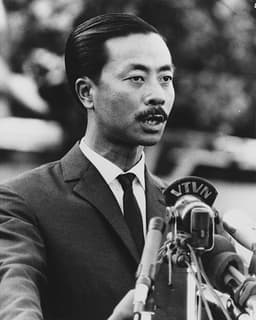
Nguyen Cao Ky
General · Modern
49.0Total
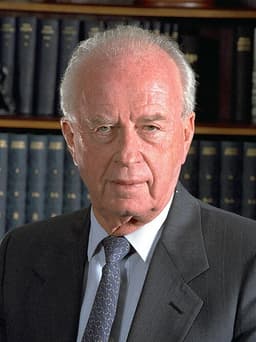
Yitzhak Rabin
General · Modern
66.4Total
Basic Information
Born
1930
1922
Died
—
—
Era
Modern
Modern
Nationality
Vietnam
Israel
Occupation
General
General
Civilization
Eastern
Middle Eastern
Score Comparison
Military (10%)
45.0
61.7
Political (20%)
39.4
82.0
Influence (20%)
50.2
68.0
Legacy (20%)
40.0
55.0
Leadership (15%)
67.0
78.0
Strategy (15%)
60.0
55.0
TOTAL
49.0
66.4
Nguyen Cao Ky — Complete Timeline
1963 AD
Commander of South Vietnamese Air ForcePolitical Action◆ Major
Nguyen Cao Ky was appointed commander of the Republic of Vietnam Air Force. He led the air force during the Buddhist crisis and participated in the coup that overthrew President Ngo Dinh Diem.
Air ForceCoupDiem
Impact: national
1965 AD
Appointed Prime MinisterPolitical Action◆ Major
Nguyen Cao Ky became Prime Minister of South Vietnam, leading a military junta. His government intensified the war against the Viet Cong and North Vietnam, with strong US support.
Prime MinisterMilitary juntaVietnam War
Impact: national
1967 AD
Conflict with President ThieuPolitical Action
Nguyen Cao Ky ran for president but lost to Nguyen Van Thieu, becoming vice president. The two leaders had a tense relationship, with Ky later accusing Thieu of corruption and mismanagement of the war.
ElectionThieuRivalry
Impact: nationaldestructive
1975 AD
Exile after fall of SaigonPolitical Action◆ Major
Nguyen Cao Ky fled South Vietnam as Saigon fell to North Vietnamese forces. He settled in the United States, where he became a critic of the communist government and later returned to Vietnam for visits.
ExileFall of SaigonVietnam War
Impact: nationaltragic
Yitzhak Rabin — Complete Timeline
1967 AD
Chief of Staff during the Six-Day WarWar
As Chief of Staff of the Israel Defense Forces, Rabin commanded the Israeli military during the Six-Day War against Egypt, Jordan, and Syria. Israel captured the Sinai Peninsula, Gaza Strip, West Bank, East Jerusalem, and Golan Heights, reshaping the region.
Six-Day WarTerritorial ExpansionMilitary Victory
Impact: global
1993 AD
Signing of the Oslo AccordsPolitical Action
As prime minister, Rabin signed the Oslo Accords with PLO Chairman Yasser Arafat on the White House lawn. The agreement established the Palestinian Authority and set a framework for Palestinian self-governance in the West Bank and Gaza Strip.
Peace ProcessPalestiniansOslo
Impact: globalconstructive
1995 AD
Assassination at Peace RallyPolitical Action
Rabin was assassinated by Israeli extremist Yigal Amir after a peace rally in Tel Aviv. The assassination shocked Israel and the world, derailing the Oslo peace process and leading to a period of political instability.
AssassinationPeace ProcessPolitical Violence
Impact: globaltragic
Expert Analysis
Yitzhak Rabin vs Nguyen Cao Ky
# The General Who Chose Peace and the General Who Chose War
On a balmy November evening in 1995, Yitzhak Rabin stood before a crowd of 100,000 Israelis in Tel Aviv, singing "The Song of Peace." Moments later, three bullets from a Jewish extremist's pistol ended his life. Twenty years earlier, another general in another divided country faced a different fate: Nguyen Cao Ky fled Saigon by helicopter as his nation collapsed, spending the rest of his life in exile. Both men were warriors who rose to lead their nations at war. But why did one become a martyr for peace, while the other became a footnote to defeat? The answer lies not in their military records, which are remarkably similar, but in the starkly different worlds they inhabited and the choices those worlds allowed.
Origins
Yitzhak Rabin was born in Jerusalem in 1922 to socialist Zionist parents who had emigrated from Russia. He grew up on a kibbutz, a child of the labor movement that built the state of Israel. His world was small, focused, and driven by a single purpose: survival. The Holocaust had just ended, and the Arab world surrounded the nascent Jewish state. Rabin learned early that Israel could not afford defeat—not militarily, not politically. He joined the Palmach, the elite strike force of the pre-state Jewish underground, and by 1948 was fighting in the War of Independence. His Israel was a nation forged in fire, where every citizen was a soldier and every soldier knew the weight of national survival.
Nguyen Cao Ky was born in 1930 in Son Tay, a village north of Hanoi in French Indochina. His father was a minor civil servant in the colonial administration. Unlike Rabin, Ky grew up in a land that had never known true independence, only French rule and then Japanese occupation during World War II. He joined the Vietnamese National Army, a force created by the French to fight the communist Viet Minh. His Vietnam was a country fractured by colonialism, ideology, and civil war—a land where loyalty was often a matter of survival rather than conviction. Ky chose the anti-communist side, but his nation's identity was far less certain than Rabin's.
Rise to Power
Rabin's ascent was methodical, a product of merit and necessity. By 1964, he was Chief of Staff of the Israel Defense Forces. Then came June 1967. As Egypt blockaded the Straits of Tiran and Arab armies massed on Israel's borders, Rabin faced the gravest test of his career. The Six-Day War was a lightning campaign: in less than a week, Israel captured the Sinai, Gaza, the West Bank, and the Golan Heights. Rabin's military score of 62.0 reflects not tactical brilliance—that belonged to generals like Moshe Dayan—but organizational genius. He transformed the IDF from a militia into a modern army. Yet the war also left Israel with occupied territories and millions of Palestinians under military rule—a problem Rabin would later confront.
Ky's rise was faster and more chaotic. In 1963, at just 33, he became commander of the South Vietnamese Air Force. He was a flamboyant figure, often photographed in a purple scarf and matching flight suit, a pistol at his hip. When a coup overthrew President Ngo Dinh Diem, Ky threw his support behind the new military junta. By 1965, he was prime minister, leading a revolving-door government of generals. His political score of 60.2 reflects the instability of his position: he ruled not by mandate but by force, dependent on American support. Where Rabin's power came from a nation's trust, Ky's came from a superpower's desperation.
Leadership & Governance
Rabin's leadership style was cautious, pragmatic, and deeply strategic. His political score of 77.7 reflects his ability to adapt. After serving as ambassador to the United States, he became prime minister in 1974. He was not a charismatic speaker; he was a general who spoke in clipped, military sentences. But he understood that Israel's long-term security required more than tanks and jets. In 1993, standing on the White House lawn with Yasser Arafat, he signed the Oslo Accords—a framework for Palestinian self-rule. His words that day were telling: "Enough of blood and tears." The man who had commanded the Six-Day War now believed that military victory alone could not bring peace.
Ky's leadership was the opposite: theatrical, impulsive, and ultimately unsustainable. As prime minister, he intensified the war against North Vietnam and the Viet Cong, relying on American bombing campaigns and ground troops. He crushed Buddhist protests, alienated civilians, and governed through a junta that was as corrupt as it was brutal. His strategy score of 65.0 shows some competence—he understood air power—but his political score of 60.2 reveals the fatal flaw: he never built a nation, only a regime. When he ran for president in 1967 and lost to Nguyen Van Thieu, the rivalry between the two generals paralyzed South Vietnam's government at its most critical hour.
Triumph & Tragedy
Rabin's greatest triumph was also his greatest tragedy. The Oslo Accords earned him a Nobel Peace Prize in 1994, but they also made him a target. Israeli extremists saw him as a traitor who had sold out the Jewish homeland. On November 4, 1995, after a peace rally in Tel Aviv, Yigal Amir fired three shots into Rabin's back. The assassin later said, "I acted on God's orders." Rabin's death shocked the world and plunged Israel into mourning. His legacy score of 68.8 is high, but it is tinged with what might have been: the peace process collapsed, and the occupied territories remain a source of conflict today.
Ky's tragedy was different. When Saigon fell in April 1975, he fled by helicopter to a U.S. Navy ship, leaving behind a country that had ceased to exist. He settled in California, where he opened a liquor store and later wrote a memoir. His legacy score of 56.0 reflects his obscurity: few remember him today, and those who do recall a man who fought for a lost cause. Yet there is a poignant moment: in exile, Ky visited the Vietnam Veterans Memorial in Washington, D.C., and wept. He had sent thousands of young Americans to die in a war he could not win.
Character & Destiny
Rabin was a man of contradictions: a hawk who became a dove, a soldier who hated war. His leadership score of 83.4 reflects his ability to change—to see that the world had shifted and that Israel must shift with it. He was not a visionary but a realist, and realism led him to Oslo. His assassination was not just a tragedy; it was a verdict on the impossibility of peace in a land of extremists.
Ky was also a man of contradictions, but of a different kind. He was a fighter pilot who loved the glamour of war but could not win the peace. His leadership score of 76.3 suggests personal charisma, but it was charisma without substance. He believed in victory but never defined what victory meant. In the end, he was a general without a country, a warrior whose war had no purpose.
Legacy
Rabin's legacy is carved into Israel's national memory. Streets and squares bear his name. His assassination is taught as a cautionary tale about the cost of extremism. Yet the peace he sought remains elusive. His military score of 62.0 and political score of 77.7 tell the story of a man who was better at governing than fighting—a general who understood that the greatest battle is the one you do not have to fight.
Ky's legacy is almost invisible. He is a footnote in the history of the Vietnam War, a cautionary example of what happens when military power is untethered from political legitimacy. His total score of 64.8 is average, and so is his place in history: neither hero nor villain, just a man who rode a storm and was swept away.
Conclusion
Standing on the White House lawn in 1993, Rabin said, "We are like a man who is trying to cross a river. He knows the opposite bank is there, but he does not know how deep the water is." He was willing to wade in. Ky, by contrast, spent his life building bridges to nowhere. The difference between them is not talent—both were capable generals. It is not courage—both faced death. It is the willingness to see the enemy not as a monster but as a neighbor, and to choose the hard path of reconciliation over the easy path of war. Rabin died for that choice. Ky lived without ever making it.
Rankings
🥇
Yitzhak RabinLeader
Mil: 61.7Pol: 82.0Inf: 68.0
66.4
🥈
Nguyen Cao Ky
Mil: 45.0Pol: 39.4Inf: 50.2
49.0
+17.4 behind
How This Comparison Works
Algorithm
Each figure is scored on 6 dimensions (0—100 scale) based on structured historical data: Military (10%), Political (20%), Influence (20%), Legacy (20%), Leadership (15%), Strategy (15%). The weighted total produces the final ranking.
Data Sources
Scores are computed from structured sub-indicators in the database. Scale factors adjust for era (Ancient ×0.85, Modern ×1.0) and civilization size (Eastern ×1.05, Other ×0.80) to account for differences in population and military scale.
Maximum 3 Figures
Comparisons are limited to 2—3 figures to ensure readability and statistical meaningfulness.
Error Margins
±5 points per dimension — Sub-scores are derived from historical records with inherent uncertainty. Two figures within 5 points on a dimension should be considered roughly equivalent in that area.
Total Score Accuracy
±3 points overall — The weighted combination of 6 dimensions produces a total score with approximately ±3 points of uncertainty. Differences of less than 3 points are not statistically significant— the figures are effectively tied.
Known Limitations
- Historical records are incomplete and uneven across civilizations
- Figures from oral-tradition societies may be underrepresented
- Occupation labels can misclassify multi-role figures
- Scores measure capability and impact, not moral character
- Quantitative scoring is a comparison tool, not absolute truth
Capability Radar
Military (10%) — Battles & Warfare
Battles
30
65
Win Rate
35
70
Expansion
10
50
Political (20%) — Governance & Reform
Reform
20
65
Diplomacy
25
85
Economy
15
60
Influence (20%) — Cultural & Global Reach
Cultural
15
55
Global
15
70
Legacy (20%) — Historical Impact
Historical
20
75
Longevity
10
60
Leadership (15%) — Power & Stability
Tenure
40
70
Stability
10
40
Strategy (15%) — Tactics & Innovation
Strategy
30
75
Tactics
40
60
Reform
25
55
Similar Comparisons
Comments & Discussion
RabinTheReformer6/16/2026
As a military historian, I see two commanders who understood war but diverged on what victory meant. Rabin, as IDF Chief of Staff in 1967's Six-Day War, executed a preemptive strike that reshaped the Middle East—brilliant tactics, strategic genius. Yet he later realized occupation corrupts armies. Ky, a former airline pilot turned Air Marshal, dropped napalm on Vietnamese villages in the 1960s, a tactic that fueled Viet Cong recruits. Rabin evolved from conqueror to peacetreaty signer (Oslo Acco
和平将军的遗产6/16/2026
作为经典学者,我看到两位将军背后的文化烙印。拉宾来自犹太传统,强调"修复世界"(Tikkun Olam),所以他最终与巴勒斯坦人握手,尽管奥斯陆协议充满缺陷,却承载了千年民族的和平渴望。阮高其来自儒家影响的越南,忠诚于反共教条,1975年西贡陷落时,他选择逃亡美国,而非谈判。拉宾在特拉维夫广场被刺杀,成了和平的符号——这种殉道在犹太历史中回响。他们的差异不是个人品性,而是文明叙事的抉择。
SkepticalSam6/16/2026
Data doesn't lie: Rabin oversaw a 53% drop in Israeli casualties during the Intifada after Oslo—from 1993 to 1995, deaths fell to 256. Ky's Vietnam? U.S. Service members killed rose from 1,863 in 1964 to 16,575 by 1967, with South Vietnameses casualties even higher. Correlation isn't causation, sure, but the trends scream: Rabin's peace gamble saved lives, Ky's war machine burned them. You can call Ky a "tragic figure," but the statistics don't mourn—they indict. Peace isn't soft; it's the harde
历史旁观者6/16/2026
作为历史爱好者,我忍不住对比他们的逃离:1995年拉宾被子弹击中,倒在"和平之歌"的旋律中——他的死亡在犹太会堂和清真寺引发哀悼。1975年阮高其从美国大使馆楼顶逃离西贡,留下一张标志性照片:他冲向直升机,身后城市在战火中燃烧。拉宾的遗产是1500页的奥斯陆协议和诺贝尔和平奖;阮高其的遗产是一盒未使用的雪茄和一本写满悔恨的回忆录。一个拥抱历史,一个被历史抛弃。时间是最苛刻的裁判。
RevisionistRay6/16/2026
Forget the hagiography. Rabin wasn't a pure dove—he deported 415 Hamas activists in 1992 and approved 6,