Loading...
This comparison has not been analyzed yet.
One-time AI generation (~1 minute). Scores and timeline are already available below.
Nguyen Phu Trong vs Tosiwo Nakayama
Nguyen Phu Trong leads by 0.8 pts · 2 figures compared
…
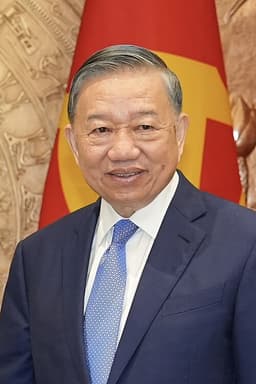
Nguyen Phu Trong
Politician · Modern
54.2Total

Tosiwo Nakayama
Politician · Modern
53.4Total
Basic Information
Born
1944
1931
Died
—
—
Era
Modern
Modern
Nationality
Vietnam
Micronesia
Occupation
Politician
Politician
Civilization
Eastern
Other
Score Comparison
Military (10%)
13.8
27.8
Political (20%)
59.3
68.0
Influence (20%)
61.0
54.9
Legacy (20%)
54.0
45.8
Leadership (15%)
75.0
72.0
Strategy (15%)
39.7
44.6
TOTAL
54.2
53.4
Nguyen Phu Trong — Complete Timeline
2011 AD
Elected as General Secretary of the Communist Party of VietnamPolitical Action◆ Major
Nguyen Phu Trong was elected as General Secretary of the Communist Party of Vietnam at the 11th National Party Congress. He became the top leader of Vietnam, succeeding Nong Duc Manh, and began consolidating power.
Communist PartyLeadershipVietnam
Impact: national
2013 AD
Launched the Anti-Corruption Campaign 'Blazing Furnace'Reform◆ Major
Nguyen Phu Trong initiated a sweeping anti-corruption campaign known as the 'Blazing Furnace'. The campaign led to the prosecution of hundreds of officials, including senior party members, and reshaped Vietnam's political landscape.
Anti-CorruptionPolitical PurgeReform
Impact: nationalconstructive
2020 AD
Oversaw Vietnam's COVID-19 ResponsePolitical Action◆ Major
Nguyen Phu Trong led Vietnam's response to the COVID-19 pandemic, implementing strict lockdowns and quarantine measures. Vietnam initially achieved low infection rates, but a later Delta variant wave overwhelmed the healthcare system.
COVID-19Public HealthCrisis Management
Impact: national
2021 AD
Re-elected for Third Term as Party ChiefPolitical Action◆ Major
Nguyen Phu Trong was re-elected as General Secretary for an unprecedented third term at the 13th National Party Congress. The move broke with precedent and solidified his dominance over Vietnamese politics.
Communist PartyLeadershipRe-election
Impact: national
2023 AD
Hosted US President Joe Biden in HanoiPolitical Action◆ Major
Nguyen Phu Trong hosted US President Joe Biden in Hanoi, leading to the elevation of US-Vietnam relations to a Comprehensive Strategic Partnership. The visit marked a significant milestone in bilateral ties and Vietnam's foreign policy.
US-Vietnam RelationsDiplomacyBiden
Impact: globalconstructive
Tosiwo Nakayama — Complete Timeline
1979 AD
Election as First President of the Federated States of MicronesiaPolitical Action◆ Major
Tosiwo Nakayama was elected as the first President of the Federated States of Micronesia (FSM) upon its establishment as a constitutional republic. He led the nation through its transition from a U.S. Trust Territory to a sovereign state in free association with the United States.
IndependencePresidencyMicronesia
Impact: nationalconstructive
1982 AD
Negotiation of the Compact of Free AssociationPolitical Action◆ Major
Nakayama led negotiations with the United States for the Compact of Free Association, which defined the FSM's relationship with the U.S. The compact provided financial assistance and defense in exchange for U.S. military access and strategic denial rights.
TreatyU.S. RelationsSovereignty
Impact: nationalconstructive
1991 AD
Admission to the United NationsPolitical Action◆ Major
Under Nakayama's leadership, the Federated States of Micronesia was admitted to the United Nations as a full member state. This marked the culmination of the nation's transition to full international sovereignty and recognition.
United NationsSovereigntyInternational Recognition
Impact: globalconstructive
This comparison has not been analyzed yet.
One-time AI generation (~1 minute). Scores and timeline are already available below.
Rankings
🥇
Nguyen Phu TrongLeader
Mil: 13.8Pol: 59.3Inf: 61.0
54.2
🥈
Tosiwo Nakayama
Mil: 27.8Pol: 68.0Inf: 54.9
53.4
+0.8 behind
How This Comparison Works
Algorithm
Each figure is scored on 6 dimensions (0—100 scale) based on structured historical data: Military (10%), Political (20%), Influence (20%), Legacy (20%), Leadership (15%), Strategy (15%). The weighted total produces the final ranking.
Data Sources
Scores are computed from structured sub-indicators in the database. Scale factors adjust for era (Ancient ×0.85, Modern ×1.0) and civilization size (Eastern ×1.05, Other ×0.80) to account for differences in population and military scale.
Maximum 3 Figures
Comparisons are limited to 2—3 figures to ensure readability and statistical meaningfulness.
Error Margins
±5 points per dimension — Sub-scores are derived from historical records with inherent uncertainty. Two figures within 5 points on a dimension should be considered roughly equivalent in that area.
Total Score Accuracy
±3 points overall — The weighted combination of 6 dimensions produces a total score with approximately ±3 points of uncertainty. Differences of less than 3 points are not statistically significant— the figures are effectively tied.
Known Limitations
- Historical records are incomplete and uneven across civilizations
- Figures from oral-tradition societies may be underrepresented
- Occupation labels can misclassify multi-role figures
- Scores measure capability and impact, not moral character
- Quantitative scoring is a comparison tool, not absolute truth
Capability Radar
Military (10%) — Battles & Warfare
Battles
16
20
Win Rate
17
24
Expansion
18
26
Political (20%) — Governance & Reform
Reform
70
55
Diplomacy
75
65
Economy
65
40
Influence (20%) — Cultural & Global Reach
Cultural
50
30
Global
55
30
Legacy (20%) — Historical Impact
Historical
55
40
Longevity
60
35
Leadership (15%) — Power & Stability
Tenure
85
60
Stability
80
50
Strategy (15%) — Tactics & Innovation
Strategy
23
29
Tactics
24
35
Reform
31
36
Similar Comparisons
Comments & Discussion
No comments yet. Be the first to share your thoughts!