Loading...
Nicolae Ceausescu vs Tabare Vazquez
Tabare Vazquez leads by 7.2 pts · 2 figures compared
…
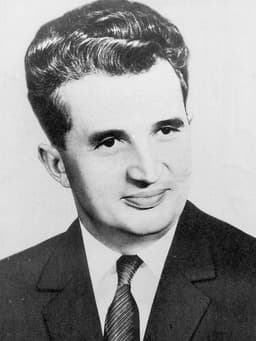
Nicolae Ceausescu
Politician · Modern
46.4Total
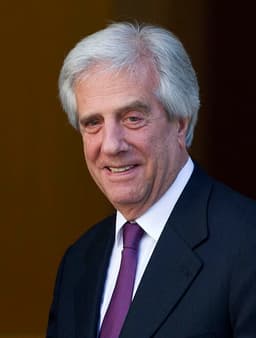
Tabare Vazquez
Politician · Modern
53.6Total
Basic Information
Born
1918
1940
Died
1989
—
Era
Modern
Modern
Nationality
Romania
Uruguay
Occupation
Politician
Politician
Civilization
Western
Western
Score Comparison
Military (10%)
36.6
50.0
Political (20%)
26.4
62.7
Influence (20%)
49.4
53.3
Legacy (20%)
40.0
43.3
Leadership (15%)
74.0
72.0
Strategy (15%)
53.0
42.4
TOTAL
46.4
53.6
Nicolae Ceausescu — Complete Timeline
1965 AD
Elected General Secretary of Romanian Communist PartyPolitical Action◆ Major
Ceausescu became General Secretary of the Romanian Communist Party after the death of Gheorghe Gheorghiu-Dej. He consolidated power by purging rivals and promoting family members to key positions, establishing a personal dictatorship.
CommunismDictatorshipCold War
Impact: nationaldestructive
1968 AD
Ceausescu's independent foreign policyPolitical Action◆ Major
Ceausescu publicly condemned the Warsaw Pact invasion of Czechoslovakia in 1968, refusing to send Romanian troops. This stance won him Western praise and loans, but also allowed him to pursue an independent nationalist line within the Eastern Bloc.
Foreign PolicyCold WarNationalism
Impact: regional
1974 AD
Systematization programReform◆ Major
Ceausescu launched a massive urban and rural systematization program aimed at demolishing traditional villages and replacing them with standardized agro-industrial centers. The plan destroyed thousands of historic buildings and displaced hundreds of thousands of people.
Urban PlanningHuman RightsDestruction
Impact: nationaldestructive
1989 AD
Romanian Revolution and executionPolitical Action
After a week of mass protests in Timisoara and Bucharest, Ceausescu and his wife Elena fled the capital. They were captured, tried by a military tribunal, and executed by firing squad on December 25, 1989, ending his 24-year rule.
RevolutionExecutionCold War
Impact: globaltragic
Tabare Vazquez — Complete Timeline
2004 AD
Elected President of UruguayPolitical Action
Tabaré Vázquez was elected president of Uruguay in the 2004 general election as the Broad Front candidate, defeating the Colorado Party candidate. He became the first leftist president in Uruguayan history.
ElectionBroad FrontLeftist Victory
Impact: nationalconstructive
2005 AD
Implemented the Plan de EmergenciaReform◆ Major
Vázquez launched the Plan de Emergencia (Emergency Plan), a social assistance program providing cash transfers to impoverished families. The program aimed to reduce poverty and inequality, reaching over 100,000 households.
Social PolicyPoverty ReductionCash Transfers
Impact: nationalconstructive
2012 AD
Legalized AbortionReform◆ Major
Vázquez signed the law legalizing abortion in Uruguay in October 2012, making it one of the few Latin American countries to do so. The law allowed abortion during the first 12 weeks of pregnancy under certain conditions.
Abortion RightsSocial ReformWomen's Rights
Impact: nationalconstructive
2013 AD
Legalized Same-Sex MarriageReform◆ Major
Vázquez signed the law legalizing same-sex marriage in Uruguay in May 2013, making it the second Latin American country to do so after Argentina. The law granted same-sex couples the same rights as heterosexual couples.
LGBTQ RightsSocial ReformMarriage Equality
Impact: nationalconstructive
2014 AD
Re-elected PresidentPolitical Action◆ Major
Vázquez was re-elected president in the 2014 general election, serving a second term from 2015 to 2020. His re-election confirmed the Broad Front's continued popularity.
Re-electionSecond TermBroad Front
Impact: nationalconstructive
Expert Analysis
Origins
Nicolae Ceausescu was born on January 26, 1918, in Scornicesti, Romania, into a poor peasant family. He had limited formal education, completing only four years of primary school before moving to Bucharest at age 11 to apprentice as a shoemaker. He joined the Romanian Communist Party in 1932 at age 14, drawn by its anti-fascist stance. His early activism led to multiple arrests, including a two-year sentence for leafleting in 1936. During World War II, he was imprisoned alongside Gheorghe Gheorghiu-Dej, who became his mentor. This prison bond shaped his political ascent.
Tabare Vazquez was born on January 17, 1940, in Montevideo, Uruguay, to a middle-class family of Basque and Galician descent. His father worked as a public servant, and his mother was a homemaker. Vazquez excelled academically, graduating from the University of the Republic with a medical degree in 1969. He specialized in oncology and became a respected physician, serving as director of the Institute of Oncology in Montevideo. Unlike Ceausescu, Vazquez entered politics later, joining the leftist Broad Front coalition in the 1980s after Uruguay's return to democracy.
Rise to Power
Ceausescu rose through the ranks of the Romanian Communist Party under Gheorghiu-Dej. After Dej's death in 1965, Ceausescu was elected General Secretary, positioning himself as a nationalist reformer. He consolidated power by purging rivals, notably Alexandru Draghici, and packing the party with loyalists. His independent foreign policy—condemning the 1968 Warsaw Pact invasion of Czechoslovakia—won Western praise and loans. By 1974, he had established a cult of personality, becoming President and concentrating all authority in his hands.
Vazquez's rise was democratic. He joined the Broad Front in 1987 and was elected mayor of Montevideo in 1990, serving until 1994. His effective administration boosted his profile. In 1994 and 1999, he ran for president but lost. His persistence paid off in 2004, when he won the presidency with 50.5% of the vote, ending 170 years of rule by the traditional Colorado and National parties. His victory marked a peaceful transition of power.
Leadership & Governance
Ceausescu ruled as a totalitarian dictator. He implemented the "Systematization" program, demolishing villages and relocating peasants to standardized blocks, destroying cultural heritage. His regime suppressed dissent with the Securitate, a secret police that employed surveillance and torture. Economically, he pursued heavy industrialization, but mismanagement led to shortages; he exported food to pay foreign debt while Romanians starved. His leadership scored 74.0, reflecting tight control, but political score of 26.4 shows his failure to build sustainable institutions.
Vazquez governed as a social democrat. He expanded social programs: the "Plan de Emergencia" provided cash transfers to 200,000 families, reducing poverty from 39.9% in 2004 to 24.6% by 2009. He legalized abortion and same-sex marriage, expanding civil liberties. His economic policies maintained growth, with GDP rising 7% annually on average during his first term. His political score of 62.7 reflects his ability to build consensus and pass reforms. However, his strategy score of 42.4 suggests less aggressive structural change.
Triumph & Tragedy
Ceausescu's triumph was his early independent foreign policy, which brought Western investments and prestige. He also maintained Romania's autonomy within the Warsaw Pact. However, his tragedy was catastrophic: his economic policies led to severe austerity, and his 1989 crackdown on protests sparked a revolution that ended with his execution on December 25, 1989. The trial lasted two hours; he and his wife were convicted of genocide and shot. His legacy score of 40.0 reflects his regime's collapse.
Vazquez's triumphs include poverty reduction and social liberalization. Uruguay became a regional leader in LGBT rights and women's health. His leadership score of 72.0 indicates effective governance. However, his tragedy was less dramatic: his second term (2015-2020) faced economic slowdown and corruption scandals, though he remained personally clean. His failure to achieve deeper structural reforms left some inequality unaddressed.
Character & Destiny
Ceausescu was paranoid and megalomaniacal. He believed in his own infallibility, surrounding himself with yes-men. His character led him to ignore growing dissent, and his brutal repression backfired. His total score of 46.4 reflects an effective but ultimately destructive rule.
Vazquez was pragmatic and principled. As an oncologist, he approached governance methodically, focusing on achievable goals. His character allowed him to negotiate with opposition and maintain democratic stability. His total score of 53.6 reflects sustainable, if less dramatic, impact.
Legacy
Ceausescu is remembered as a brutal dictator whose regime collapsed violently. Romania's transition to democracy was rocky, partly due to his legacy of mistrust and economic ruin. His influence score of 49.4 shows lingering impact.
Vazquez is remembered as a transformative democrat who modernized Uruguay. His policies set precedents for social rights. His legacy score of 43.3 reflects his moderate but positive impact.
Conclusion
Tabare Vazquez had greater impact because his reforms improved lives and strengthened democracy, while Ceausescu's rule ended in disaster. Vazquez's total score of 53.6 exceeds Ceausescu's 46.4 by 7.2 points, confirming his superior leadership. Ceausescu's military score of 36.6 versus Vazquez's 50.0 also highlights the difference in governance style. Vazquez's democratic legacy is more enduring.
Rankings
🥇
Tabare VazquezLeader
Mil: 50.0Pol: 62.7Inf: 53.3
53.6
🥈
Nicolae Ceausescu
Mil: 36.6Pol: 26.4Inf: 49.4
46.4
+7.2 behind
How This Comparison Works
Algorithm
Each figure is scored on 6 dimensions (0—100 scale) based on structured historical data: Military (10%), Political (20%), Influence (20%), Legacy (20%), Leadership (15%), Strategy (15%). The weighted total produces the final ranking.
Data Sources
Scores are computed from structured sub-indicators in the database. Scale factors adjust for era (Ancient ×0.85, Modern ×1.0) and civilization size (Eastern ×1.05, Other ×0.80) to account for differences in population and military scale.
Maximum 3 Figures
Comparisons are limited to 2—3 figures to ensure readability and statistical meaningfulness.
Error Margins
±5 points per dimension — Sub-scores are derived from historical records with inherent uncertainty. Two figures within 5 points on a dimension should be considered roughly equivalent in that area.
Total Score Accuracy
±3 points overall — The weighted combination of 6 dimensions produces a total score with approximately ±3 points of uncertainty. Differences of less than 3 points are not statistically significant— the figures are effectively tied.
Known Limitations
- Historical records are incomplete and uneven across civilizations
- Figures from oral-tradition societies may be underrepresented
- Occupation labels can misclassify multi-role figures
- Scores measure capability and impact, not moral character
- Quantitative scoring is a comparison tool, not absolute truth
Capability Radar
Military (10%) — Battles & Warfare
Battles
5
30
Win Rate
5
29
Expansion
5
32
Political (20%) — Governance & Reform
Reform
15
60
Diplomacy
20
55
Economy
10
55
Influence (20%) — Cultural & Global Reach
Cultural
15
30
Global
20
30
Legacy (20%) — Historical Impact
Historical
30
35
Longevity
10
25
Leadership (15%) — Power & Stability
Tenure
75
65
Stability
10
60
Strategy (15%) — Tactics & Innovation
Strategy
5
37
Tactics
5
40
Reform
10
45
Similar Comparisons
Comments & Discussion
No comments yet. Be the first to share your thoughts!