Loading...
This comparison has not been analyzed yet.
One-time AI generation (~1 minute). Scores and timeline are already available below.
Nicomedes IV of Bithynia vs Trebonianus Gallus
Trebonianus Gallus leads by 1.1 pts · 2 figures compared
…

Nicomedes IV of Bithynia
Emperor · Ancient
36.5Total
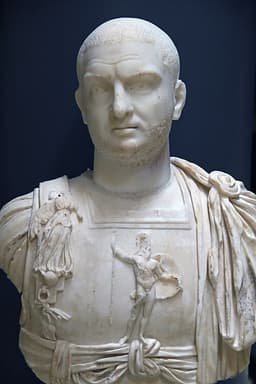
Trebonianus Gallus
Emperor · Ancient
37.6Total
Basic Information
Born
-94
206
Died
-74
253
Era
Ancient
Ancient
Nationality
Bithynia
Roman Empire
Occupation
Emperor
Emperor
Civilization
Western
Western
Score Comparison
Military (10%)
28.5
50.0
Political (20%)
25.0
30.7
Influence (20%)
44.0
43.2
Legacy (20%)
40.0
34.2
Leadership (15%)
33.6
33.6
Strategy (15%)
38.9
35.7
TOTAL
36.5
37.6
Nicomedes IV of Bithynia — Complete Timeline
90 BC
Restoration by Roman InterventionWar◆ Major
After being expelled from Bithynia by Mithridates VI of Pontus, Nicomedes IV was restored to his throne by Roman forces under Manius Aquillius. This intervention triggered the First Mithridatic War between Rome and Pontus.
Mithridatic WarsRoman InterventionExile
Impact: regional
88 BC
Alliance with Rome against MithridatesWar
Nicomedes IV allied with Rome during the First Mithridatic War, providing troops and resources. However, his forces were defeated by Mithridates VI, leading to his temporary flight and the Pontic occupation of Bithynia.
Mithridatic WarsMilitary AllianceDefeat
Impact: regional
74 BC
Bequest of Bithynia to RomePolitical Action
Nicomedes IV, the last king of Bithynia, bequeathed his kingdom to the Roman Republic in his will upon his death. This act transformed Bithynia into a Roman province, ending the Hellenistic monarchy and expanding Roman control in Asia Minor.
Roman AnnexationEnd of DynastyProvincialization
Impact: regional
Trebonianus Gallus — Complete Timeline
251 AD
Treaty with the GothsWar◆ Major
Facing a devastating Gothic invasion and the outbreak of the Plague of Cyprian, Trebonianus Gallus negotiated a humiliating peace with the Goths. He agreed to pay an annual tribute and allowed them to keep their plunder and prisoners, a decision criticized by contemporaries.
Gothic WarPeace TreatyTribute
Impact: regional
Accession as Roman EmperorPolitical Action◆ Major
After the death of Emperor Decius at the Battle of Abritus, Trebonianus Gallus was proclaimed emperor by the Roman army. He was governor of Moesia at the time and quickly secured recognition from the Senate.
Imperial AccessionThird CenturyCrisis
Impact: global
Plague of CyprianOther◆ Major
During Gallus's reign, a severe plague, known as the Plague of Cyprian, swept through the Roman Empire. It caused massive mortality, weakened the military, and contributed to economic and social instability, exacerbating the Crisis of the Third Century.
PlaguePandemicCrisis of the Third Century
Impact: globaltragic
253 AD
Defeat and Death at the Battle of Interamna NaharsWar◆ Major
Rebel general Aemilianus, proclaimed emperor by the Moesian legions, marched into Italy. Trebonianus Gallus and his son Volusianus met him at Interamna Nahars (modern Terni) but were defeated and killed by their own troops, who defected to Aemilianus.
Civil WarBattleAssassination
Impact: globaltragic
This comparison has not been analyzed yet.
One-time AI generation (~1 minute). Scores and timeline are already available below.
Rankings
🥇
Trebonianus GallusLeader
Mil: 50.0Pol: 30.7Inf: 43.2
37.6
🥈
Nicomedes IV of Bithynia
Mil: 28.5Pol: 25.0Inf: 44.0
36.5
+1.1 behind
How This Comparison Works
Algorithm
Each figure is scored on 6 dimensions (0—100 scale) based on structured historical data: Military (10%), Political (20%), Influence (20%), Legacy (20%), Leadership (15%), Strategy (15%). The weighted total produces the final ranking.
Data Sources
Scores are computed from structured sub-indicators in the database. Scale factors adjust for era (Ancient ×0.85, Modern ×1.0) and civilization size (Eastern ×1.05, Other ×0.80) to account for differences in population and military scale.
Maximum 3 Figures
Comparisons are limited to 2—3 figures to ensure readability and statistical meaningfulness.
Error Margins
±5 points per dimension — Sub-scores are derived from historical records with inherent uncertainty. Two figures within 5 points on a dimension should be considered roughly equivalent in that area.
Total Score Accuracy
±3 points overall — The weighted combination of 6 dimensions produces a total score with approximately ±3 points of uncertainty. Differences of less than 3 points are not statistically significant— the figures are effectively tied.
Known Limitations
- Historical records are incomplete and uneven across civilizations
- Figures from oral-tradition societies may be underrepresented
- Occupation labels can misclassify multi-role figures
- Scores measure capability and impact, not moral character
- Quantitative scoring is a comparison tool, not absolute truth
Capability Radar
Military (10%) — Battles & Warfare
Battles
3
20
Win Rate
10
15
Expansion
11
5
Political (20%) — Governance & Reform
Reform
10
10
Diplomacy
30
15
Economy
15
10
Influence (20%) — Cultural & Global Reach
Cultural
10
10
Global
10
5
Legacy (20%) — Historical Impact
Historical
30
15
Longevity
20
10
Leadership (15%) — Power & Stability
Tenure
20
25
Stability
10
5
Strategy (15%) — Tactics & Innovation
Strategy
14
15
Tactics
14
20
Reform
20
10
Similar Comparisons
Comments & Discussion
No comments yet. Be the first to share your thoughts!