Loading...
This comparison has not been analyzed yet.
One-time AI generation (~1 minute). Scores and timeline are already available below.
Odaenathus of Palmyra vs Servius Tullius
Servius Tullius leads by 3.7 pts · 2 figures compared
…

Odaenathus of Palmyra
Emperor · Ancient
56.9Total
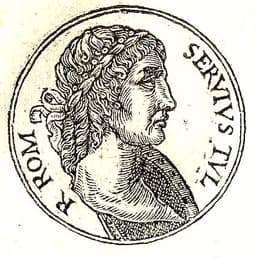
Servius Tullius
Emperor · Ancient
60.6Total
Basic Information
Born
220
-578
Died
267
-535
Era
Ancient
Ancient
Nationality
Palmyrene Empire
Roman Kingdom
Occupation
Emperor
Emperor
Civilization
Middle Eastern
Western
Score Comparison
Military (10%)
76.0
46.7
Political (20%)
45.0
72.0
Influence (20%)
54.9
55.7
Legacy (20%)
48.3
50.0
Leadership (15%)
66.0
85.0
Strategy (15%)
68.1
60.0
TOTAL
56.9
60.6
Odaenathus of Palmyra — Complete Timeline
260 AD
Defense of the Roman East against Shapur IWar◆ Major
After Roman Emperor Valerian was captured by the Sassanid king Shapur I, Odaenathus of Palmyra led a successful campaign against the Persians. He defeated Shapur's forces, drove them back across the Euphrates, and secured the Roman eastern frontier.
Roman-Persian WarMilitary CampaignPalmyra
Impact: regionalconstructive
261 AD
Recognition as King of Palmyra and Corrector Totius OrientisPolitical Action◆ Major
Roman Emperor Gallienus recognized Odaenathus as King of Palmyra and appointed him Corrector Totius Orientis (Governor of the East). This gave Odaenathus authority over the Roman eastern provinces, effectively making him the ruler of the Roman East.
AppointmentRoman EmpirePalmyra
Impact: regionalconstructive
267 AD
Campaign against the GothsWar
Odaenathus led a military campaign against the Goths who were raiding Asia Minor. He successfully defeated them, further securing the Roman eastern provinces and demonstrating his military prowess.
Military CampaignGothsRoman East
Impact: regionalconstructive
AssassinationPolitical Action◆ Major
Odaenathus was assassinated along with his eldest son Herodianus at Emesa. The assassination was likely orchestrated by his nephew or by his wife Zenobia. This event led to Zenobia taking power in Palmyra.
AssassinationPalmyraPower Transition
Impact: regionaltragic
Servius Tullius — Complete Timeline
575 BC
Introduction of the Census and Centuriate AssemblyReform◆ Major
Servius Tullius instituted the first Roman census, dividing the population into five classes based on wealth. He also reorganized the army and created the Centuriate Assembly, a new political body where voting power was weighted by property, replacing the old tribal system.
Political ReformCensusClass System
Impact: nationalconstructive
Creation of the Tribal AssemblyReform◆ Major
Servius Tullius divided Rome into four urban tribes and several rural tribes based on geography, not kinship. This reorganization formed the basis for the Tribal Assembly, which handled administrative and legislative matters, and weakened the power of the old patrician gentes.
Political ReformTribal DivisionAdministration
Impact: nationalconstructive
Reform of the Roman ArmyReform◆ Major
Servius Tullius reformed the Roman army, organizing soldiers into centuries based on their wealth class. This created a more professional and effective military force, with each century providing its own equipment, and established the comitia centuriata as a military assembly.
Military ReformCenturiate SystemArmy Organization
Impact: nationalconstructive
Construction of the Servian WallCultural◆ Major
Servius Tullius built the Servian Wall, a massive defensive wall around Rome, enclosing the seven hills. This wall protected the city from external attacks and defined the urban boundary, becoming a symbol of Roman strength and security.
FortificationUrban DefenseCity Wall
Impact: nationalconstructive
535 BC
Assassination by Tarquinius SuperbusPolitical Action◆ Major
Servius Tullius was murdered by his son-in-law, Lucius Tarquinius Superbus, who conspired with Tullia, Servius's daughter. Tarquinius seized the throne after the assassination, and Tullia drove her chariot over her father's body, an act that became infamous in Roman history.
AssassinationRoyal MurderUsurpation
Impact: nationaltragic
This comparison has not been analyzed yet.
One-time AI generation (~1 minute). Scores and timeline are already available below.
Rankings
🥇
Servius TulliusLeader
Mil: 46.7Pol: 72.0Inf: 55.7
60.6
🥈
Odaenathus of Palmyra
Mil: 76.0Pol: 45.0Inf: 54.9
56.9
+3.7 behind
How This Comparison Works
Algorithm
Each figure is scored on 6 dimensions (0—100 scale) based on structured historical data: Military (10%), Political (20%), Influence (20%), Legacy (20%), Leadership (15%), Strategy (15%). The weighted total produces the final ranking.
Data Sources
Scores are computed from structured sub-indicators in the database. Scale factors adjust for era (Ancient ×0.85, Modern ×1.0) and civilization size (Eastern ×1.05, Other ×0.80) to account for differences in population and military scale.
Maximum 3 Figures
Comparisons are limited to 2—3 figures to ensure readability and statistical meaningfulness.
Error Margins
±5 points per dimension — Sub-scores are derived from historical records with inherent uncertainty. Two figures within 5 points on a dimension should be considered roughly equivalent in that area.
Total Score Accuracy
±3 points overall — The weighted combination of 6 dimensions produces a total score with approximately ±3 points of uncertainty. Differences of less than 3 points are not statistically significant— the figures are effectively tied.
Known Limitations
- Historical records are incomplete and uneven across civilizations
- Figures from oral-tradition societies may be underrepresented
- Occupation labels can misclassify multi-role figures
- Scores measure capability and impact, not moral character
- Quantitative scoring is a comparison tool, not absolute truth
Capability Radar
Military (10%) — Battles & Warfare
Battles
75
20
Win Rate
85
25
Expansion
70
40
Political (20%) — Governance & Reform
Reform
55
85
Diplomacy
80
65
Economy
60
75
Influence (20%) — Cultural & Global Reach
Cultural
50
55
Global
40
40
Legacy (20%) — Historical Impact
Historical
55
65
Longevity
45
60
Leadership (15%) — Power & Stability
Tenure
65
70
Stability
70
70
Strategy (15%) — Tactics & Innovation
Strategy
85
35
Tactics
80
30
Reform
60
60
Similar Comparisons
Comments & Discussion
No comments yet. Be the first to share your thoughts!