Loading...
Oscar Mejia Victores vs Ramon Castilla
Ramon Castilla leads by 7.8 pts · 2 figures compared
…

Oscar Mejia Victores
General · Modern
51.9Total
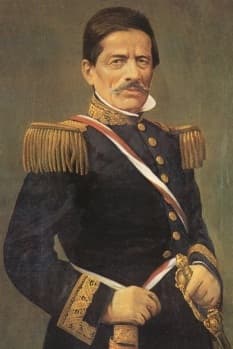
Ramon Castilla
General · Modern
59.7Total
Basic Information
Born
1930
1797
Died
—
1867
Era
Modern
Modern
Nationality
Guatemala
Peru
Occupation
General
General
Civilization
Western
Western
Score Comparison
Military (10%)
22.6
40.0
Political (20%)
68.0
72.0
Influence (20%)
50.2
56.7
Legacy (20%)
43.3
52.0
Leadership (15%)
80.0
78.0
Strategy (15%)
41.0
60.0
TOTAL
51.9
59.7
Oscar Mejia Victores — Complete Timeline
1983 AD
1983 Guatemalan coup d'étatPolitical Action◆ Major
Mejia Victores, then Defense Minister, led a coup that ousted President Efrain Rios Montt. He assumed the presidency, becoming the last military ruler of Guatemala.
CoupMilitary RuleGuatemala
Impact: nationaldestructive
1984 AD
Human rights abuses during his ruleOther◆ Major
During his presidency, Mejia Victores' government continued counterinsurgency operations that resulted in forced disappearances and massacres of indigenous Maya communities, as documented by truth commissions.
Human RightsCivil WarAtrocities
Impact: nationaltragic
1985 AD
Transition to civilian rulePolitical Action
Under pressure, Mejia Victores oversaw the drafting of a new constitution and called for democratic elections. He transferred power to civilian President Vinicio Cerezo in 1986, ending decades of military rule.
DemocratizationConstitutionElection
Impact: nationalconstructive
Ramon Castilla — Complete Timeline
1824 AD
Battle of AyacuchoWar
Castilla fought as a junior officer in the decisive Battle of Ayacucho, which ended Spanish rule in Peru. This victory secured Peruvian independence and marked the end of the Spanish Empire in South America, shaping Castilla's nationalist views.
Peruvian War of IndependenceBattleLiberation
Impact: regional
1845 AD
First Presidency of PeruPolitical Action◆ Major
Castilla was elected President of Peru in 1845, serving until 1851. His first term focused on economic development, including the guano boom, and infrastructure projects such as railroads and ports, modernizing the Peruvian state.
PresidencyEconomic DevelopmentGuano
Impact: nationalconstructive
1854 AD
Abolition of Slavery in PeruReform◆ Major
During his second presidency, Castilla issued a decree abolishing slavery in Peru on December 3, 1854. This reform freed approximately 25,000 slaves and was part of a broader liberal agenda, though it faced opposition from slave-owning elites.
AbolitionSlaveryHuman Rights
Impact: nationalprogressive
Abolition of Indigenous TributeReform◆ Major
Castilla also abolished the indigenous tribute tax in 1854, which had been a burden on native communities since colonial times. This measure aimed to integrate indigenous peoples into the Peruvian state as equal citizens, though its implementation was uneven.
Indigenous RightsTax ReformCitizenship
Impact: nationalprogressive
1855 AD
Second Presidency and Guano BoomPolitical Action◆ Major
Castilla served a second term from 1855 to 1862, during the peak of the guano export boom. He used guano revenues to fund public works, pay off foreign debt, and modernize the military, but also faced criticism for corruption and over-reliance on a single resource.
PresidencyGuanoModernization
Impact: nationalconstructive
1860 AD
Constitutional Reform of 1860Reform◆ Major
Castilla oversaw the adoption of a new constitution in 1860, which established a centralized republic with a strong executive. The constitution remained in effect until 1920 and shaped Peru's political structure, though it limited regional autonomy.
ConstitutionPolitical ReformCentralization
Impact: nationalconstructive
Expert Analysis
Ramon Castilla vs Oscar Mejia Victores
# The General’s Choice
On a December morning in 1854, Ramon Castilla sat at a desk in the presidential palace of Lima, the ink still wet on a decree that would change Peru forever. Across the continent and a century later, in 1985, another general named Oscar Mejia Victores stood before a microphone in Guatemala City, announcing elections that would end his own rule. Both men wore the same uniform—the crisp insignia of a military commander—and both wielded the same power of life and death over their nations. Yet one is remembered as a liberator, the other as a reluctant caretaker. What drove them to such different ends?
Origins
Ramon Castilla was born in 1797 in the remote Peruvian province of Tarapacá, a dusty outpost of the Spanish Empire. His father was a Spanish colonial official, his mother a local woman of mixed heritage. The young Castilla grew up in a world of rigid hierarchy, where the color of one’s skin determined one’s fate. He joined the Spanish army as a teenager, but when the wars of independence erupted, he switched sides—a decision that would define his life. By 1824, at the age of twenty-seven, he fought as a junior officer in the Battle of Ayacucho, the final clash that broke Spanish rule in South America. That victory was not just a military turning point; it was a personal baptism into the idea that the old order could be swept away.
Oscar Mejia Victores, born in 1930, entered a different world. Guatemala in the 1930s was a country of coffee plantations and military strongmen, where power passed through the barrel of a gun. He came of age during the Cold War, when the United States viewed Central America as a chessboard against communism. Mejia Victores trained in counterinsurgency tactics, learning that the enemy was not a foreign empire but an idea—and that the army’s job was to crush it. By the 1970s, he had risen through the ranks of a military that saw itself as the only bulwark against chaos.
Rise to Power
Castilla’s path to power was gradual and earned. After Ayacucho, he spent years as a provincial administrator, learning the art of governance. He watched Peru stagger through coups and civil wars, and he understood that stability required more than bayonets. In 1845, he was elected president—a rare peaceful transfer in a land of caudillos. His first term focused on building railroads, paying off foreign debt, and exploiting the sudden wealth of guano, the bird-dropping fertilizer that became Peru’s gold. He was not a visionary; he was a pragmatist who saw that reform was the only way to hold the country together.
Mejia Victores rose through a coup. In 1983, as defense minister under General Efrain Rios Montt, he watched his boss wage a scorched-earth campaign against Mayan villagers suspected of supporting leftist guerrillas. Then, in a swift move, Mejia Victores ousted Rios Montt and took power himself. The coup was not about ideology—it was about survival. Rios Montt had become a pariah, accused of genocide, and the army needed a cleaner face. Mejia Victores was that face: a general who could smile for the cameras while the killing continued.
Leadership & Governance
Castilla’s leadership was defined by two bold reforms. In 1854, during his second presidency, he issued a decree abolishing slavery in Peru. The move was partly moral—he had seen the brutality of bondage in the mines and fields—but also practical. The guano boom required free labor, not chained men. That same year, he abolished the indigenous tribute tax, a colonial relic that had crushed native communities for three centuries. These were not empty gestures; they were the foundation of a modern state. In 1860, he oversaw a new constitution that centralized power in Lima, hoping to end the cycle of regional revolts. Castilla used guano revenues to build schools, hospitals, and railways, transforming Peru from a colonial backwater into a republic with ambition.
Mejia Victores governed in the shadow of terror. His regime continued the counterinsurgency operations that had already killed tens of thousands of Guatemalans. Forced disappearances, torture, and massacres were the tools of his trade. Yet he understood that the old ways could not last. The Cold War was ending, and international pressure was mounting. In 1984, he allowed a constituent assembly to draft a new constitution. In 1985, he called for democratic elections and handed power to a civilian president, Vinicio Cerezo. It was not a conversion to democracy; it was a calculation. The army would retreat to the barracks, but it would keep its hands on the levers of power.
Triumph & Tragedy
Castilla’s greatest triumph was the abolition of slavery. On December 3, 1854, he declared that “no one shall be born a slave in Peru.” The decree freed thousands, though it came with a bitter irony: the government compensated slave owners, not the enslaved. His tragedy was that his reforms could not outlast him. After his death in 1867, Peru descended into chaos, squandering the guano wealth on wars and corruption. He had built a house on sand.
Mejia Victores’ triumph was the transition itself. In a region where military rulers clung to power until death or exile, he stepped aside. His tragedy was the silence that accompanied that step. He never apologized for the disappearances, never faced a trial. He simply vanished from history, a footnote in a country that preferred to forget.
Character & Destiny
Castilla was a man of his time—pragmatic, ambitious, and ruthless when necessary. He jailed rivals and crushed rebellions, but he also believed that a nation could be remade. His character was shaped by the optimism of the independence era, when everything seemed possible. Mejia Victores was a man of the Cold War—cynical, cautious, and trapped by the logic of fear. He did not believe in remaking Guatemala; he only believed in surviving it.
Their destinies were written by their eras. Castilla rode the wave of a new world, where the abolition of slavery and the rise of republics were the winds of history. Mejia Victores stood in the dying light of an old one, where the military’s power was crumbling under the weight of its own atrocities. One chose to build; the other chose to leave.
Legacy
Castilla is remembered as Peru’s great reformer—the man who ended slavery and modernized the state. His face appears on coins, his name on streets. Yet his legacy is complicated: he was also a caudillo who centralized power and ignored the poor. Mejia Victores is barely remembered at all. In Guatemala, his name evokes a shrug or a shudder. He is the last military ruler, the man who closed the door on an era of dictators, but who left the room stained with blood.
Conclusion
Perhaps the difference between these two generals is not in their hearts but in their circumstances. Castilla could afford to be generous because Peru was rich with guano and hope. Mejia Victores could only afford to retreat because Guatemala was exhausted by war and grief. History does not reward intention; it rewards timing. One general abolished slavery because he could; the other handed over power because he had to. In the end, both faced the same choice—to hold on or to let go—and each answered according to the age that made him.
Rankings
🥇
Ramon CastillaLeader
Mil: 40.0Pol: 72.0Inf: 56.7
59.7
🥈
Oscar Mejia Victores
Mil: 22.6Pol: 68.0Inf: 50.2
51.9
+7.8 behind
How This Comparison Works
Algorithm
Each figure is scored on 6 dimensions (0—100 scale) based on structured historical data: Military (10%), Political (20%), Influence (20%), Legacy (20%), Leadership (15%), Strategy (15%). The weighted total produces the final ranking.
Data Sources
Scores are computed from structured sub-indicators in the database. Scale factors adjust for era (Ancient ×0.85, Modern ×1.0) and civilization size (Eastern ×1.05, Other ×0.80) to account for differences in population and military scale.
Maximum 3 Figures
Comparisons are limited to 2—3 figures to ensure readability and statistical meaningfulness.
Error Margins
±5 points per dimension — Sub-scores are derived from historical records with inherent uncertainty. Two figures within 5 points on a dimension should be considered roughly equivalent in that area.
Total Score Accuracy
±3 points overall — The weighted combination of 6 dimensions produces a total score with approximately ±3 points of uncertainty. Differences of less than 3 points are not statistically significant— the figures are effectively tied.
Known Limitations
- Historical records are incomplete and uneven across civilizations
- Figures from oral-tradition societies may be underrepresented
- Occupation labels can misclassify multi-role figures
- Scores measure capability and impact, not moral character
- Quantitative scoring is a comparison tool, not absolute truth
Capability Radar
Military (10%) — Battles & Warfare
Battles
10
45
Win Rate
10
50
Expansion
5
30
Political (20%) — Governance & Reform
Reform
55
85
Diplomacy
50
70
Economy
30
75
Influence (20%) — Cultural & Global Reach
Cultural
15
55
Global
15
50
Legacy (20%) — Historical Impact
Historical
30
65
Longevity
20
60
Leadership (15%) — Power & Stability
Tenure
40
65
Stability
35
60
Strategy (15%) — Tactics & Innovation
Strategy
15
45
Tactics
15
40
Reform
20
55
Similar Comparisons
Comments & Discussion
铁幕判官6/16/2026
别洗白Mejia了。他统治下的危地马拉是死亡集中营——1982年对玛雅人的焦土政策杀了上万平民,包括妇女儿童。Castilla当然不完美,但他废除奴隶制、推广公共教育时, Peru识字率从5%跳到25%。战争罪和改革家,能比?Mejia的手上沾满鲜血,Castilla的墨水里至少有点理想主义。
帝国回声6/16/2026
Castilla是个被浪漫化的殖民跟班。他打着独立旗号,却维护了白人地主对原住民的剥削——1854年废除奴隶制只是换个剥削形式,黑人从种植园进了矿场。Mejia至少诚实:他1979年政变推翻了腐败政权,1985年选举不是仁慈,是军队发现自己hold不住了。Castilla自称解放者,Mejia自认过渡者,我选后者。
混血史学家6/16/2026
两个都是独裁者,但Castilla聪明地利用了多元文化。他本人是混血,懂得在印第安、黑人和克里奥尔间玩平衡——税收惠及农村,军队里用地方领袖。Mejia则只会用军靴踩人,1983年取消所有民间组织。Castilla让农民有了投票权骗忠诚,Mejia连骗都懒得骗。结果?Castilla的民族融合神话,比Mejia的分裂镇压更持久。
Chronicler85076/16/2026
The numbers don't lie: Castilla’s Peru saw GDP per capita rise 40% during his reforms, while Mejia’s Guatemala cratered 15% despite his so-called stability. Castilla nationalized guano revenues—a massive natural resource windfall—and rebuilt infrastructure. Mejia, presiding over a resource-poor plantation economy, couldn’t even balance a budget. One created prosperity; the other just kept the lights on for the rich.
Chronicler83036/16/2026
Castilla’s abolition of slavery in 1854 wasn’t just morality—it was a military masterstroke. He needed black soldiers to crush a rebellion, so he traded freedom for conscription. That December decree bought him an army and a legend. Mejia? He handed power back without bloodshed, but only because a CIA-backed death squad in his pocket made him fear the alternative. One fought for a revolution, the other for survival.